
Most businesses underestimate the true cost of building an e-commerce platform. They budget for pages, features, and design, but rarely account for scalability: the ability to handle traffic spikes, maintain fast performance, and operate reliably as the business grows. In 2025, cloud infrastructure, performance engineering, and long-term operations drive far more cost than the initial build itself. This blog answers the real question leaders are asking: how much does it actually cost to build a scalable e-commerce platform, and where does that money truly go?
What It Really Costs to Build a Functional E-Commerce Platform
Before calculating scalability cost, every business must understand the baseline: how much it takes to build a functional, fully custom e-commerce platform without large-scale load requirements.
Industry benchmarks from top development studies show:
Basic e-commerce sites range from $5,000–$20,000, but lack depth, integrations, and scalability.
Custom mid-market e-commerce platforms average $50,000–$100,000.
Feature-rich or enterprise-grade e-commerce platforms often exceed $120,000, depending on complexity and integrations.
Mobile e-commerce app development follows a similar pattern:
Simple apps start around $10,000,
Advanced cross-platform e-commerce apps reach $150,000–$500,000+, especially when integrating AI, AR, or multi-language features.
A realistic baseline for a modern business is:
$40,000–$70,000 for a lean but well-architected system
$70,000–$120,000+ for rich UX, advanced promo logic, multi-currency, or complex catalog management
However, none of this guarantees scalability. A baseline build typically assumes moderate traffic levels (hundreds of concurrent users, not thousands), a single-region deployment, a single primary database, and minimal caching. The platform can run reliably under normal load, but it has no architectural support for sudden traffic spikes, flash-sale concurrency, or high-volume search and filtering. At this stage, there is also no CDN strategy, no distributed caching layer, no search engine capable of handling large catalogs, and no observability stack to ensure uptime all of which are mandatory for scaling.
This is the structural gap: a functional build addresses transaction flow, while a scalable build addresses traffic, throughput, and reliability. The baseline cost delivers the first outcome, but the ability to grow sustainably without downtime or uncontrollable cloud bills requires an additional layer of engineering that sits well beyond the initial $40,000–$120,000 investment. This is why the total cost of a scalable e-commerce platform can reach 2–4× the baseline, depending on traffic targets and expansion plans.
The Real Cost of a Scalable E-Commerce Platform
This is the section where the e-commerce app development cost becomes concrete. Instead of abstract architecture talk, it translates into numbers that leaders can plan around. At every scale, the total first-year investment is a combination of four elements: build cost, scalability cost, performance optimization, and annual cloud cost. What changes across 100,000, 1,000,000, and 5,000,000+ MAU is how large each of these components becomes, and how tightly they need to be managed. Beyond infrastructure and cloud spending, scalability cost is also affected by organizational gaps such as poor documentation, which often leads to avoidable rework, bugs, and delays. We’ve analyzed this challenge in detail in our article on the hidden cost of poor documentation.
1. Scalable E-Commerce for ~100,000 MAU
At around 100,000 monthly active users, a brand typically operates in one or a few regions, runs regular campaigns, and manages a catalog that is growing but not yet massive. The goal at this stage is to avoid obvious bottlenecks without over-engineering.
Build cost: US$40,000–$70,000: This covers a solid custom implementation: a clean product catalog, robust checkout flow, order management, basic promotions, integration with major payment gateways, and an admin panel the team can actually work with. The codebase is modular enough to evolve, but the architecture is still relatively simple.
Scalability cost: US$10,000–$20,000: Here, scalability cost is about preventing the obvious failures: a single overworked server, a database that falls over during a sale, or pages timing out under modest spikes. This budget typically goes into introducing a load balancer, enabling basic autoscaling rules, setting up a CDN, and adding a small caching layer for common queries. It’s not about infinite scale, it’s about not breaking when traffic doubles.
Performance optimization: US$5,000–$10,000: At this tier, performance optimization focuses on “quick wins” with outsized impact: compressing and resizing images, tuning the heaviest database queries, optimizing product listing and search results, and tightening frontend rendering. The goal is simple: keep page loads comfortably under two seconds for typical users so that marketing spend isn’t wasted on a slow site.
Cloud cost: US$1,500–$3,000 per month (US$18,000–$36,000 per year): The cloud cost at this level covers a modest but well-configured footprint: a few application instances, a managed database, object storage for media, CDN traffic, and basic logging/monitoring. Bills are noticeable but predictable, and with a decent architecture the cost-to-revenue ratio is usually healthhealthy.
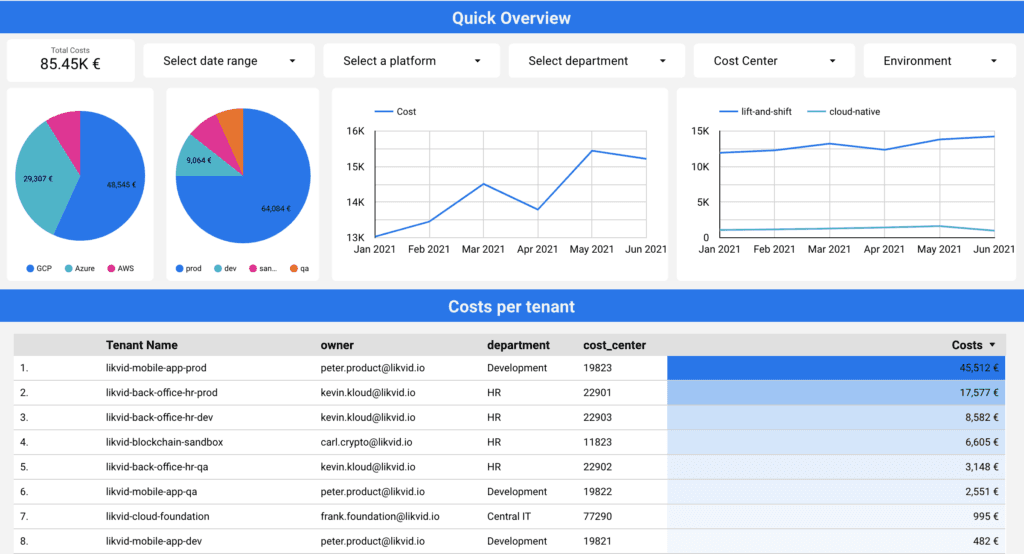
Cloud cost dashboard showing cost distribution across environments and services (Source: FinOps community dashboard)
Total first-year cost: ~US$60,000–$100,000
At 100k MAU, engineering complexity is manageable. The main risk is either under-investing (leading to outages during campaigns) or over-investing too early (paying for scale you don’t yet need).
2. Scalable E-Commerce for ~1,000,000 MAU
Crossing the one-million-MAU threshold changes the economics of the platform. Concurrency, data volume, and operational load all increase sharply. At this point, the system can no longer be treated as “a website”; it is a critical revenue engine.
Build cost: US$70,000–$120,000: The build cost now reflects a more mature product: richer UX, complex catalog structures with many variants and attributes, advanced promotions, loyalty features, multiple shipping options, multi-currency, and deeper integrations with CRM, ERP, or marketing tools. Frontend and backend both need to be structured for teams to work in parallel.
Scalability cost: US$40,000–$70,000: Here, scalability cost becomes a substantial line item. The platform often moves to multi-AZ or multi-node deployments. Queuing systems are introduced for background jobs (orders, notifications, inventory sync). Databases may use read replicas, dedicated search engines, and more aggressive caching strategies. The objective is to handle traffic spikes, large search volumes, and high order throughput without throttling or downtime.
Performance optimization: US$15,000–$30,000: At this size, performance optimization stops being a one-off task and becomes an ongoing discipline. The team invests in SSR/ISR or similar rendering strategies to keep first-load times low, rewrites slow queries, optimizes indexing strategies, and runs structured load tests ahead of major campaigns. Small improvements in latency can translate into significant gains in conversion and cart completion.
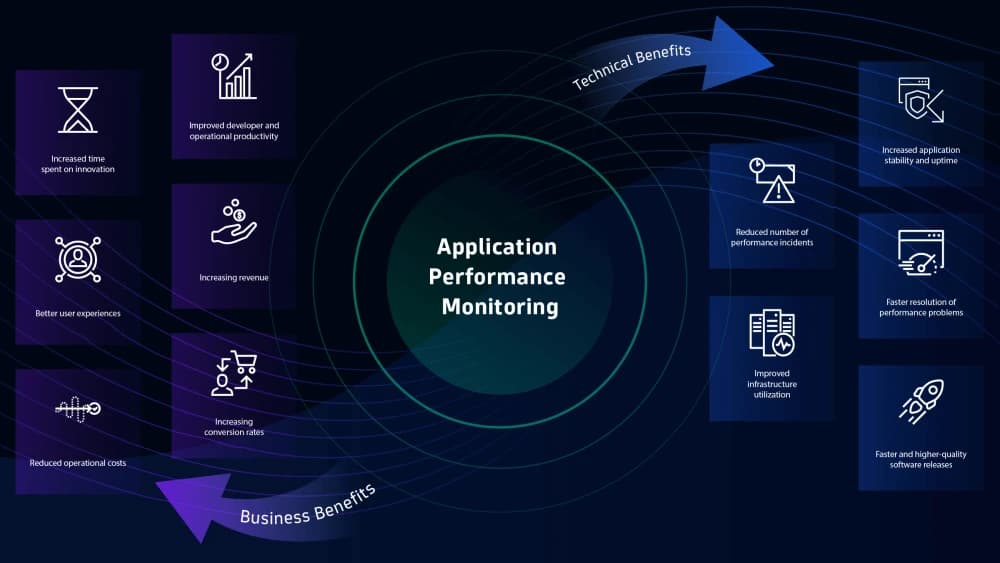
Application performance monitoring benefits for scalable e-commerce stability and optimization (Source: APM industry report)
Cloud cost: US$5,000–$15,000 per month (US$60,000–$180,000 per year): The cloud cost now reflects higher compute usage, more powerful databases, greater storage volumes, heavier CDN traffic, and more comprehensive monitoring. This is the stage where many companies discover that poor autoscaling rules, unoptimized storage, or unused resources can inflate bills by 30–40%. Architecture and FinOps discipline become as important as adding new features.
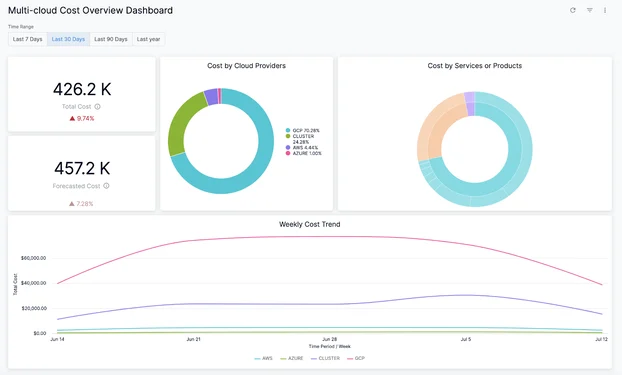
Multi-cloud cost overview showing cost by provider and weekly spend trend (Source: Cloud cost optimization report)
Total first-year cost: ~US$150,000–$300,000
At 1M MAU, the platform either matures into an efficient growth engine or becomes a financial and operational drag. The difference lies in how deliberately scalability cost, cloud cost, and performance optimization are planned and managed.
3. Enterprise-Grade E-Commerce for 5,000,000+ MAU
Above five million monthly active users, the platform operates at the scale of large retailers, marketplaces, or global D2C brands. Every architectural decision has a financial and reputational impact. Outages are headline events. Latency, even in tens of milliseconds, is noticeable in the data.
Build cost: US$150,000–$300,000: The build cost covers highly complex requirements: multi-brand or multi-tenant support, granular role-based access, extensive localization, complex tax and compliance logic, and deep, often bidirectional integrations with ERP, WMS, CRM, and data platforms. The architecture must support multiple teams deploying and iterating safely.
Scalability cost: US$80,000–$150,000: At this level, scalability cost is essentially the price of building a distributed system, not a website. The platform may use multi-region or active-active clusters, distributed databases, global traffic routing, advanced queueing, and resilient patterns such as circuit breakers and bulkheads. Disaster recovery and failover strategies are not optional; they are designed, tested, and maintained.
Performance optimization: US$30,000–$60,000: For 5M+ MAU, performance optimization becomes a continuous, data-driven cycle. Teams enforce latency budgets, run regular large-scale load and chaos tests, refine caching layers, and fine-tune edge delivery across regions. Performance work is prioritized not just for technical pride, but because every fractional improvement in conversion has visible revenue impact at this scale.
Cloud cost: US$20,000–$50,000 per month (US$240,000–$600,000+ per year): The cloud cost now reflects a truly global footprint: multiple regions, high-availability clusters, heavy storage and CDN usage, extensive logging and observability stacks, and often additional security and compliance services. Here, undetected inefficiencies can easily burn tens of thousands of dollars per month. FinOps, cost dashboards, and regular optimization cycles are mandatory, not “nice to have.”
Total first-year cost: ~US$350,000–$850,000+
At this tier, the platform is a core business asset. The real question is no longer “How much does it cost?” but “Are we getting the right return on the scalability cost, cloud cost, and performance optimization we are paying for?”
Build Scalable E-Commerce Platforms Without Overspending
Building a scalable e-commerce platform is not about layering on the most complex architecture. It’s about designing a system that grows in the right direction where every component serves long-term performance, stability, and cost efficiency. Our role is to ensure that brands expand confidently without facing the usual cloud surprises, scaling failures, or maintenance overhead that often appear after launch.
Designing scalable architecture that avoids unnecessary cost: We architect the platform around real growth patterns instead of hypothetical peak scenarios. This means building lean, resilient foundations, optimized search, fast checkout flows, stable catalog and inventory systems, and load-ready APIs so that the platform can scale naturally without forcing you into expensive rework or oversized infrastructure.
Reducing cloud cost through smart, FinOps-driven decisions: Cloud spending becomes one of the largest operating expenses as traffic grows. We work to keep it predictable and efficient by applying smart autoscaling rules, optimizing compute and storage usage, leveraging CDN intelligently, and eliminating silent cost leaks. In many cases, these refinements help businesses cut 25–40% of their cloud bill while maintaining or improving performance.
Continuous performance optimization to protect conversion and revenue: Performance isn't a one-time activity, it’s an ongoing competitive advantage. We monitor real traffic patterns, query loads, and user behavior to keep the platform consistently fast as the business expands. Faster page loads, stable concurrency, and smooth search experiences directly translate to higher conversion rates and a healthier revenue curve.
Providing long-term cost visibility and operational clarity: Scaling becomes predictable when businesses clearly understand how cost evolves from 100k to 1M to 5M+ MAU. We help teams plan for that growth by modeling infrastructure needs, long-term cloud spending, and maintenance requirements. This gives leaders full visibility into future operating costs instead of navigating surprises as traffic levels increase.
The result is a platform designed to grow with your business: stable under load, cost-efficient in the cloud, and maintainable for the long run without paying for unnecessary capacity or over-engineering from day one.
Conclusion
Building a scalable e-commerce platform is ultimately a balance between performance, reliability, and long-term financial discipline. The real cost doesn’t lie only in the initial development, but in how well the system handles growth, traffic spikes, and operational complexity over time. By designing with scalability in mind and guiding businesses toward smarter cloud and infrastructure decisions, Twendee we help teams avoid the hidden costs that typically surface months after launch. Our approach ensures that every layer of the platform from architecture to cloud usage to ongoing optimization supports sustainable growth, stable user experiences, and predictable operating expenses as the business scales.
Stay connected with us via Facebook, X, and LinkedIn.