

For years, an application modernization strategy usually began with the most visible signs of technical debt: aging infrastructure, rising maintenance costs and technologies approaching end of support.
AI changes the order of that conversation.
An application can still perform its original function reliably while preventing data from moving, decisions from reaching the right teams or AI from acting across a workflow. The systems that deserve attention first are therefore not always the oldest. They are increasingly the ones that control the flow of data, decisions and actions across the business.
AI Is Changing What Makes an Application Worth Modernizing
Traditional modernization programs often treat application condition as the starting point. Technology teams assess which systems are expensive to maintain, difficult to secure or dependent on scarce skills, then build a replacement or migration plan around them.
Those factors remain important. Gartner estimates that approximately 40% of infrastructure systems across asset classes have technical-debt concerns, affecting performance, scalability and resilience. But AI introduces another form of exposure: an application may be technically stable and still be strategically unfit for an AI-enabled operating model.
The difference lies in how AI creates value.
A conventional application primarily serves the employees who log into it. An AI system must work across applications. It may need to retrieve a customer record from CRM, verify an order in ERP, check inventory, interpret a policy document and send an approved action back into an operational platform.
A break anywhere in that chain limits the entire use case.
This is why apparently functional systems are becoming modernization priorities. A finance application may still close the books correctly, but its data may only be available through scheduled exports. A customer service platform may still record cases, but lack the interfaces required to retrieve transactions or initiate a refund. An inventory system may contain the right information, but use data structures that other systems cannot interpret consistently.
In each case, the application continues to work for its original user. It does not work as part of an intelligent, connected workflow.
The cost of ignoring that distinction is beginning to appear in AI business cases. Research by the IBM Institute for Business Value found that organizations which fully account for modernization, data integration and vulnerability remediation in their AI plans project 29% higher ROI than those that exclude those costs.
The finding points to a broader executive issue. Modernization is no longer a separate infrastructure program that can be considered after the AI strategy is approved. It is part of the economics of delivering that strategy.
Legacy Systems Should Be Prioritized by Workflow Leverage, Not Age
The age of an application tells leaders how long it has existed. It says little about the value that modernizing it could release.
A twenty-year-old system supporting a contained, low-change process may remain dependable for several more years. A much newer platform may require earlier intervention if it sits between AI and the data or actions needed for a high-value operation.
The more useful question is therefore: Which application change would remove the most friction from the workflows that matter most?
This moves legacy system assessment away from a system-by-system inventory and toward workflow leverage.
Consider an AI-enabled customer resolution process. The customer service platform may be the visible interface, but the outcome could depend on order management, payment, logistics and policy systems. Modernizing the interface alone will not improve resolution if employees must still move manually between the systems behind it.
The priority should fall on the dependency creating the greatest constraint. That might be an order platform without usable APIs, a fragmented customer data layer or a payment system that cannot accept controlled actions from another application.
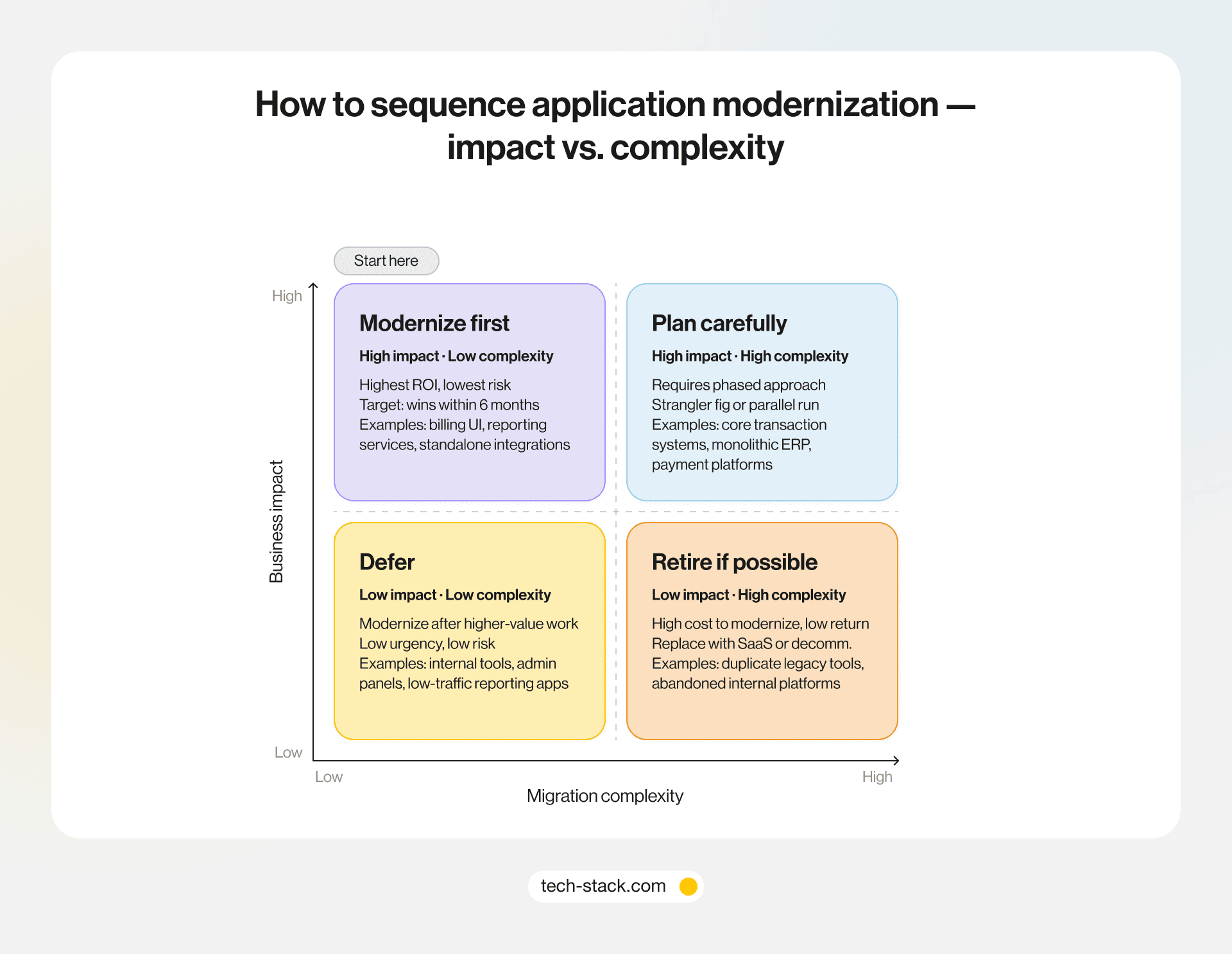
Application modernization prioritization matrix comparing business impact and migration complexity across modernize first, plan carefully, defer and retire categories. (Source: Techstack)
This distinction becomes even more important as enterprises move from copilots to agents. Gartner predicts that more than 40% of agentic AI projects will be cancelled by the end of 2027, citing escalating costs, unclear business value and inadequate risk controls. Many of these problems cannot be solved by selecting a better model. They arise because the surrounding workflows, systems and controls are not ready for operational AI.
Modernization priority should consequently reflect three connected forms of leverage.
First, the application must matter to a commercially or operationally important workflow.
Second, changing it should unlock capabilities beyond one isolated use case.
Third, the organization must be able to expose its data and functions with the permissions, traceability and reliability that enterprise AI requires.
A central ERP integration layer, for example, may support procurement, finance, customer service and supply-chain use cases. Improving it could create more value than replacing several older but peripheral applications. By contrast, rebuilding a standalone internal tool may improve its user experience without changing the organization’s capacity to deploy AI at scale.
Recent analysis on connecting AI agents with ERP systems reaches a similar conclusion: AI needs clean, structured data through standard services or APIs, as well as controlled interfaces for returning decisions and actions to systems of record.
The strategic shift is subtle but significant. Enterprises are no longer only paying down the technical debt that creates the most maintenance pain. They must also address the architectural constraints that suppress the most future value.
Modernization Should Target the Constraint, Not Automatically Replace the Application
Once an application becomes a priority, replacement is still only one possible response.
This matters because enterprise systems contain more than code. They hold business rules, exception logic, historical integrations and operational knowledge accumulated over many years. Rebuilding the whole application can remove outdated technology, but it can also recreate functions that already work, expand migration risk and delay the outcome that justified modernization in the first place.
A stronger enterprise application modernization approach asks what specifically prevents the system from supporting the target workflow.
When the core application is reliable but isolated, exposing selected data and functions through secure APIs may be enough. When the constraint is fragmented or inconsistent information, the priority may be the data layer rather than the application itself. Specific modules can be refactored when tightly coupled components limit change. Re-platforming can address infrastructure or scalability constraints while preserving valuable business logic.
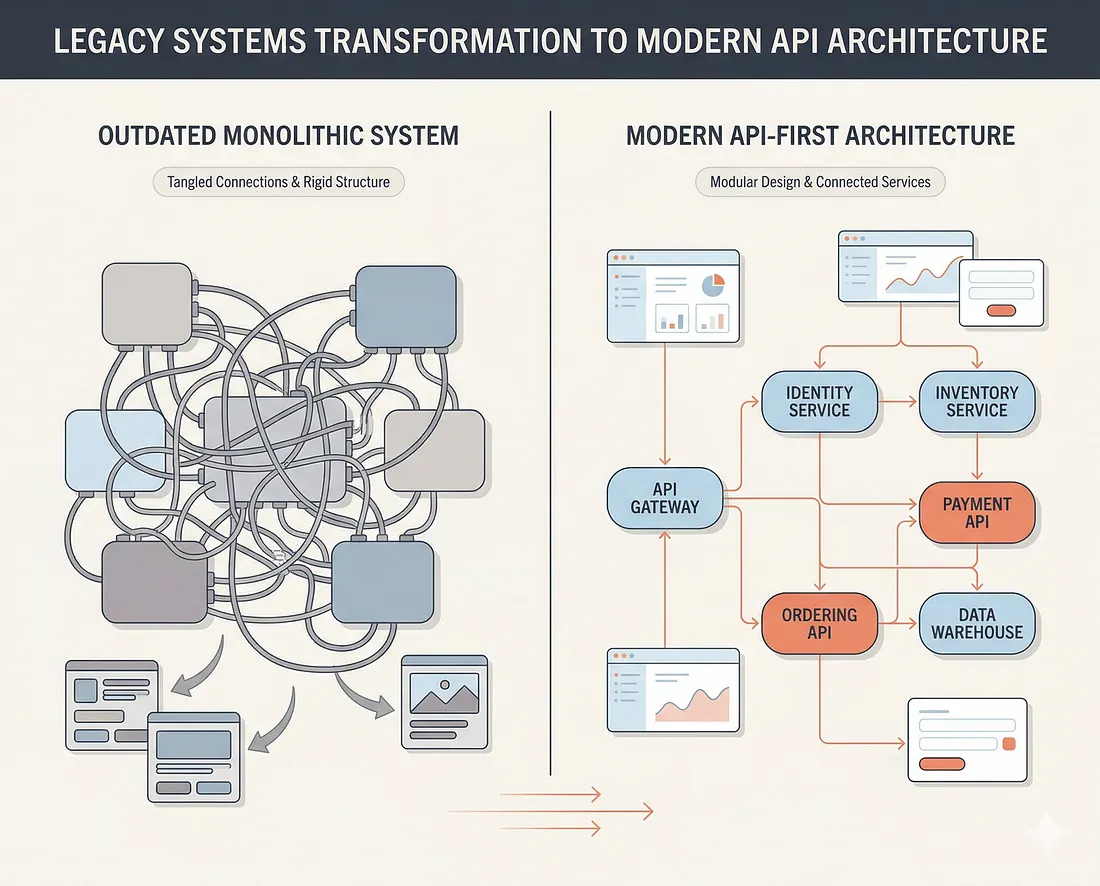
Legacy application modernization infographic showing a tangled monolithic system transformed into a modular API-first architecture with an API gateway and connected business services. (Source: Hashbyt)
Complete replacement becomes appropriate when the constraints are structural: the system presents unacceptable operational or security risk, its economics no longer make sense, or its architecture cannot support the company’s future operating model.
The experience of Alcon shows why the level of intervention matters. Its legacy application did not connect effectively with critical systems such as ERP, limiting adoption and creating ongoing administrative work. After developing a serverless application with API-based integration, usage among representatives in Canada increased from 20% to 93%, while weekly data-administration work fell from four to five hours to almost zero, according to the company’s AWS modernization case study.
The business outcome did not come simply from replacing something old. It came from removing the integration constraint that prevented the application from fitting into the wider operational environment.
This leads to a more disciplined principle: Modernize the smallest set of components capable of unlocking the required business capability.
That principle is especially valuable when AI is involved. Enterprises do not need every application to become cloud-native before an AI workflow can generate value. They need the right data to be accessible, the right actions to be executable and the right controls to remain enforceable.
The Best Modernization Roadmaps Optimize Sequence, Not Volume
Modernization programs are often described by scale: the number of applications migrated, workloads transformed or platforms retired.
Those measures can indicate activity without demonstrating progress.
Launching too many modernization initiatives at once distributes architecture, engineering and business expertise across multiple fronts. Shared dependencies emerge late, operational teams face overlapping changes and benefits remain fragmented across incomplete workflows.
A more effective modernization roadmap is built around sequence. It identifies the smallest initial changes that can open an important workflow, then uses those improvements as foundations for subsequent use cases.
In many portfolios, the first move is not a major replacement. It may be a common API layer, a governed source of operational data or a new identity and permission model. These foundational changes may appear modest when viewed as standalone IT projects, but their value increases when several workflows depend on them.
The next investments should extend that leverage. Components that reduce operational risk or unlock multiple AI use cases move forward. Systems whose modernization produces limited near-term value can remain stable until their dependencies or economics change.
Penn Mutual used this kind of controlled sequencing when modernizing its infrastructure. The company migrated 40 to 80 virtual machines per month, shortened its modernization timeline by six months and retired legacy systems without disrupting business operations. Its AWS case study presents continuity not as a reason to postpone modernization, but as a requirement the roadmap was designed to protect.
The same logic applies to AI readiness. A company should not wait for a multiyear transformation to finish before deploying valuable AI use cases. Nor should it connect AI indiscriminately to applications that lack reliable data and governance.
Each modernization wave should deliver a complete operational improvement: access to a trusted dataset, connection across a defined workflow, reduction of a known risk or controlled execution of a new AI-enabled action.
At Twendee, this means beginning with the workflow the business wants to improve, then tracing the applications, data and control dependencies behind it. That perspective helps determine whether a system needs API enablement, data restructuring, cloud re-platforming, targeted redevelopment or full replacement.
The result is a phased roadmap that changes what is necessary without turning modernization itself into a source of unnecessary operational disruption.
Conclusion
AI is not making every legacy application equally urgent. It is exposing which systems have the greatest influence over the data, decisions and actions required by future operations.
A successful application modernization strategy therefore prioritizes workflow leverage over application age, targets the actual constraint and sequences investment around measurable business value.
Twendee helps enterprises assess these dependencies and build practical modernization roadmaps across APIs, data architecture, cloud platforms and targeted redevelopment. Visit the Twendee website, follow Twendee on LinkedIn, or book a conversation through Twendee’s Calendly to identify the systems your AI strategy depends on—and modernize them in the order that creates the greatest operational value.
