
Enterprise APIs were built to connect predictable software. AI changes that assumption. As copilots and agents begin selecting tools, chaining requests and taking actions across core systems, enterprise API management, API governance, API lifecycle management and API integration strategy become part of the AI operating model—not simply the integration stack. The strategic question is no longer whether AI can reach enterprise systems, but whether it can do so without weakening security, accountability or operational control.
AI has changed who enterprise APIs need to serve
For most of the API economy, the primary consumers were known in advance: web applications, mobile applications, partner platforms and internal services. Their request patterns were encoded in software, tested before release and tied to relatively stable business processes.
AI copilots, agents and LLM-based applications behave differently. They can decide which tool to call based on context, create several requests from one instruction and change the next step according to the response. A support agent may read a customer record, check an order-management system, query a payment service and prepare a refund request. The API is no longer serving one application screen; it is supporting a reasoning process that moves across systems.
The gap between adoption and readiness is already visible. Postman’s 2025 State of the API Report found that 89% of developers use AI, while only 24% design APIs for AI agents. An API can therefore be technically available to an agent without being designed for how that agent discovers, combines or acts on its capabilities.
Enterprise API strategy is becoming execution infrastructure for AI. Its quality will shape how reliably AI can translate a business request into a controlled action.
AI is exposing the limits of traditional API strategy
Traditional API architecture assumes a considerable degree of predictability. A known application calls a defined endpoint, follows an established workflow and produces traffic within an expected range. Authentication identifies the application or user, while testing confirms that the integration behaves correctly before production.
AI introduces a less predictable decision-maker. One natural-language request can trigger a chain of calls whose length depends on context. An agent may retry an operation, choose another tool or combine information from several services before deciding what to do next. The issue is not merely higher traffic. It is greater variability in how traffic is generated and greater authority behind each request.
A rate limit created for a mobile application may not reflect the cost of an agent generating dozens of calls in one task. A broad service account that worked for a tightly coded integration may become risky when attached to a system that selects actions dynamically. Endpoint documentation written for developers may also be too ambiguous for a model using metadata to decide whether and how to call it.
The APIs have not necessarily failed; the assumptions around them have changed. Enterprises do not need to label every existing API “legacy,” but they do need to identify where AI changes the request pattern, decision path or level of operational authority.
AI governance starts at the API layer
AI governance is often discussed through model quality, data privacy and human oversight. Once an agent can interact with ERP, CRM, finance or customer-service systems, however, governance becomes operational at the API layer.
Responsible-AI principles have limited practical value if an agent uses shared credentials, receives excessive permissions or leaves no traceable record of its actions. Postman found that 51% of developers view unauthorized agent access as a leading security risk, showing that the control problem is becoming concrete rather than theoretical.
Identity is the first boundary. Microsoft’s guidance on agent identities argues that identity models designed for people and conventional applications are insufficient for autonomous agents. Dedicated identities allow agent activity to be authenticated, governed and recorded separately. Enterprises need to know which agent acted, whose authority it represented and which policy applied at that moment.
Authorization must then distinguish between access and action. An agent may read inventory but not change it, prepare a purchase order but not submit it, or recommend a refund while requiring approval before money moves. Rate limits should also reflect business risk, not only infrastructure capacity: reading product data and initiating payments should not share the same execution boundaries.
Observability closes the loop. NIST’s API protection guidance treats authentication, authorization, request validation, resource controls and logging as connected protections across the API lifecycle. It also recommends monitoring request sequences that may individually pass validation while collectively creating risk. For AI, logs must provide enough context to reconstruct the initiating request, agent identity, systems touched, approvals received and final business outcome.
Once AI can call enterprise APIs, API governance defines the practical limits of AI authority.
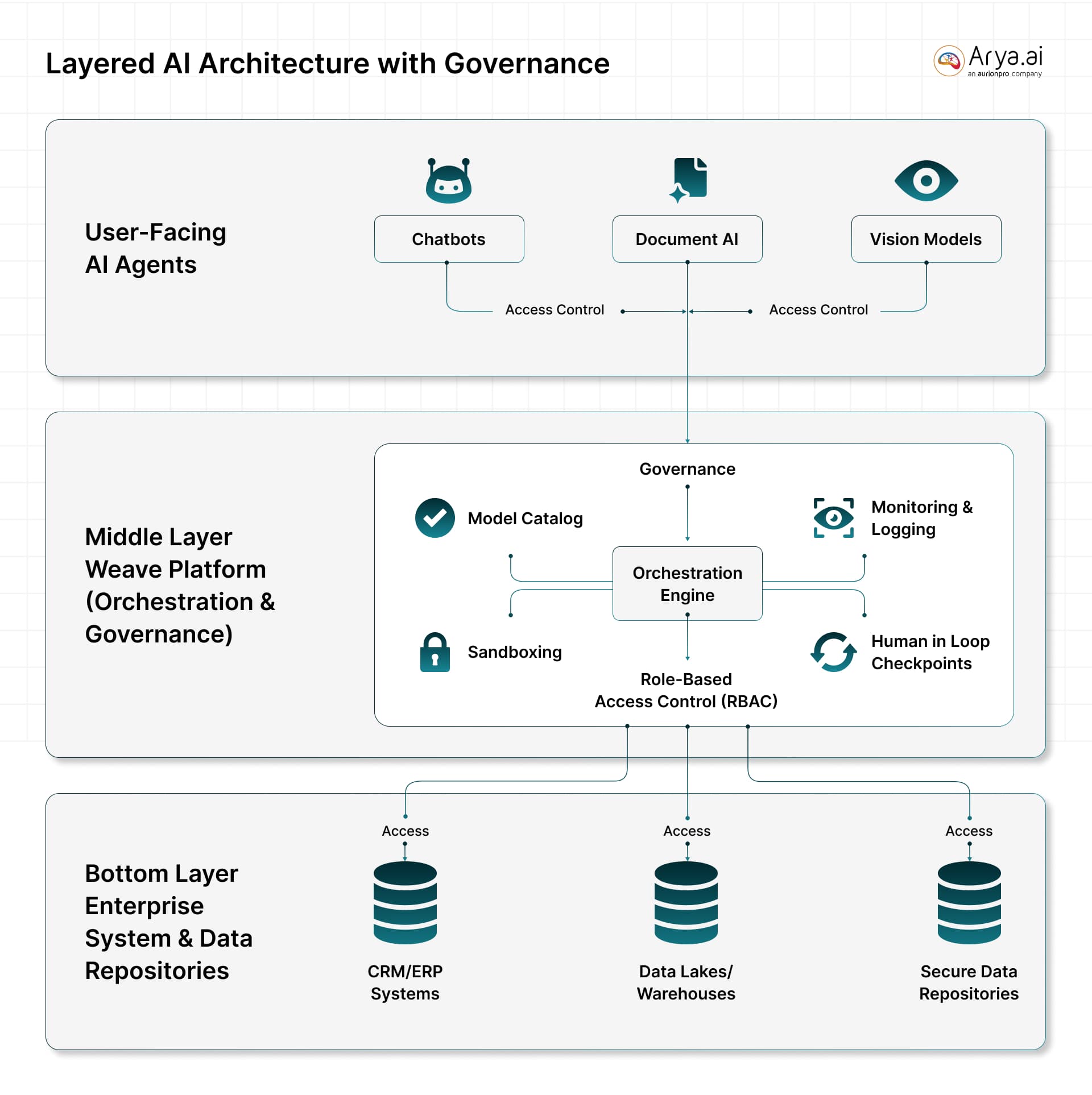
Layered AI governance architecture showing user-facing AI agents connected to enterprise systems through orchestration, role-based access control, monitoring, audit logging, sandboxing, and human approval checkpoints. (Source: Arya)
AI extends the API lifecycle beyond application integration
API lifecycle management traditionally covers design, development, testing, deployment, versioning and retirement. AI adds dependencies because agent behavior does not live only in application code. It can change when the model, system prompt, tool description, orchestration logic, permissions or available context changes.
An API may therefore remain technically healthy while becoming unreliable for an AI workflow. A schema change might still satisfy a conventional client but alter the information an agent uses to choose its next step. A revised tool description may cause the same model to call an endpoint more frequently. A model upgrade may improve general reasoning while changing how it interprets errors or optional fields.
The lifecycle must now include AI-consumer registration, compatibility testing across model and API versions, permission reviews when agent capabilities change, and monitoring of actual production usage. Deprecation also becomes more complex because removing one endpoint may affect several workflows that discover or invoke it through shared tool definitions.
The NIST Generative AI Profile emphasizes logging, change-management records, version history and metadata as part of managing AI incidents. The executive implication is clear: model changes and API changes cannot be governed as separate release streams when they participate in the same operational workflow.
An AI-ready integration layer is becoming the new control point
Giving an agent direct access to core systems may accelerate a pilot, but it creates a weak foundation for scale. A more durable architecture places an integration layer between AI systems and the ERP, CRM, payment platform or other systems of record.
This layer is not simply middleware. It becomes the point where the enterprise authenticates agent identities, translates model-generated requests into structured API calls, enforces permissions, validates inputs, applies business rules, requests approval and captures audit evidence. It can also shield core systems from model changes by presenting a stable contract to the AI layer as backend services evolve.
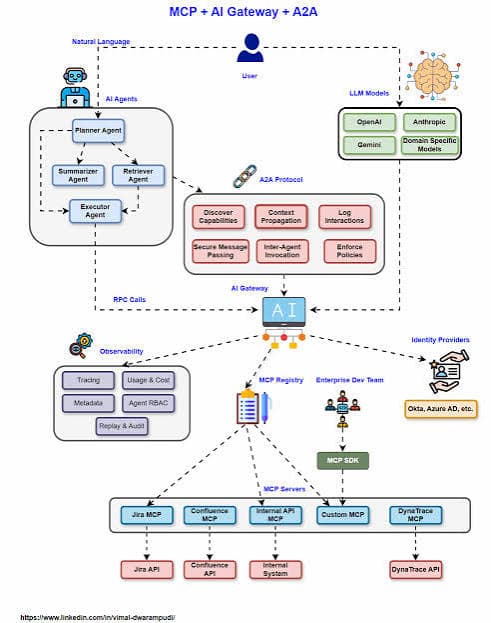
Enterprise AI integration architecture connecting AI agents and LLMs to business systems through an AI gateway, with MCP services, A2A communication, identity management, policy enforcement, observability, RBAC and audit controls. (Source: Vimal Dwarampudi)
The business value goes beyond risk reduction. Google Cloud reports that Wells Fargo uses Apigee API Management to create reusable, task-specific APIs for generative AI. A retrieval-based tool for branch bankers reduced the workflow involved in resolving policy and procedure queries by approximately 20%. The architectural lesson is that governed access to enterprise knowledge can improve AI delivery across teams without rebuilding each connection for every use case.
This is why API platforms are evolving toward AI gateways. Google Cloud describes an AI gateway as an intermediary for security, traffic management, observability and consistent service contracts across AI workloads. Terminology may vary, but the principle is stable: AI should reach enterprise systems through a controlled path rather than a growing collection of direct connections.
Twendee helps enterprises assess existing API architecture, identify where agent access changes the risk profile and build secure integration layers for both conventional applications and AI-driven workflows. The objective is not to replace every API, but to create clearer boundaries around the systems and actions that matter most.
Conclusion
Most enterprise APIs were designed to connect software. The next challenge is enabling them to support intelligent systems without compromising governance, security or operational control.
Organizations that modernize their API strategy now will be better positioned as AI moves from isolated assistants into everyday execution. To assess whether your current architecture is ready for that shift, visit the Twendee website, follow Twendee on LinkedIn, or book a conversation through Twendee’s Calendly.
