As data stacks grow, data contracts are becoming less about documentation and more about operational control. A field rename, type change or revised business definition can look harmless inside one source system, yet still break dashboards, applications or automated workflows downstream. The real challenge is not keeping data static. It is making change visible before it becomes failure.
For growing data teams, that shifts the focus from basic data quality management to data pipeline reliability: defining what systems can safely expect from shared data, then enforcing those expectations as data changes.
Small Data Changes Can Create Outsized Downstream Failures
Most pipeline failures do not begin with dramatic infrastructure incidents. They often start with changes that make perfect sense locally.
A product team renames a customer field. Finance updates the definition of recognized revenue. An engineering team changes a timestamp from string to datetime. The source application keeps working, so the change appears successful. The problem becomes visible later, when a downstream transformation fails, a dashboard silently excludes records, or an automated process reads the field differently.
This is what makes modern data reliability difficult: the producer sees the change, but rarely sees the full dependency graph behind it.
Uber faced this as its data platform grew. In an engineering review, the company described an earlier generation of pipelines as vulnerable to upstream format changes. By the time its platform had scaled beyond 100 petabytes, Uber was operating several thousand ingestion pipelines and tables with around 1,000 columns and five or more nesting levels. The company moved toward centralized schema services, mandatory schema checks and semantic validation because structural correctness alone was not enough. Uber Engineering documented the evolution in detail.
A change can be technically valid at the source and still be operationally disruptive downstream. Once the same data supports several teams and systems, reliability stops being a concern owned only by the data team. It becomes part of how the business manages change.
Data Pipelines Carry Expectations, Not Just Data
A pipeline is usually described as infrastructure for moving and transforming data. In practice, every pipeline also carries a set of expectations.
A consumer may depend on a field being present, having a certain type, arriving within a certain freshness window and retaining the same business meaning over time. A dashboard may assume that active_customer follows one definition. A credit workflow may assume that payment_status has a fixed set of values. An AI agent may use the same fields to decide whether to trigger an action.
The risky part is that these expectations are often implicit. They sit inside SQL models, application logic, workflow rules and team knowledge rather than in a shared interface.
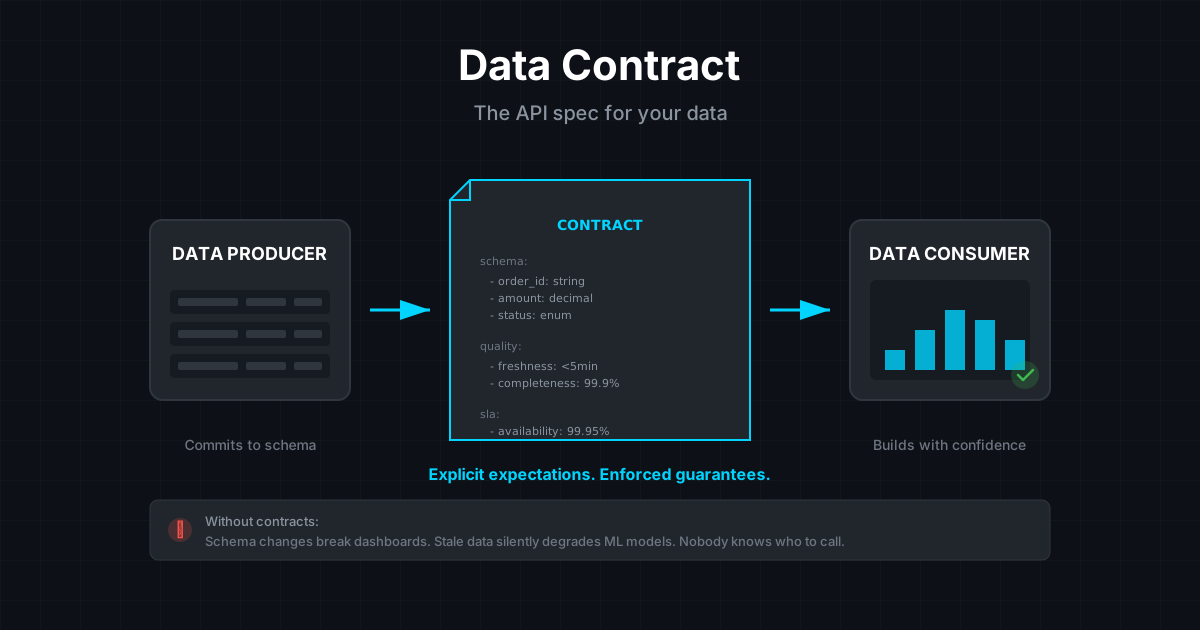
This is where data contracts become useful. Rather than treating them as another layer of documentation, it is more useful to see them as an agreement between producers and consumers. The producer states what it will provide. The consumer knows what it can safely depend on.
Google Cloud describes schemas in Pub/Sub in similar terms: a schema creates a contract between publisher and subscriber, and the platform can reject messages that do not conform. Google Cloud’s Pub/Sub documentation also supports schema revisions, reinforcing a key point: reliability depends on managing evolution, not freezing interfaces forever.
The pipeline therefore becomes more than a route from source to destination. It becomes an enforceable boundary between systems.
Data Contracts Turn Hidden Data Risk Into Controlled Change
The strongest case for data contract implementation is not that contracts describe data more clearly. It is that they make breaking change testable before it spreads.
A useful contract works across three layers. It protects structures such as fields, data types and compatibility rules; semantics, meaning what those fields actually represent in the business; and expectations, defining what producers commit to maintain and what consumers can rely on.
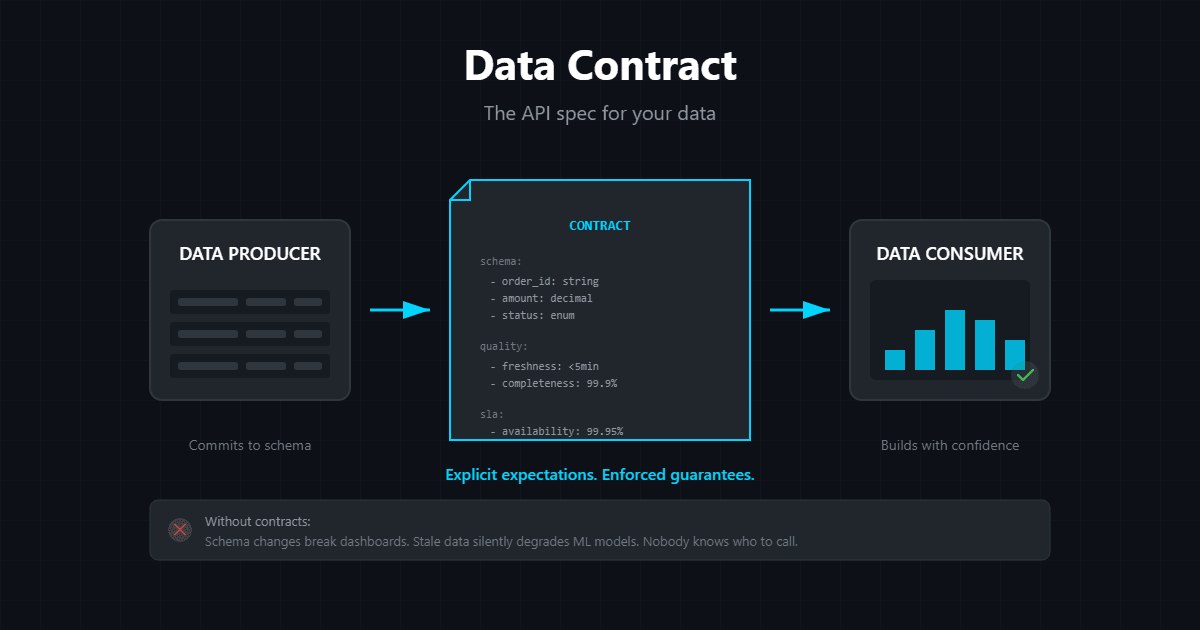
Data contract defining schema, data quality and SLA expectations between data producers and data consumers (Source: Tacnode)
The semantic layer is easy to underestimate because a schema can stay technically unchanged while the meaning of the data shifts. A column called available_inventory may still be an integer after a system update, yet its definition could move from “physical stock” to “stock minus reserved orders.” Every downstream system would receive a valid integer, while some could now make the wrong decision.
Virgin Media O2 has taken this broader view. In a 2025 architecture case published with Google Cloud, VMO2 described data contracts as machine-readable interfaces covering schema, semantics, quality metrics and service-level objectives such as freshness and completeness. The company connected those contracts directly to validation, data quality scans, orchestration, monitoring and alerts instead of leaving them as static documentation. The VMO2 and Google Cloud case shows the contract acting as an operational control layer across a federated data environment.
This is the key shift. The purpose of a contract is not to stop systems from changing. Growing businesses need systems to evolve. The goal is to make change visible, testable and manageable before it becomes a downstream failure.
In that sense, a data contract is closer to change control than documentation.
As Data Drives More Systems, Governance Has to Move Into the Pipeline
The case for stronger contracts becomes more important as operational data moves beyond analytics.
Spotify offers a useful view of that scale. Its engineering team reported more than 38,000 actively scheduled pipelines and over 1,800 event types across its data platform. Spotify Engineering describes schemas, lineage, quality checks, monitoring and access controls as built-in properties of the endpoints created by those pipelines.
The implication for enterprise architecture is important. When one dataset powers only a dashboard, a breaking change may create an analytics incident. When the same operational data feeds applications, ERP or CRM workflows, automation and AI systems, the blast radius becomes much larger.
That is why data governance cannot remain only in policies, catalogs or review meetings. It has to move closer to execution. A contract becomes valuable when a schema change can be checked before deployment, violations are surfaced automatically, and teams can see which assumptions are no longer being met.
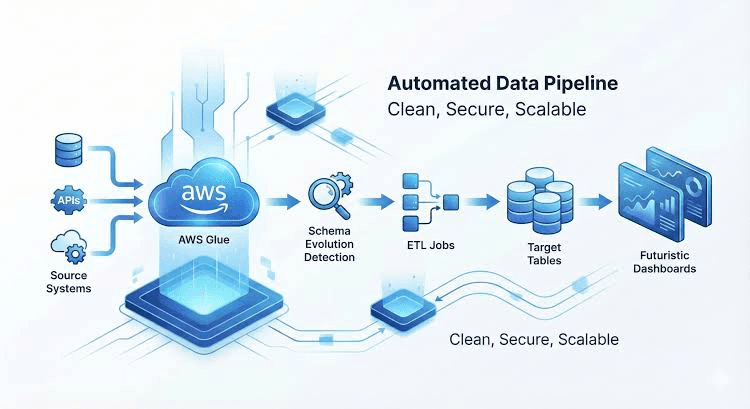
Automated data pipeline with schema evolution detection between source systems, ETL jobs, target tables and downstream dashboards (Source: Kuldeep Trivedi)
For companies building AI agents on top of operational systems, this matters even more. An agent can only make reliable decisions if the data interface beneath it remains predictable. More intelligent models do not compensate for unstable definitions or silently changing source data.
Data Reliability Requires Governing How Data Changes Over Time
This is where data pipeline reliability differs from a narrower view of data quality.
Data quality asks whether data is accurate, complete and valid at a given point in time. Reliability asks a harder question: will the systems depending on that data continue to behave correctly as schemas, source applications and business rules evolve?
That requires three capabilities working together: clear interfaces between producers and consumers, validation before changes reach downstream systems, and monitoring after deployment to detect drift or contract violations.
The point is not to introduce another governance artifact. A contract that exists only in a document does little to reduce operational risk. Its value comes from enforcement inside the pipeline.
This is also how Twendee approaches enterprise data integration. Instead of treating pipelines as isolated ETL jobs, Twendee helps define stable interfaces between operational systems and downstream consumers, then embeds validation and monitoring into the data flow. That makes changes in ERP, CRM, databases or internal applications easier to manage without forcing downstream teams to discover problems after production is affected.
For growing organizations, this matters because data infrastructure rarely breaks at a clean organizational boundary. One team changes a source. Another owns the pipeline. A third depends on the result. Data contracts create a clearer operating model across those boundaries.
Conclusion
Reliable data infrastructure is not infrastructure that never changes. It is infrastructure designed to change without silently breaking everything built on top of it.
As more business processes, applications and AI systems depend on shared operational data, data contracts offer a practical way to make expectations explicit and move governance into the pipeline itself.
Twendee helps enterprises design those interfaces, strengthen validation and monitoring, and build data pipelines that remain dependable as systems evolve. If your data architecture is becoming harder to change without downstream risk,visit the Twendee website, follow Twendee on LinkedIn, or book a conversation through Twendee’s Calendly to build a more reliable integration layer.