Many companies want AI, but their systems are not ready for it. The problem is not that legacy systems are always broken. Many of them still run critical operations reliably. The deeper issue is that they were built for a different era: stable processes, isolated departments, batch reporting, and limited integration. AI requires something else. It needs accessible data, clear workflows, permission logic, auditability, and systems that can exchange context in real time.
That is why AI-ready enterprise systems are becoming a prerequisite for practical AI adoption. An AI-ready system is not simply software with AI features added on top. It is a business system where data is structured, workflows are observable, integrations are stable, and AI outputs can be tied back to real operational context.
Why AI-ready enterprise systems matter more than another AI tool
Enterprise AI often begins with a tool-first mindset. A team adds a chatbot to internal documents, tests an AI assistant for reporting, or pilots automation for customer support. These experiments can be useful, but they often expose a harder problem: the company’s systems cannot support AI beyond a controlled demo.
McKinsey’s 2025 State of AI report makes this clear. The companies capturing stronger AI value are not only deploying tools. They are redesigning workflows, changing operating models, strengthening data practices, and scaling AI through organizational rewiring. The lesson is direct: AI value depends on how well the business can absorb AI into real operations, not only on model capability. (McKinsey)
This is where legacy systems become a blocker. A CRM may hold sales activity, but billing data sits somewhere else. Finance approvals may run through email and spreadsheets. HR data may not connect with project ownership. Customer support may know about a delivery issue before the account manager does. In this environment, AI can still generate answers, but those answers may be incomplete, outdated, or operationally unsafe.
The business cost of outdated systems is already measurable. Pegasystems and Savanta found that the average global enterprise wastes more than $370 million per year because of outdated legacy technology and technical debt. That number is not only about maintenance. It reflects the cost of slow modernization, duplicated effort, fragile processes, and the opportunity lost when teams keep patching systems instead of building new capabilities. (Pegasystems)

The average enterprise wastes more than $370 million annually due to legacy technology and technical debt (Source: Pegasystems)
For companies preparing for AI, this creates a practical warning. AI cannot turn fragmented operations into intelligent operations by itself. If the system foundation is weak, AI may only make the interface feel modern while the underlying workflow remains slow, manual, and difficult to trust.
Where legacy systems block AI-ready operations
Legacy systems usually create AI blockers quietly. They do not always fail visibly. They create friction through trapped data, unclear workflow ownership, fragile integrations, and limited governance. These problems become more serious when AI moves from “answering questions” to supporting decisions and actions.
1. Data is trapped where AI cannot use it well
AI needs business context. In enterprise operations, that context rarely lives in one place. A useful sales recommendation may require CRM history, invoice status, delivery progress, support tickets, and contract terms. A finance assistant may need budget data, approval rules, vendor records, payment history, and supporting documents.
Legacy environments often make this context difficult to access. Data may be stored in old databases, custom-built systems, local spreadsheets, or platforms with limited API support. Even when teams can export the data, it may not be current enough or consistent enough for AI to reason from.
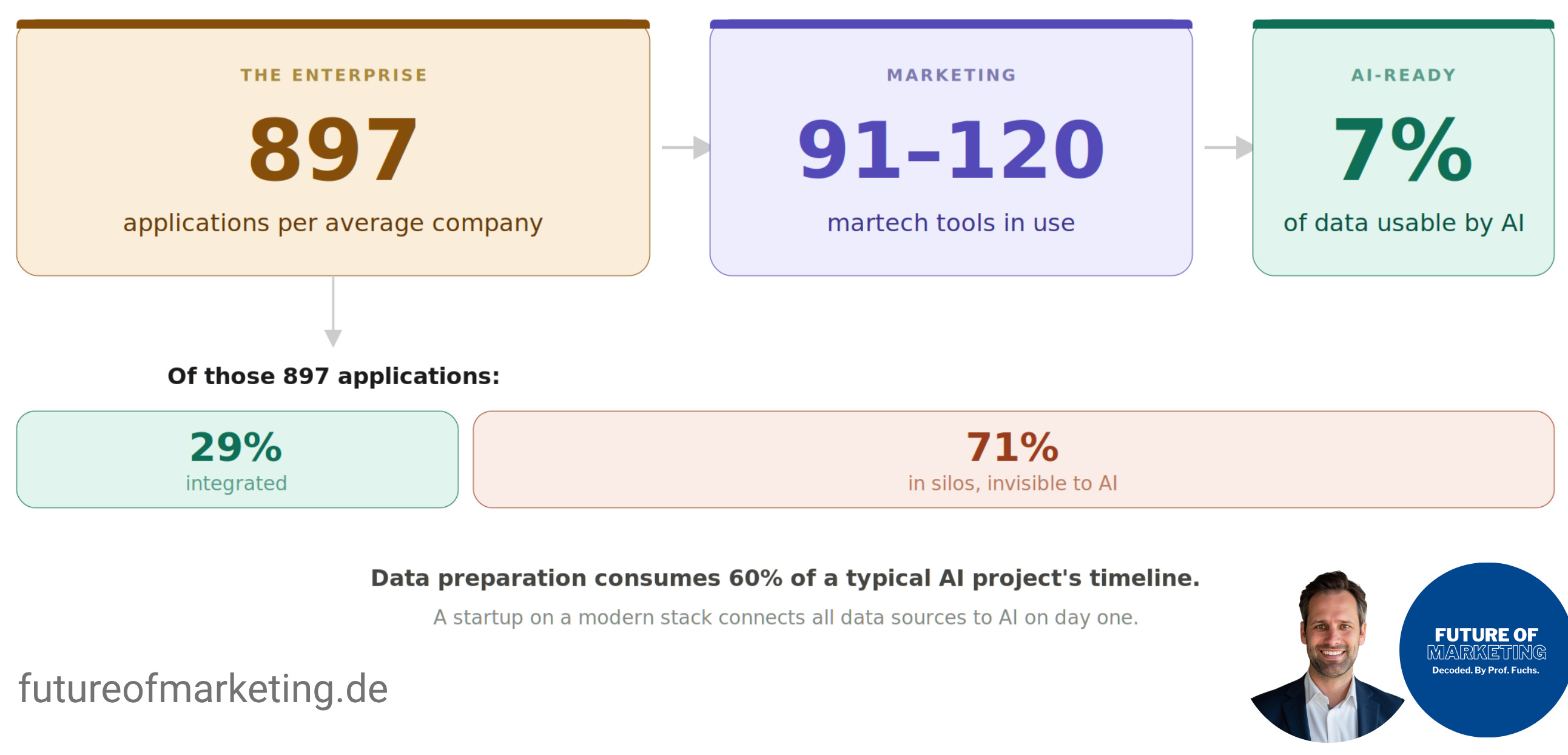
MuleSoft’s 2025 Connectivity Benchmark shows the scale of this issue: the average enterprise manages 897 applications, yet only 29% are integrated. The report also notes that disconnected systems reduce the accuracy and usefulness of AI agents. This means many companies are trying to adopt AI in environments where most applications still cannot exchange data reliably. (MuleSoft)
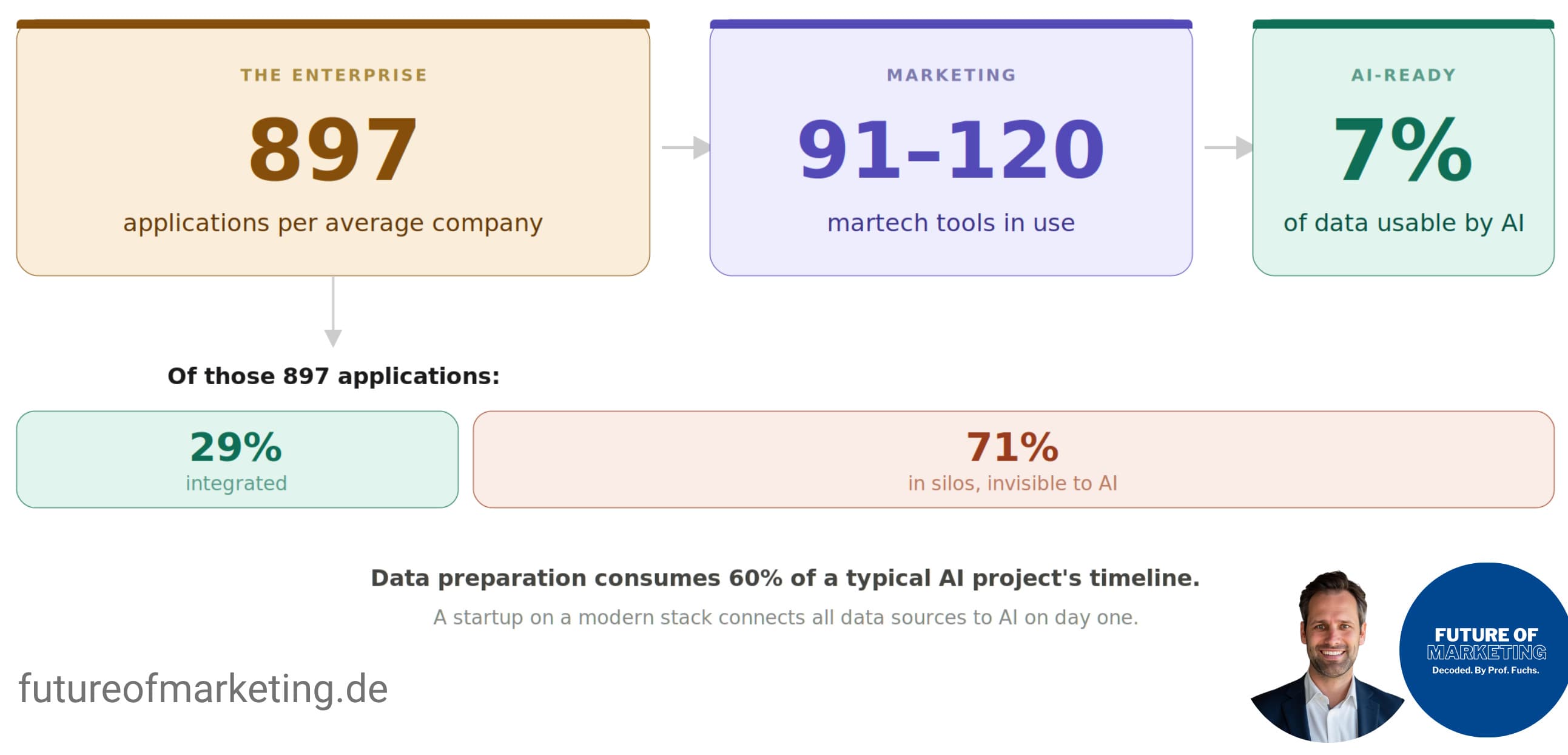
Only 29% of enterprise applications are integrated, leaving much of business data trapped in silos and harder for AI to use (Source: Future of Marketing)
The result is an “operationally blind” AI layer. It may summarize what it can see, but it cannot understand the full situation. A sales AI may recommend a follow-up without knowing the customer has unpaid invoices. A reporting bot may explain revenue trends without seeing delayed delivery status. A support assistant may resolve a ticket without understanding the contractual context.
2. Workflows are not structured enough for reliable automation
Many legacy operations still depend on informal workflow logic. A request begins in email. A manager approves it through chat. Finance checks a spreadsheet. Operations updates a separate tool. Someone manually reconciles the final status before leadership gets a report.
People can work around this because they understand the hidden process. AI cannot. AI needs the system to show who owns the task, what status it has, what rule applies, which approval is required, and where the next action should go.
This is why enterprise workflow systems matter. AI cannot reliably route requests, detect bottlenecks, or recommend next steps if the workflow itself is invisible. A finance approval workflow, for example, must have structured request types, approval thresholds, supporting documents, audit trails, and escalation rules before AI can safely assist it.
Without that structure, AI automation becomes shallow. It may draft a message or summarize a document, but it cannot confidently move work forward. Worse, it may accelerate a broken workflow by sending faster reminders without solving the underlying ownership problem.
3. Legacy architecture makes AI scaling expensive and risky
AI pilots often succeed because they operate in a narrow environment. A small dataset is prepared manually. A limited workflow is selected. A few users test the system. But production AI needs more than a good demo. It needs stable data access, secure permissions, monitoring, integration with business systems, and clear governance.
Legacy architecture makes this difficult. Every new AI use case may require a custom connector, a manual export, a data-cleaning workaround, or a one-off integration. Over time, the cost of scaling AI rises because each use case depends on fragile system plumbing.
IBM’s 2026 view of AI adoption challenges identifies data quality and readiness, governance, and integration into business processes as common barriers when organizations move from pilots to enterprise-wide adoption. These are system-readiness problems. They show that AI scaling is not only about adopting stronger models. It is about whether the enterprise architecture can support repeatable AI use cases.
For AI-ready enterprise systems, architecture must become more modular, integration-ready, and permission-aware. Otherwise, AI adoption turns into a series of disconnected experiments layered on top of systems that were never designed to support them.
How enterprise system modernization should prepare companies for AI
Enterprise system modernization should not automatically mean replacing everything. That approach is often too risky, expensive, and disruptive. A better path is to identify which legacy limitations directly block AI readiness, then modernize around the workflows and data flows that matter most.
The starting point should be an operational assessment, not a software shopping exercise. Companies need to understand where data is trapped, where workflows depend on manual coordination, where integrations break, and where AI would require stronger permissions or auditability.
A practical modernization path usually follows five steps:
Assess the legacy environment: Identify critical systems, manual workarounds, duplicated data, integration gaps, and workflows that slow decision-making.
Map AI-blocking workflows: Prioritize processes where AI could create value, but only if the workflow becomes more structured.
Stabilize data access: Build APIs, integration layers, data pipelines, or controlled connectors so AI can access current and trusted business context.
Modernize high-friction workflows: Move approvals, requests, ownership, status tracking, and audit trails into structured enterprise workflow systems.
Add AI only where the foundation is ready: Integrate AI into workflows where data, permissions, and decision boundaries are clear.
This is where Twendee’s role becomes more specific. Twendee supports companies through the full legacy-to-AI modernization path: assessing existing architecture, identifying workflow and data bottlenecks, building integration layers, modernizing ERP or internal systems, and designing AI-ready platforms with structured data, workflow logic, and scalable architecture.
For example, a company may not need to replace its entire ERP immediately. It may first need to connect ERP and CRM data, digitize approval workflows, rebuild one legacy module that blocks automation, or create an internal operations platform where requests, ownership, and reporting become visible. These steps reduce dependency on fragile systems while preparing the business for practical AI integration.
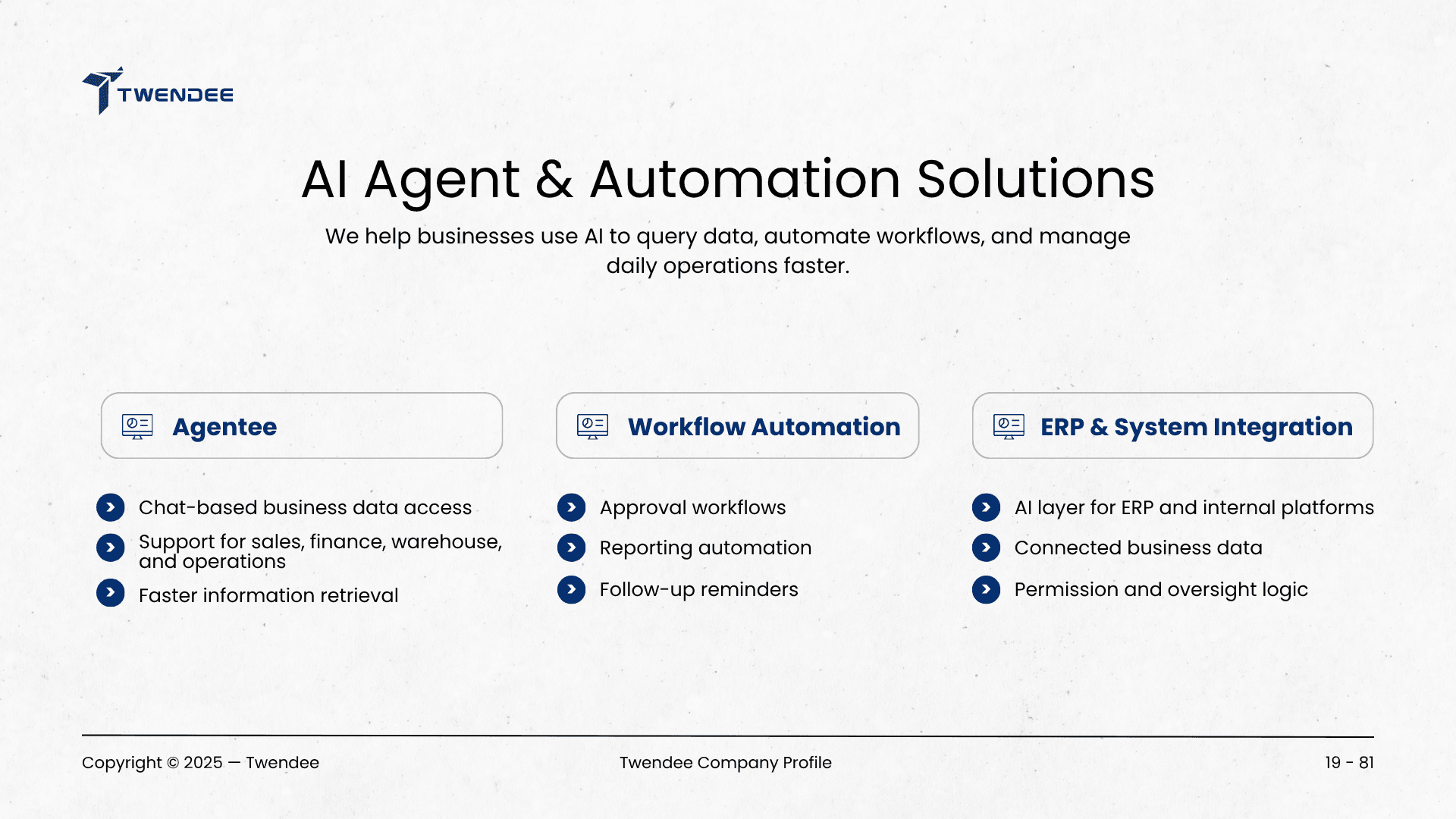
Twendee provides AI Agent, workflow automation, and ERP integration solutions to help businesses query data, automate workflows, and manage operations faster (Source: Twendee)
The point is not modernization for the sake of newer software. The point is to make the business easier for AI and people to understand.
Why the next AI upgrade will depend on system modernization
The next AI upgrade will not be won by companies that add the most AI tools. It will be won by companies that make their enterprise systems ready for AI to operate inside real workflows.
This matters because AI is moving closer to core business systems. AI assistants, agents, workflow automation, and decision-support tools increasingly need access to ERP, CRM, finance, HR, documents, approvals, and internal operational data. If those systems remain fragmented, AI will remain fragmented too.
The most valuable AI-ready enterprise systems will share a few traits. They will connect data across departments. They will make workflows visible. They will support permission-based access. They will record operational history. They will allow AI to assist, recommend, or automate within clear business rules.
That is the real meaning of enterprise system modernization in the AI era. It is not about replacing old tools with newer ones. It is about removing the architectural limits that prevent automation and AI from creating reliable operational value.
Conclusion
Legacy enterprise systems are blocking the next AI upgrade because many were not built for connected data, observable workflows, scalable integrations, or governed AI use cases. They may still keep the business running, but they often limit what AI can safely and usefully improve.
For companies preparing for AI adoption, enterprise system modernization is becoming the foundation. The priority is not to add AI everywhere. It is to modernize the systems, workflows, and architecture that AI depends on.
Twendee helps businesses move from legacy-dependent operations to AI-ready enterprise systems by assessing current architecture, connecting critical data, modernizing workflows, and designing scalable platforms where automation and AI can operate with control.
Book a call: Calendly
Read latest blog: Automation Breaks When Workflows Are Poorly Defined