

Artificial intelligence has moved from experimental labs into boardroom strategy. Global enterprise spending on AI continues to accelerate, yet real implementation outcomes tell a different story. Many organizations announce ambitious AI initiatives but struggle to translate those initiatives into measurable operational impact.
The gap rarely comes from the algorithms themselves. Instead, the real challenge lies in AI adoption readiness: whether the organization has the data foundations, operational processes, governance structures, and internal capabilities required to make AI work at scale.According to a global survey by IBM, only 42% of enterprises have actively deployed AI in their operations, while another 40% remain in early exploration stages (IBM Global AI Adoption Index, 2024). The technology exists. The infrastructure to use it effectively often does not. Understanding the real barriers behind AI adoption readiness has therefore become one of the most critical strategic questions facing enterprises today.
Why AI Adoption Readiness Is the Real Bottleneck in Enterprise AI
Most organizations approach AI as a technology procurement problem. In practice, it is an organizational transformation problem. Research from McKinsey & Company shows that only about 20% of companies using AI report significant bottom-line impact, largely because they underestimate the operational complexity required to integrate AI into business workflows (McKinsey Global Survey on AI, 2023). The core issue behind weak AI adoption readiness is that AI systems do not operate independently. They rely on a functioning ecosystem of data infrastructure, governance frameworks, and business processes.
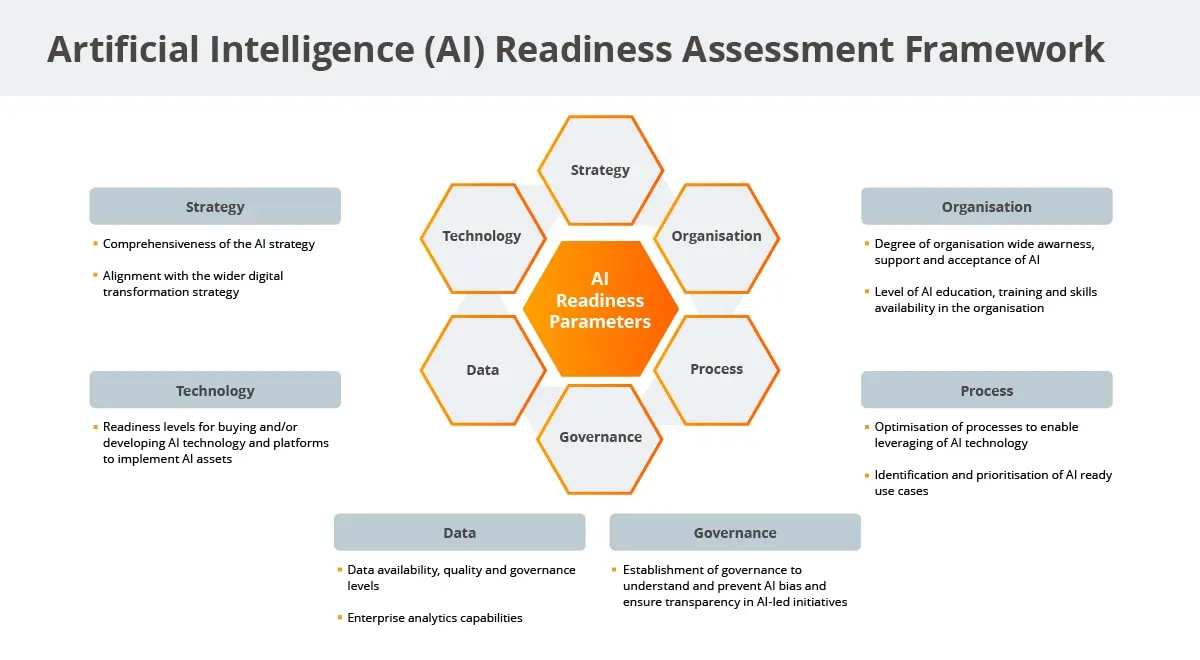
Enterprise AI readiness framework connecting data, governance, and operations (source: Glean)
Three structural realities explain why many enterprises remain unprepared:
AI depends on operational systems, not just models: AI models require continuous access to structured and reliable data. If enterprise systems are fragmented, outdated, or poorly integrated, AI outputs become unreliable. A study by Gartner found that over 85% of AI projects fail to deliver value due to issues related to data quality, governance, or integration, rather than algorithm performance (Gartner AI Strategy Report).
AI introduces decision automation: Traditional software processes data. AI systems often influence or automate decision-making, which requires governance frameworks, monitoring, and accountability. Without clear governance, AI outputs risk becoming opaque “black box” recommendations that organizations hesitate to trust.
AI changes organizational workflows: Deploying AI frequently reshapes how teams work. Sales forecasting models alter revenue planning. Fraud detection models modify risk management processes. Predictive maintenance transforms operations. These changes require process redesign and internal capability development, not simply installing new tools.
Because of these dependencies, AI adoption readiness is fundamentally about whether the organization itself is prepared to support AI-driven operations.
Enterprise AI Readiness: Data Infrastructure Is Still the Weakest Link
Among all components of enterprise AI readiness, data infrastructure remains the most common point of failure. Artificial intelligence requires large volumes of structured, reliable, and accessible data. Yet many companies still operate with fragmented data ecosystems built for reporting rather than machine learning. According to a global survey by Deloitte, 55% of organizations cite data management and integration as the biggest obstacle to scaling AI initiatives (Deloitte State of AI in the Enterprise, 2023).
Several structural problems typically appear in enterprises attempting AI deployment.
Fragmented data architecture: Business data is often distributed across multiple systems: CRM platforms, ERP databases, internal applications, and external APIs. Without a unified architecture, AI models struggle to access consistent datasets for training and inference.
Low data quality and labeling: Machine learning models depend heavily on labeled datasets and consistent formats. In many enterprises, historical data was never designed for AI training. As a result, large portions of AI project timelines are spent on data cleaning, structuring, and annotation, rather than model development. Research from MIT Sloan Management Review estimates that data preparation consumes roughly 80% of the time spent on AI projects (MIT Sloan AI and Data Strategy Study).
Limited real-time data pipelines: Many enterprise systems operate on batch-based data processing. AI applications such as fraud detection, logistics optimization, or predictive maintenance require real-time or near-real-time data streams. Without modern data pipelines, AI models cannot deliver operational value.
These data limitations explain why strong enterprise AI readiness begins not with model development, but with data architecture modernization.
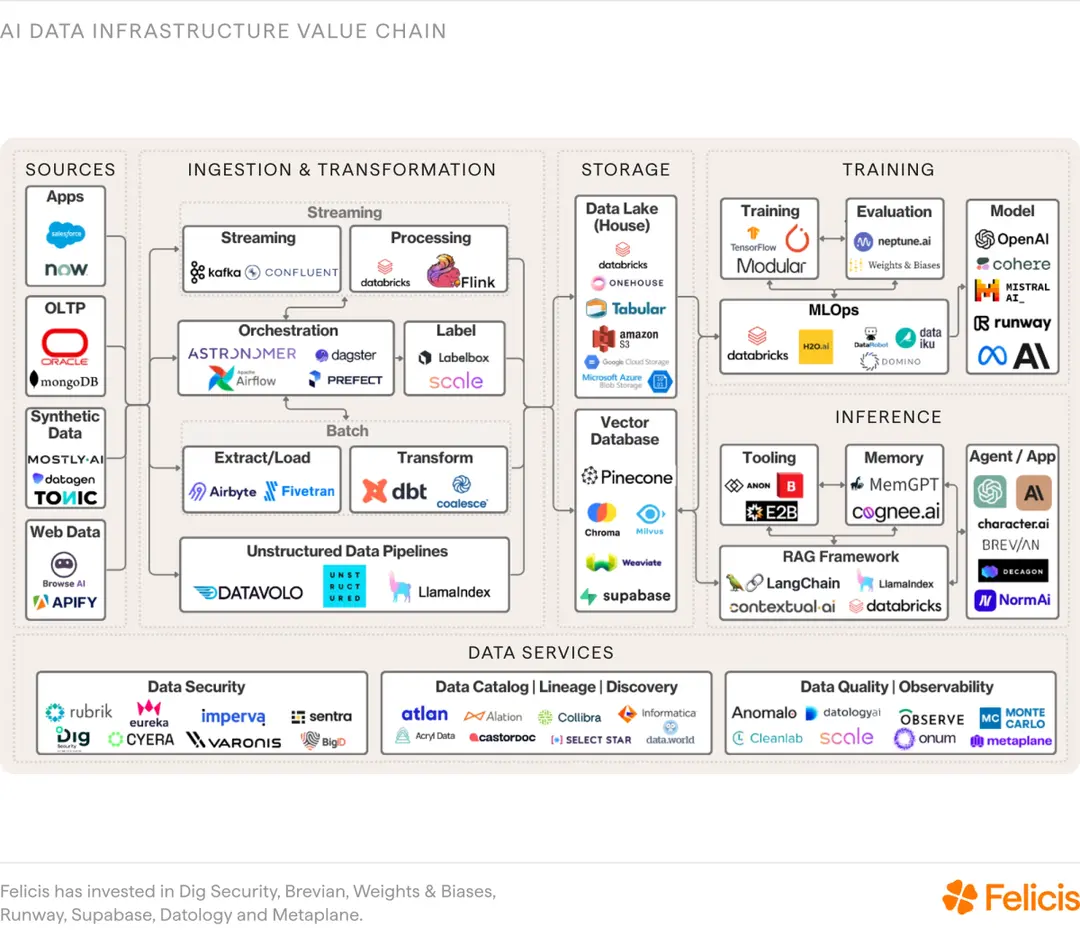
Enterprise AI data infrastructure pipeline architecture (source: Felicis)
AI Transformation Challenges Often Come From Organizational Capability Gaps
Beyond infrastructure, one of the most underestimated barriers to AI adoption readiness is the internal capability gap within organizations. AI initiatives often require collaboration between several teams that traditionally operate independently: engineering, data science, product management, operations, and business leadership.
When these functions are not aligned, AI projects struggle to move beyond pilot stages. A report by PwC found that more than 60% of enterprises face talent shortages when scaling AI initiatives, particularly in areas such as machine learning engineering, data architecture, and AI governance (PwC AI Talent Report). Three capability gaps commonly appear.
Limited cross-functional coordination: AI projects require continuous collaboration between technical and non-technical teams. Without clear ownership structures, initiatives remain experimental rather than operational.
Insufficient AI literacy in leadership: Executives often support AI conceptually but lack the technical understanding needed to guide implementation decisions. This leads to either overambitious expectations or overly cautious adoption.
Lack of operational AI teams: Successful AI deployment requires specialized roles beyond data scientists, including:
ML engineers responsible for production pipelines
Data engineers managing infrastructure
AI product managers coordinating business integration
Without these capabilities, organizations cannot maintain AI systems after initial deployment. The result is a cycle where companies launch AI pilots but struggle to transition them into production systems.
Why AI Governance Is Now a Core Pillar of AI Adoption Readiness
As enterprises move from AI experimentation to operational deployment, AI governance has become a key factor in AI adoption readiness. Early AI initiatives often focused on model performance. But once AI systems start influencing business decisions, organizations must ensure these systems operate under clear accountability and risk management structures. Without governance frameworks, AI initiatives can introduce risks related to transparency, compliance, and operational reliability. For this reason, governance is increasingly viewed not as a compliance layer added later, but as a foundation for scaling AI responsibly.
Research from Stanford Institute for Human-Centered Artificial Intelligence shows that organizations implementing formal AI governance practices are significantly more successful at deploying AI across multiple departments. Several governance challenges typically appear when enterprises attempt to scale AI:
Model transparency and explainability: Many AI models operate as complex statistical systems rather than rule-based logic. In regulated industries such as finance or healthcare, lack of explainability can limit deployment.
Continuous monitoring and model drift: AI models can degrade as data patterns change. Governance frameworks therefore require monitoring systems to detect performance drift and trigger retraining when necessary.
Data security and privacy risks: AI systems rely on enterprise data pipelines that may contain sensitive information. Governance policies must define strict protocols for data access, storage, and usage.
Human oversight in automated decisions: AI outputs that influence important business decisions often require defined human review processes to reduce risk and bias.
Regulatory developments further reinforce this need. The EU AI Act introduces risk-based rules requiring transparency and accountability for high-risk AI systems. These developments highlight a broader reality: AI governance is becoming a structural requirement for strong AI adoption readiness. Organizations that design governance frameworks early are far more likely to scale AI safely and effectively across their operations.
Conclusion
Artificial intelligence is advancing rapidly, yet many enterprises still struggle to convert AI ambition into real operational value. The underlying issue is rarely the model or the technology itself. In most cases, the gap lies in AI adoption readiness: fragmented data ecosystems, unclear operational workflows, and the absence of governance frameworks capable of supporting AI-driven decisions.
Organizations that succeed with AI typically start by strengthening the foundations of enterprise AI readiness. This means evaluating data maturity, aligning internal processes with AI-driven workflows, and establishing governance structures that ensure transparency, monitoring, and accountability. Without these elements, even well-funded AI initiatives often remain limited to pilots rather than scalable business systems.
For companies navigating these AI transformation challenges, external expertise can significantly accelerate progress. Twendee works with enterprises to assess AI adoption readiness across data infrastructure, system architecture, governance frameworks, and internal capabilities. Based on this assessment, Twendee helps organizations design practical AI roadmaps, identify high-impact use cases, and build the technical foundations needed to deploy AI reliably in production environments.
From data pipeline architecture and AI system integration to governance design and scalable deployment, Twendee focuses on turning AI strategy into operational systems that actually work inside real enterprises. For organizations preparing the next stage of their AI journey, strengthening AI adoption readiness is not just a technical step, it is the foundation for sustainable AI transformation.
Read latest blog: Do Web3 Developers Over-Optimize for Decentralization Too Early?
