

Growth does not only add employees, customers, and revenue. It also adds handoffs, approval layers, specialized teams, systems, and exceptions. A process that once moved through a few familiar people can quickly become distributed across an entire organization.
This is where business process ownership begins to weaken. Every team may complete its assigned tasks, yet no one remains accountable for the end-to-end result. The process still appears to operate, but delays, repeated escalations, and inconsistent decisions gradually become part of normal business operations.
Process Ownership Often Breaks Before Leaders Notice
Process ownership often begins to break long before leaders recognize it as an organizational problem. The workflow may still appear functional: tasks are completed, approvals continue moving, and teams remain busy. Beneath that activity, however, ownership is gradually being fragmented across departments, systems, and management layers.
No single failure may be serious enough to attract immediate attention. Instead, the process becomes increasingly dependent on:
Informal follow-ups
Individual experience
Personal relationships
Managers stepping in whenever work becomes stuck
These workarounds create the impression that operations remain under control, even as reliability becomes harder to maintain.
In a smaller organization, ownership is rarely documented because it is usually understood. A sales manager knows who can approve a commercial exception. An operations lead knows who should resolve a delayed order. When something falls outside the normal process, the issue can often be settled through a direct conversation.
As the organization expands, that informal model stops working. Functions become more specialized, management layers increase, and workflows pass through more teams, systems, and locations. A customer onboarding process may involve sales, finance, legal, compliance, operations, customer success, and IT. Each function can complete its assigned step without being accountable for whether the customer is successfully onboarded.
This creates an important distinction:
Task Responsibility | Process Ownership |
Who performs the activity? | Who is accountable for the end-to-end outcome? |
Focuses on execution | Focuses on performance |
Usually defined clearly | Often left unclear |
The problem becomes more serious because organizational structures are normally vertical, while business processes are horizontal. Employees report to functional managers, receive departmental targets, and work through function-specific systems. Yet processes such as order-to-cash, procurement, customer onboarding, incident resolution, and product delivery move across those boundaries.
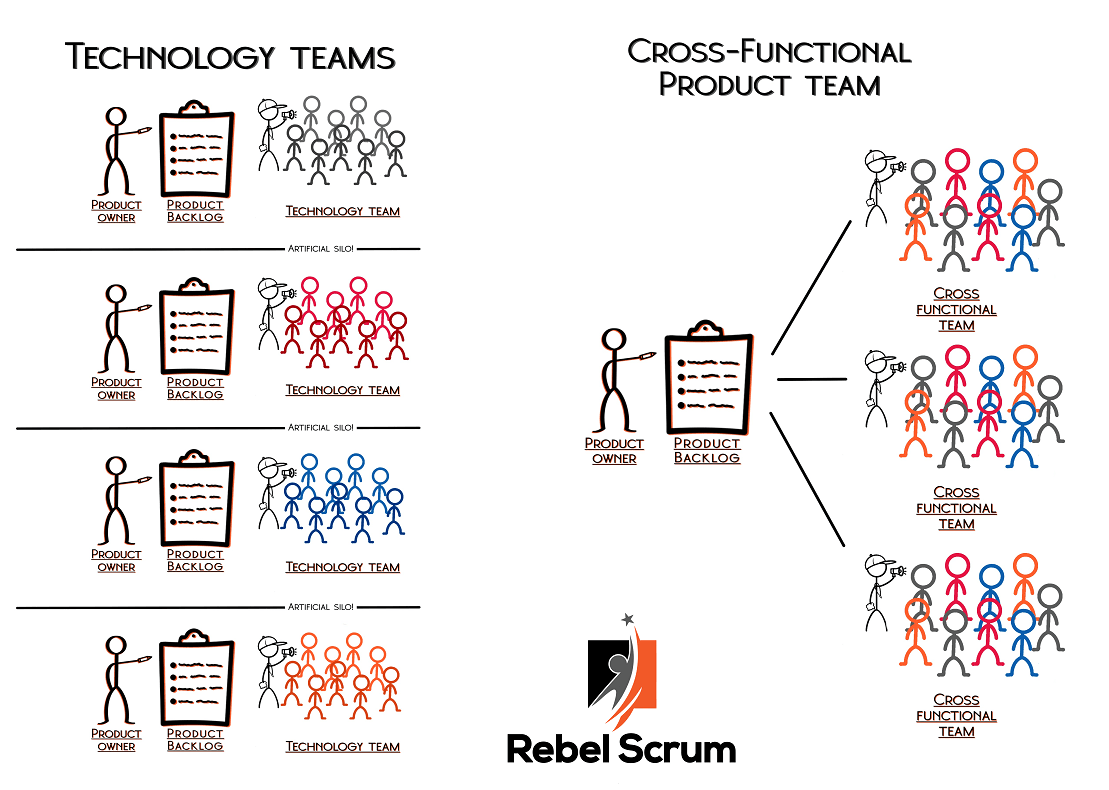
Comparison of siloed technology teams with separate owners and backlogs versus a cross-functional product team operating through one owner, one backlog, and fewer workflow handoffs. (Source: Rebel Scrum)
Research published by Harvard Business Review found that 75% of cross-functional teams were dysfunctional. The analysis linked failure to weaknesses such as unclear governance, limited accountability, and poorly defined goals. The issue is not cross-functional work itself. The problem emerges when horizontal workflows expand faster than the ownership structures supporting them.
At first, employees compensate through meetings, messages, spreadsheets, and manual follow-ups. The process keeps moving because experienced people know whom to contact and which rules can be interpreted. But this resilience is often personal rather than systemic. When those employees leave, workloads increase, or the process expands into a new market, the hidden gaps become visible.
Leaders may only recognize the problem when service-level agreements begin slipping, customers receive inconsistent answers, or senior managers are repeatedly asked to resolve routine operational issues. By that point, ownership has not suddenly disappeared. It has been weakening gradually as scale added more handoffs without adding clear end-to-end accountability.
Why Ownership Breaks Across Teams and Workflows
Ownership often breaks because functional authority is mistaken for process authority. A department head may control the people, budget, and resources within a function without having the authority to change an end-to-end workflow involving several other departments.
This creates local optimization. Finance may add controls to reduce financial risk. Legal may introduce additional reviews to improve compliance. Operations may prioritize resource utilization. Each decision can be reasonable within one function while making the overall process slower, more expensive, or more difficult for customers.
Decision rights also become unclear as organizations grow. Decisions that were once made by one experienced leader become distributed among managers, committees, specialists, and approval groups. Yet the organization may never clearly define which decisions should be delegated, which require consultation, and which need senior approval. When everyone owns part of the process, nobody owns the outcome.
The failure of Target's Canadian expansion highlights how operational complexity can outgrow ownership structures. During its rapid rollout, Target had to coordinate buyers, suppliers, warehouses, logistics providers, store teams, and newly implemented systems. According to Reuters, inventory data mismatches caused products to accumulate in distribution centers while store shelves remained empty.
The failure had multiple causes, but it demonstrates a common scaling challenge: many teams contributed to the process, yet no single authority maintained complete visibility and accountability across inventory data, exceptions, and operational execution. As workflows become more complex, organizations need clear end-to-end ownership to prevent local decisions from creating systemic failures.
The Hidden Cost of Unclear Process Ownership
Many operational delays that appear to be workflow problems are, at their core, ownership problems. A process rarely slows down only because an employee takes too long to complete a task. More often, work remains idle because no one has the authority to make the next decision, resolve an exception, challenge an unnecessary approval, or accept responsibility for the final outcome.
This distinction matters because workflow tools can show where work is delayed without explaining why the delay continues. A dashboard may reveal that a request has remained under review for five days, but it cannot determine who should intervene or who is accountable for preventing the same delay from happening again. A dashboard can expose a delay but only ownership can remove its cause.
Firstly, unclear ownership slows decision-making. When accountability is ambiguous, employees naturally become more cautious. Instead of acting, they seek additional approval, involve more stakeholders, or escalate issues upward. The process continues moving, but progress becomes dependent on coordination rather than authority. What appears to be a workflow delay is often a decision delay caused by unclear ownership.
Secondly, it creates hidden coordination costs. Without a clearly accountable owner, organizations compensate through status meetings, follow-up messages, approval checkpoints, and manual reporting. These activities help keep work moving, but they consume operational capacity that could otherwise be spent on execution and improvement.
According to Asana's Anatomy of Work research, knowledge workers spend 60% of their time on "work about work," including communicating about tasks, searching for information, switching between applications, and chasing updates. While not all of this can be attributed to ownership issues, the findings illustrate how quickly coordination can become a hidden operational cost when responsibilities and next actions are unclear.
Thirdly, it increases process variability. When ownership is weak, outcomes often depend on individual experience rather than the operating model itself. One request moves quickly because an experienced employee knows whom to contact. Another request remains stuck because someone else follows the documented workflow exactly as written.
Over time, performance becomes dependent on relationships, tribal knowledge, and managerial intervention rather than repeatable processes. Customers may receive different outcomes for similar requests, and managers find themselves repeatedly resolving issues that should have been handled within the workflow.
Finally, it weakens organizational accountability. Gallup reported that only 46% of employees clearly know what is expected of them at work. When role clarity declines, accountability becomes increasingly difficult to maintain across teams. Employees may complete their assigned tasks, yet no one feels responsible for the overall business outcome.
This creates a dangerous situation where every activity appears to have an owner, but the process itself does not.
The visible result is longer cycle times, more escalations, and slower execution. The less visible impact is often more significant: duplicated effort, management distraction, inconsistent customer experiences, and growing operational complexity.
For leaders, the challenge is not simply to identify where work is delayed. It is to determine whether someone has both the authority and accountability to improve the process as a whole. When ownership remains unclear, organizations often respond with more controls, more reports, and more meetings. Yet these interventions add activity without necessarily improving outcomes.
Strong process ownership changes that dynamic. It shifts attention from managing individual tasks to managing the performance of the entire workflow, making operational improvement both measurable and sustainable.
What Scalable Process Ownership Looks Like
Scalable ownership does not mean assigning every activity to one person. It means establishing a governance model in which one role remains accountable for the end-to-end process while multiple teams remain responsible for execution.
A process owner should understand the complete journey from the initial trigger to the final business outcome. The owner needs sufficient authority to define performance standards, review process data, coordinate changes, resolve cross-functional conflicts, and determine how recurring exceptions should be managed.
This role operates alongside functional management rather than replacing it. Functional leaders remain responsible for people, skills, resources, and departmental performance. The process owner remains accountable for how effectively the workflow operates across those functions.
APQC’s guidance on business process ownership emphasizes that process owners should understand process performance, create organizational buy-in, and establish accountability. Cross-functional steering groups can provide additional oversight, but the final accountability for process performance should remain identifiable.
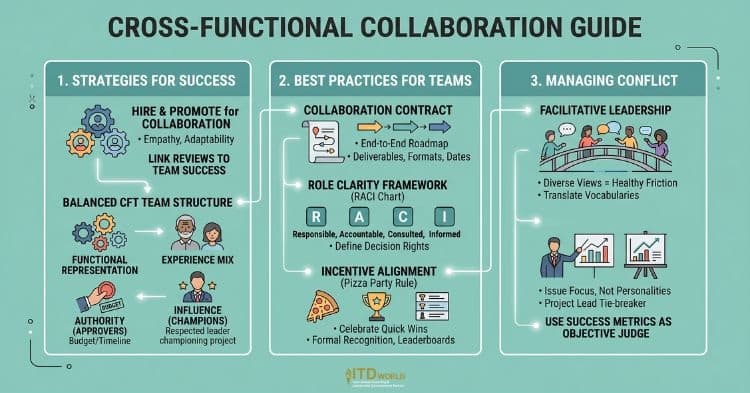
Cross-functional process ownership framework defining role clarity, decision rights, end-to-end roadmaps, functional representation, and shared performance metrics across business teams. (Source: ITD World)
The process boundary must also be explicit. The organization should define where the process begins, what outcome marks its completion, which metrics determine success, and which teams contribute along the way. Decision thresholds, service levels, exception routes, and change approval procedures should be visible rather than dependent on personal knowledge.
Scalable process governance therefore combines centralized accountability with distributed execution. Teams should have enough authority to handle routine cases, while unusual or high-risk cases follow predetermined escalation paths.
Most importantly, the process owner should be measured against end-to-end outcomes such as total cycle time, customer impact, exception volume, rework, bottlenecks, and management intervention—not simply whether individual tasks were completed.
Building Operational Systems Around Ownership
Ownership becomes scalable only when it is embedded in the systems through which work is performed. A policy document may identify the process owner, but employees need that ownership to remain visible throughout daily operations.
Every workflow instance should clearly display its current owner, responsible team, required approver, deadline, status, and next action. Routine cases should follow rule-based routing, while exceptions should be escalated according to risk, value, urgency, or elapsed time.
The 2012 Knight Capital incident illustrates what can happen when operational ownership is unclear. According to the U.S. Securities and Exchange Commission (SEC), a faulty software deployment triggered unintended trading activity, resulting in losses of more than $460 million within 45 minutes.
While the incident involved technology, the underlying issue extended beyond software. The SEC found weaknesses in deployment controls, testing procedures, monitoring, and escalation processes. No single operational authority had sufficient visibility and accountability across the entire workflow—from deployment and risk monitoring to incident response and shutdown decisions.
The lesson is clear: automation can accelerate execution, but it cannot replace ownership. When critical workflows lack clear accountability, small failures can escalate into major operational and financial consequences.
A scalable operational system must therefore do more than route tasks. It should show where work is waiting, expose repeated reassignments, preserve decision histories, assign exception ownership, and trigger escalation before a delay or control failure becomes a larger business problem.
Integration is equally important. When process information is divided among email, spreadsheets, messaging tools, CRM platforms, ERP systems, and departmental applications, the process owner cannot see the complete flow. A connected system creates a shared operational record and makes accountability visible across team boundaries.
This shared operational foundation is also becoming increasingly important for AI adoption. As explored in ERP Systems Are Becoming the Starting Point for AI Adoption, ERP systems bring together structured business data, workflow context, permissions, and decision rules—giving AI the operational context it needs to support or automate business processes responsibly.
This is where Twendee can support organizations beyond conventional software implementation. Twendee works with businesses to map operational workflows, clarify ownership and approval logic, and build custom software, automation workflows, ERP systems, and digital operations platforms around real business processes.
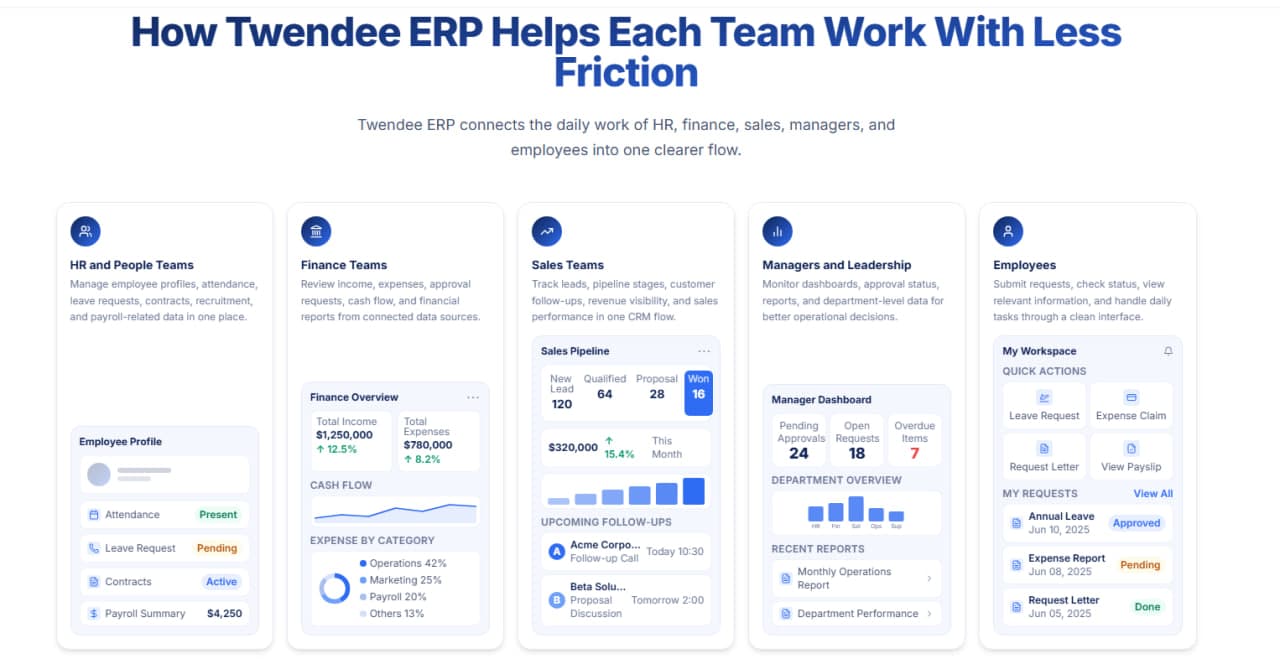
Twendee ERP connects HR, finance, sales, managers, and employees through shared workflows, approval visibility, operational dashboards, and centralized business data. (Source: Twendee)
The objective is not simply to digitize an existing sequence of tasks. It is to translate business process management and governance principles into operational systems with clear responsibilities, decision rights, escalation paths, and performance visibility.
Conclusion
As organizations grow, process complexity often increases faster than accountability. New teams, systems, and approval layers create more handoffs and decision points, making workflows harder to manage without clear end-to-end ownership.
Many companies respond by adding more controls, reports, meetings, or software. However, operational friction is often an ownership problem rather than a technology problem. When no one is accountable for the performance of the entire workflow, delays, escalations, and inconsistent outcomes become difficult to eliminate.
Strong process ownership provides the foundation for scalable operations. It creates accountability, improves decision-making, and helps organizations maintain control as complexity grows. As businesses invest in automation, ERP, and AI, clear ownership becomes even more critical because technology can accelerate work, but only governance and accountability can ensure it moves in the right direction.
Twendee helps organizations build operational systems with clear process ownership, approval workflows, escalation paths, and operational visibility. By aligning technology with real business processes, companies can improve accountability, reduce operational friction, and scale cross-functional workflows more effectively.
To learn how Twendee can support stronger process governance and workflow management, visit the Twendee website, follow Twendee on LinkedIn, or book a conversation through Twendee’s Calendly.
