

A production delay rarely begins at the moment a line stops. By then, the problem has already moved through inventory, maintenance, scheduling, approvals, and team handoffs. This is why manufacturing operations visibility matters. Without it, factories often detect delays only after the cost has already started to build. In manufacturing, the visible delay is usually the final symptom. The real issue starts much earlier.
Production Delays Are Often Operational, Not Just Technical
When a factory misses a production target, the first assumption is often that something happened on the shop floor. A machine stopped. A worker was unavailable. The material was late. A quality issue appeared. Those things matter, but they are rarely isolated events.
A machine breakdown may have started as a maintenance signal that was not escalated in time. A material shortage may have started as an inventory mismatch between procurement and warehouse data. A late production batch may have started with an unclear approval, a manual handoff, or a schedule update that did not reach the right team quickly enough.
That is why production delays are hard to manage with disconnected tools. Each team sees one part of the problem, but no one sees the full operational chain early enough.
Recent data makes this risk clearer. In a 2025 Fluke survey of more than 600 senior decision-makers and maintenance professionals in the US, UK, and Germany, 55% of US manufacturers said they had been hit by unplanned downtime in the past year. Nearly half of affected US respondents reported 6 to 10 downtime incidents each week. For manufacturers, downtime is no longer a rare disruption. It is becoming a recurring operational pattern. The problem is not only that factories experience delays. The bigger problem is that many factories still detect them too late.
Why Visibility Matters More Than More Reporting
Many manufacturers already have reports. The issue is that reporting often happens after the delay has already affected production. A weekly report can explain why output dropped. A monthly dashboard can show that downtime increased. A supervisor note can describe what happened during a shift. But none of these gives the business enough time to act before the delay reaches the production line.
Manufacturing operations visibility is different from reporting. Reporting looks backward. Visibility connects the current state of production, inventory, maintenance, quality, and workflow ownership in one operational view.
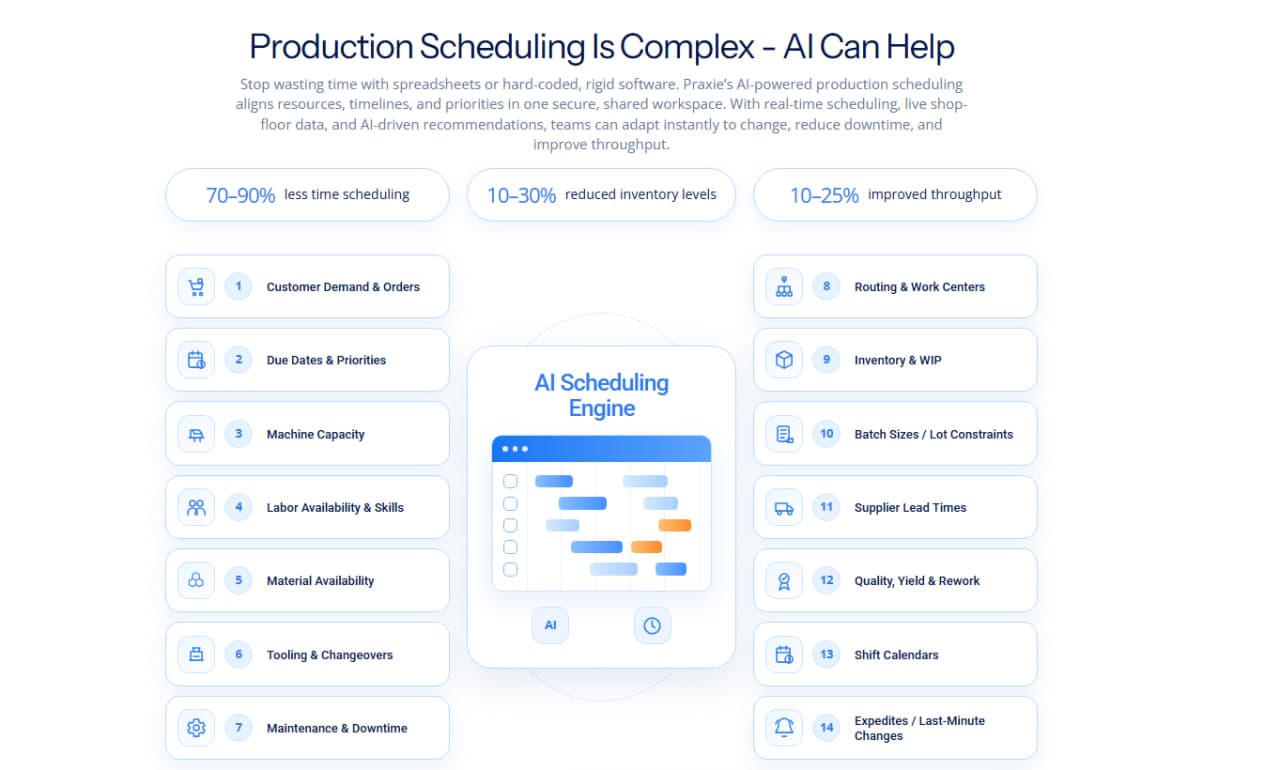
Manufacturing scheduling visibility factors (source: praxie)
That difference matters because downtime is expensive. Fluke’s 2025 findings show that the average cost of a downtime incident for US manufacturers can reach $400,000 per hour. In larger or more complex operations, the impact can rise much higher.
The same pattern appears beyond manufacturing. Splunk’s 2026 research found that downtime costs Global 2000 companies $600 billion annually, up 50% in two years. While this data covers broader enterprise downtime, the lesson is relevant for manufacturing leaders: disruption becomes more costly when systems are complex, teams lack shared context, and issues are detected late.
For factories, the goal is not to create more dashboards. The goal is to reduce the time between an early warning signal and the right operational action.
Where Manufacturing Workflow Systems Usually Break Down
Production visibility often fails at the handoff points.
A handoff happens when one team depends on another team before work can continue. These handoffs are common in manufacturing:
Production depends on warehouse confirmation before a batch begins.
Maintenance depends on operations to release equipment for inspection.
Procurement depends on approval before ordering replacement parts.
Quality depends on production data before clearing finished goods.
Management depends on accurate updates before making schedule decisions.
When these handoffs are managed manually, delay risk increases. A task can be waiting for one person. A message can be missed. A spreadsheet can be outdated. A team may assume another team has already completed its part.
This is why factory operations management cannot rely only on individual effort. Even strong teams struggle when the system does not clearly show status, ownership, priority, and dependencies.
Deloitte’s 2025 Smart Manufacturing and Operations Survey found that 92% of surveyed manufacturers believe smart manufacturing will be the main driver of competitiveness over the next three years. The same survey reported average improvements of 10% to 20% in production output from smart manufacturing initiatives.
Those gains are not only about automation. They come from giving teams better visibility into what is happening across the operation and helping them act faster.
Production Visibility Should Connect Data, Workflow, and Ownership
A factory does not need visibility for the sake of visibility. It needs visibility so teams can make better decisions earlier. That requires three things working together.
First, data needs to be connected. Production, inventory, maintenance, quality, and purchasing data should not live in separate places with different versions of the truth. When one team sees a material as available and another team sees it as pending, the system is already creating delay risk.
Second, workflows need to be clear. If a maintenance issue affects production capacity, the next step should not depend on someone remembering who to call. The system should show what needs to happen, who owns it, and how urgent it is.
Third, visibility needs to be actionable. A dashboard that shows a problem but does not connect to the next action still leaves teams chasing updates manually. The best manufacturing workflow systems help teams move from signal to decision to action faster.
This is especially important as manufacturers invest more in digital transformation. Rockwell Automation’s 2026 State of Smart Manufacturing Report highlights that 59% of manufacturers are already using smart manufacturing, while 90% say digital transformation is needed to stay competitive. As more operations become digital, the real advantage will come from how well those systems are connected inside daily workflows.
How Twendee Helps Manufacturers See Problems Earlier
For many manufacturers, the challenge is not a lack of tools. It is the lack of one connected operational view. Twendee helps businesses build operational monitoring systems that connect production, inventory, maintenance, approvals, and workflow data into a unified platform. Instead of forcing teams to check multiple files, systems, and message threads, Twendee focuses on making operational status easier to see and easier to act on.
In a manufacturing context, this can support:
Real-time visibility into production status, inventory readiness, and maintenance risks.
Clear ownership for approvals, handoffs, and issue resolution.
Unified workflow tracking across production, warehouse, maintenance, quality, and management teams.
Better reporting that reflects live operational reality, not outdated manual updates.
This is also where ERP and AI-enabled operations become practical. AI can only support manufacturing decisions when the underlying workflow, data, permissions, and ownership are clear. If production data is scattered, maintenance signals are isolated, and inventory updates are inconsistent, AI will only surface fragmented answers. Twendee’s role is to help manufacturers build that foundation first: connected systems, clearer workflows, and stronger operational visibility. If your team is looking to improve production visibility and reduce operational delays, book a consultation with Twendee to explore how a connected workflow system can support your factory operations.
Conclusion
Production delays usually start long before the factory notices. They begin in small operational gaps: unclear handoffs, disconnected data, delayed approvals, missing inventory signals, or maintenance warnings that do not reach production planning in time.
For manufacturers, better visibility is no longer just an operational improvement. It is a way to protect output, reduce downtime, and make daily decisions faster.
Twendee helps manufacturing teams build connected operational monitoring systems that bring production, inventory, maintenance, and workflow data into one clearer view.
To explore how Twendee helps businesses build integrated operational platforms and reduce software fragmentation, visit Twendee Software or connect with the team on LinkedIn.
Read latest blog: Automation Breaks When Workflows Are Poorly Defined
