

Software fragmentation rarely looks like a major business problem at first. It starts with one CRM, one project tool, one finance platform, one spreadsheet, and one “temporary” workaround. But over time, the stack grows faster than the workflow behind it, leaving teams with scattered data, duplicated work, and decisions that move slower than the business needs.
How software fragmentation turns useful tools into operational drag
Most enterprise software stacks do not become fragmented because teams make poor decisions. They become fragmented because each department solves its own immediate problem. Sales needs a CRM to manage leads. Finance needs accounting software to track payments. HR needs a platform for leave requests and employee records. Operations needs tools for task tracking, delivery status, inventory, or approval flows. Each tool may be useful inside its own department, but the problem begins when these systems are not connected to the wider business process.
This is why software fragmentation is often underestimated. It does not announce itself as a failed system. It appears as small, repeated inefficiencies: an employee copying customer data from one tool into another, a manager asking for manual updates because the dashboard is incomplete, a finance team reconciling numbers from different sources, or an operations team using spreadsheets because the main system does not reflect the real workflow.
The scale of this problem is already visible. According to BetterCloud’s 2025 State of SaaS Report, organizations use an average of 106 SaaS tools, only slightly down from 112 the previous year. Productiv also reported that the average SaaS portfolio decreased from 374 apps to 342 apps, showing that companies are trying to consolidate, but enterprise software stacks remain extremely large and complex.
The point is not that every company should use fewer tools. In many cases, specialized platforms are necessary. The real issue is that too many tools are added without a clear operating architecture. When systems do not share data, process logic, or ownership, employees become the invisible connectors between platforms.
That is where productivity starts to leak. A sales update may need to be checked again by finance. A delivery status may be stored in one spreadsheet but discussed in another chat group. A purchase request may require email approval because the internal tool does not reflect the actual approval chain. The company may appear digitally mature because it has many software platforms, but the daily workflow still depends heavily on manual coordination.
This creates a hidden productivity cost that is much larger than software licensing. Teams lose time switching between systems, validating information, clarifying ownership, and rebuilding reports. More importantly, leaders lose confidence in whether the data they see reflects what is actually happening inside the business. At this stage, software is no longer just supporting operations. It is quietly shaping how slowly or clearly the company can operate.
Why software fragmentation makes automation and AI harder to scale
The deeper risk of software fragmentation is not only operational inefficiency. It also weakens the foundation for automation and AI adoption. Automation works best when workflows are structured, repeatable, and clearly owned. A trigger should lead to a defined next step. A request should move through a known approval path. A data field should have one reliable source. But in a fragmented software environment, the process is often split across tools, spreadsheets, chat messages, and manual judgment.
That makes automation fragile. For example, a company may want to automate invoice approval. On paper, this sounds simple. In reality, the required information may sit across procurement software, accounting tools, email threads, and department-level spreadsheets. If supplier data, budget ownership, approval limits, and payment status are not connected, automation cannot confidently move the workflow forward. It either stops too often for human checking or creates new risks by acting on incomplete information.
The same logic applies to AI agents. AI systems are only as useful as the operational context they can access and act upon. If customer records, transaction histories, task ownership, and approval rules are scattered across disconnected business systems, AI cannot reliably understand what action should be taken, who should approve it, or which data should be trusted.
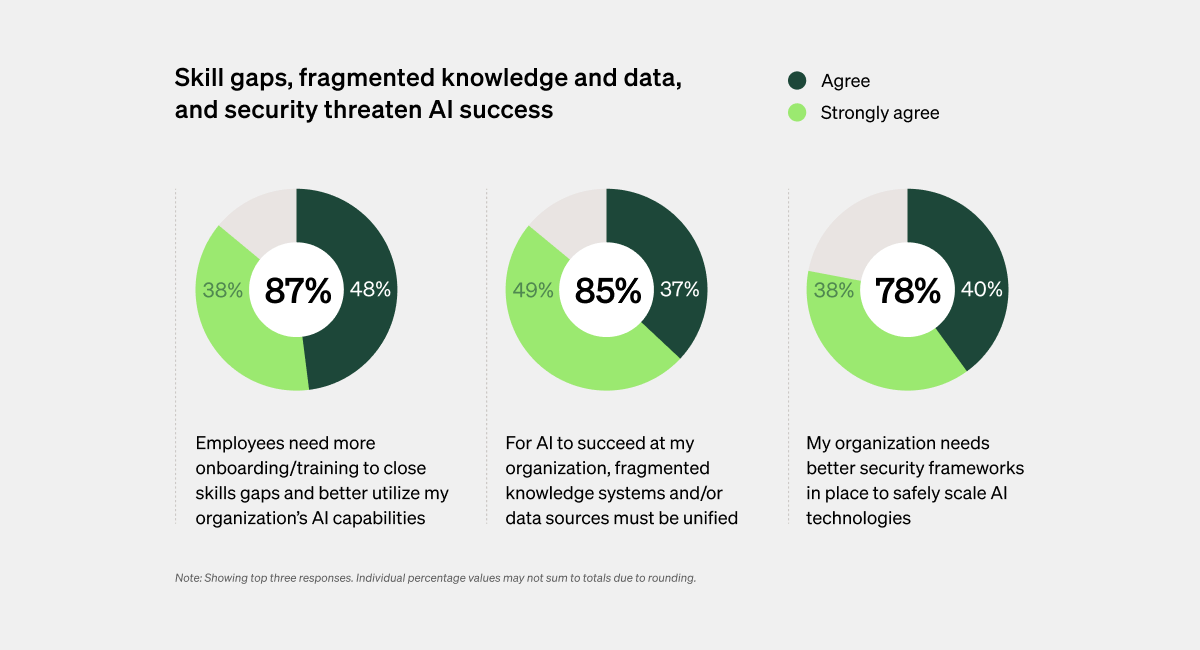
Fragmented data limits AI adoption (Source: IBM Institute for Business Value)
This is why many AI initiatives struggle to move beyond experiments. Gartner’s research, cited by Reuters, predicts that more than 40% of agentic AI projects could be scrapped by the end of 2027 because of rising costs, unclear business value, and immature implementation. The issue is not simply that AI is overhyped. It is that many enterprises try to add intelligent automation on top of workflows that are not yet operationally ready.
A fragmented system creates three practical problems for AI adoption.
First, data quality becomes inconsistent. AI may retrieve outdated, duplicated, or conflicting information from different systems.
Second, permissions become harder to manage because user access is spread across multiple tools.
Third, accountability becomes unclear because the workflow itself does not define who owns the final decision.
This is where enterprise tool overload becomes a strategic blocker. A company cannot simply “add AI” to a messy system and expect reliable results. AI agents need clear workflow boundaries, structured data access, approval logic, and system-level traceability. Without that foundation, AI may increase speed in isolated tasks but fail to create real enterprise productivity.
Gartner also emphasizes the need for strong digital foundations and adaptive governance when dealing with SaaS sprawl. Its research on SaaS sprawl and enterprise architecture argues that companies should not focus only on minimizing applications, but on building governance models that allow new SaaS solutions to create value without increasing operational risk. This is an important distinction. The goal is not to remove every tool. The goal is to make tools work inside a coherent operating model.
For many enterprises, the first step toward AI readiness is not choosing an AI vendor. It is mapping where work actually happens, where data breaks, and where employees are forced to manually connect systems. Once those gaps are visible, automation becomes more practical, and AI has a cleaner foundation to support real decisions.
How integrated internal systems reduce software fragmentation at the source
Solving software fragmentation does not always mean replacing the entire software stack. In many cases, companies already have useful tools. The real challenge is that these tools were not designed around the company’s end-to-end workflow. This is why the solution should begin with workflow consolidation, not tool elimination.
A strong internal system should answer several operational questions clearly. Where does a request begin? Which data source should be trusted? Who owns each step? Which actions require approval? What should be visible to managers? What should be automated, and what still needs human judgment?
When those questions are answered at the system level, software fragmentation becomes easier to control. For example, a company may keep its CRM, accounting system, and communication tools, but build a central workflow layer that connects customer data, sales activities, invoice status, and management reporting. Another company may need a custom ERP module to replace scattered spreadsheets for internal requests, approval tracking, role-based permissions, and operational dashboards. In both cases, the goal is not simply to build another tool. The goal is to create a clearer operating structure.
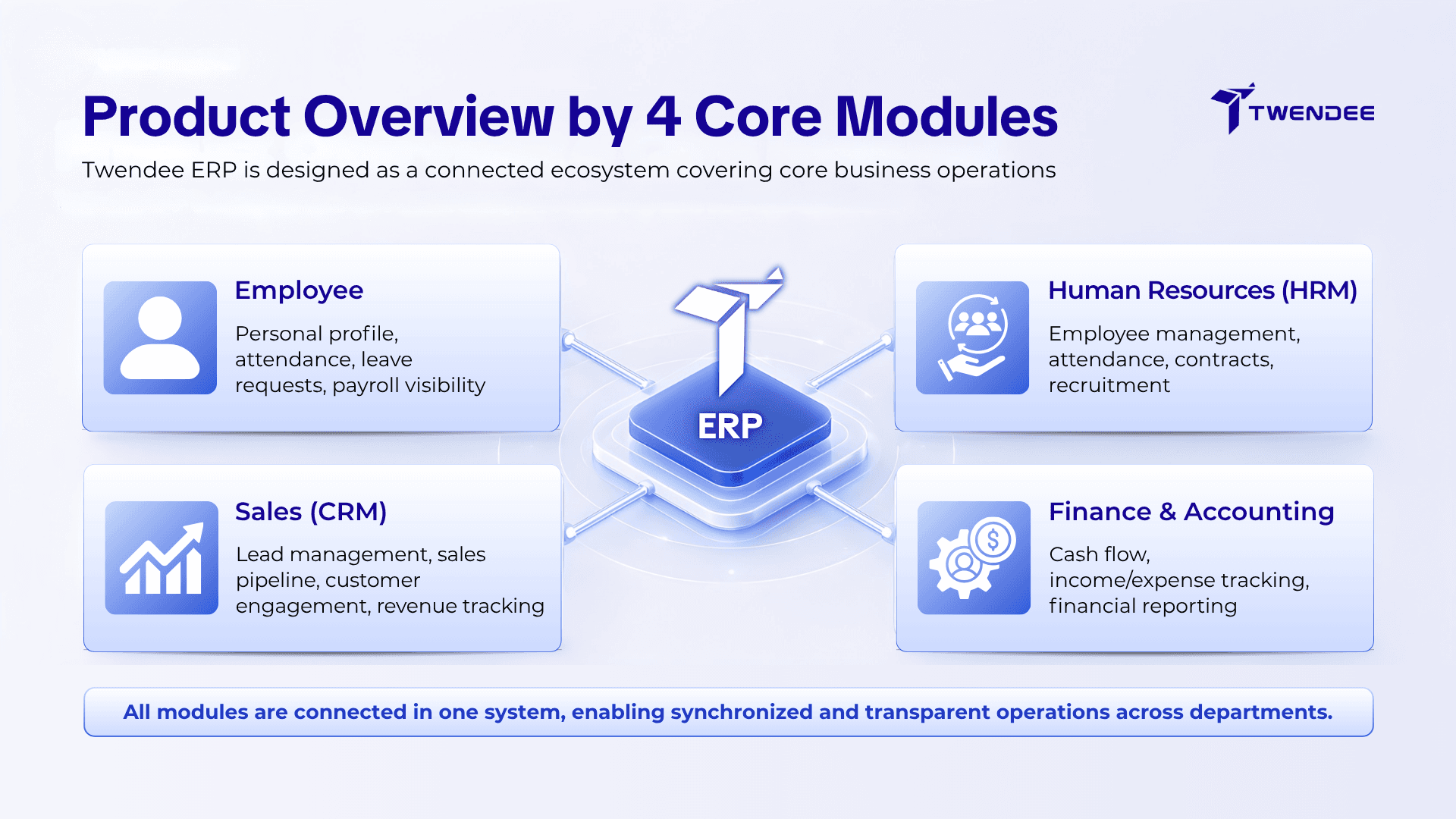
Integrated ERP modules reduce software fragmentation (Source: Twendee)
This is where Twendee’s role fits naturally. Twendee helps businesses reduce software fragmentation by designing and building integrated internal systems around how work actually moves across teams. Instead of treating each tool as a separate application, Twendee focuses on workflow logic, data flow, role permissions, approval paths, and operational visibility.
In practice, this can include custom ERP platforms, CRM and finance integrations, internal dashboards, approval portals, workflow automation systems, and AI-enabled operational tools. For companies preparing to adopt AI agents or automation, Twendee can also help structure the workflow boundaries that intelligent systems need before they can operate safely.
This matters because enterprise productivity does not improve simply by adding more software. It improves when teams can work from a shared source of truth, managers can see progress without chasing updates, and systems can move routine tasks forward without creating confusion.
A well-designed ERP or operational platform can reduce tool fragmentation in several ways:
It brings scattered data into a more reliable workflow layer.
It clarifies ownership across departments and approval stages.
It reduces duplicated manual work caused by disconnected systems.
It creates cleaner conditions for future automation and AI adoption.
The value is especially clear for companies with cross-functional operations. In logistics, one order may involve sales, warehouse, finance, delivery, and customer service. In retail, inventory visibility depends on store, supplier, warehouse, and finance data. In B2B services, project delivery may require coordination between sales, project management, billing, and leadership.
When these teams operate through disconnected tools, productivity loss becomes structural. When workflows are integrated, the company does not just save time. It gains better control over how decisions are made, how risks are tracked, and how operations scale. This is the difference between digital adoption and digital maturity. Digital adoption means the company uses many tools. Digital maturity means those tools support a coherent way of working.
Book a call: Calendly
Conclusion
Software fragmentation is easy to ignore because each tool often has a reasonable purpose. But when too many systems operate separately, enterprises face a deeper productivity problem: duplicated work, scattered data, unclear ownership, slower approvals, and weak visibility across teams.
The impact becomes even more serious as companies move toward automation and AI. Intelligent systems cannot deliver reliable value when the operational foundation is fragmented. Before AI can scale, workflows need to be connected, permissions need to be clear, and data needs to move through a trusted system.
Twendee helps businesses approach this problem from the operational layer. Through custom ERP platforms, workflow integration, internal systems, and AI-ready automation design, Twendee supports companies in reducing fragmentation at the source. The result is not just fewer tools, but clearer workflows, better visibility, and a stronger foundation for scalable digital operations.
To explore how Twendee helps businesses build integrated operational platforms and reduce software fragmentation, visit Twendee Software or connect with the team on LinkedIn.
Read latest blog: Automation Breaks When Workflows Are Poorly Defined
