

Subscription growth looks clean on a dashboard. MRR rises, customer acquisition accelerates, and the business appears healthier. Behind that growth, every new subscriber adds invoices, renewals, payment events, plan changes, and support requests. The real challenge is building the operational capacity to manage recurring relationships at scale. That is where subscription management software becomes more than a billing tool: it becomes part of the operating model behind sustainable growth.
Subscription Growth Creates a Different Kind of Operational Complexity
Recurring revenue remains attractive because it can improve predictability and deepen customer relationships. The opportunity is real. Zuora’s 2025 Subscription Economy Index found that companies in its index grew revenue 11% faster than the S&P 500 over the previous two years, while unique subscribers increased by 25%. It also found that businesses using four or more revenue models achieved faster average revenue per account growth than those relying on fewer models. More growth, in other words, often arrives with more pricing and lifecycle variation to operate.
This is the paradox many subscription businesses discover late. More customers do not merely create more invoices. They create more combinations of billing cycles, discounts, upgrades, downgrades, credits, failed payments, tax rules, and renewal conditions. As monetization becomes more flexible, the operation behind it becomes less linear.
At a smaller scale, teams absorb this complexity through experience. Finance knows which invoices need attention, while Sales and Customer Success remember commercial exceptions and renewal dates. Much of that operating knowledge lives in people rather than systems.
Growth exposes weakness. The early warning is a steady rise in correction work: more manual reviews, more cross-department questions, and more customer issues requiring several systems to resolve. Subscription growth creates operational complexity, not just more revenue.
Recurring Revenue Turns Every Customer Into an Ongoing Operating Process
A one-time sale usually has a clear end state. An order is confirmed, an invoice is issued, payment is collected, and the transaction is closed. A subscription has no equivalent finish line until the customer leaves.
Each customer remains an active process across onboarding, recurring billing, service usage, support, renewal, expansion, and possible churn. A business with 10,000 subscribers is therefore not simply processing 10,000 recurring payments. It is managing 10,000 customer journeys moving through different states at the same time.
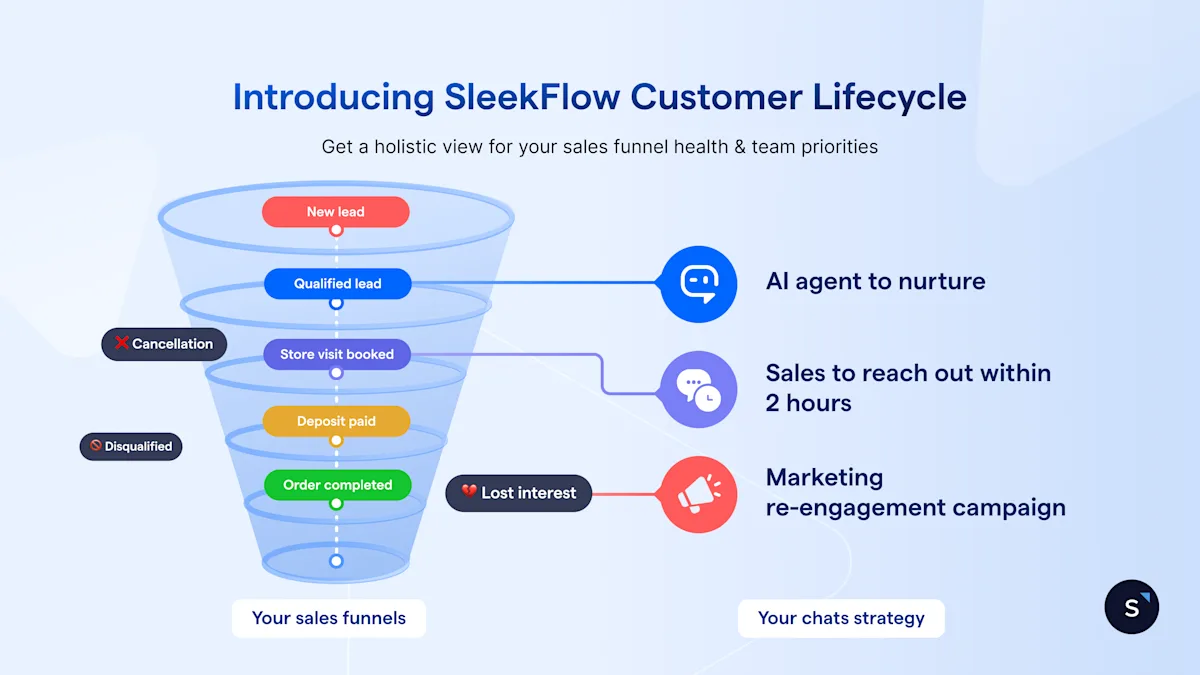
Customer lifecycle workflow from lead qualification to purchase, with automated sales and marketing follow-ups. ( Source: SleekFlow )
Even a simple plan change can affect several records and teams. The billing amount may need to be prorated. Product access may change immediately. CRM must reflect the new contract value. Finance may need a different revenue schedule, while Customer Success needs the correct renewal context.
Recurring revenue is harder to operate because continuity matters. Every interaction must preserve the correct commercial context from one billing period to the next. When that context is lost, the business pays through internal rework and a less consistent customer experience.
The Real Bottleneck Is Not Billing. It Is Disconnected Operations.
Billing is often where a subscription problem becomes visible, but it is not always where the problem begins.
Sales may keep contract terms in CRM, Finance records invoices and payments elsewhere, and Customer Success tracks adoption and renewal risk in another tool. The subscription platform processes charges but may not hold the full context behind the relationship.
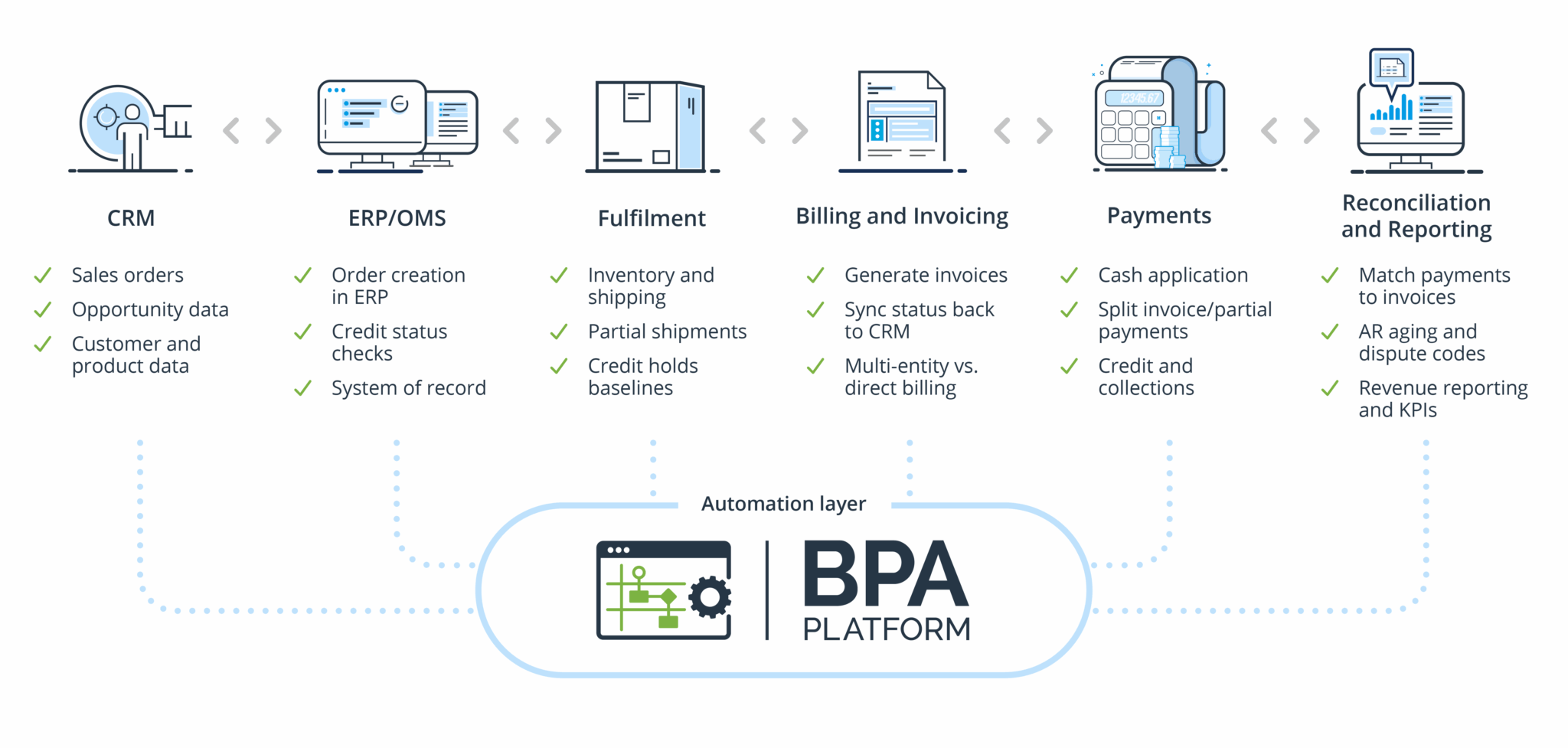
Connected workflow linking CRM, ERP, billing, payments, and financial reporting through automation. (Source: Codeless Platforms)
Individually, each system can work as intended. The bottleneck appears in the gaps between them.
MuleSoft’s 2025 Connectivity Benchmark Report surveyed 1,050 IT leaders and found that organizations used 897 applications on average, yet only 2% had integrated more than half of them. It also found that 39% of developer time was spent building custom integrations. For subscription businesses, this fragmentation is especially costly because customer data must remain consistent across repeated transactions and lifecycle events.
Consider a renewal. The invoice may be generated correctly, but the customer has already negotiated different terms with Sales. Customer Success may know the account is at risk, while Finance sees only an unpaid balance. Support may be handling an unresolved issue that makes an automated reminder poorly timed. Every team can complete its own task while the overall customer journey still fails.
This is operational fragmentation: information exists, but it does not move with the work.
Intercom’s billing transformation shows why integration matters. According to a Stripe customer case study, Intercom built a custom connection between its billing platform and Salesforce so self-service and sales-led customers could follow a more consistent subscription experience. The company delivered an MVP in five months while introducing new pricing and AI products. By July 2024, it had migrated 20% of subscription customers and 12% of revenue, while customer-facing teams gained more ability to resolve issues without escalating them to engineering.
The lesson is broader than billing architecture. Improving one system creates limited value when customer, commercial, and financial workflows remain disconnected.
Manual Coordination Becomes the Hidden Cost of Subscription Scale
Manual work can be effective at the beginning. Spreadsheets are flexible, internal messages are fast, and experienced employees can bridge missing system logic with judgment.
The problem is that manual coordination scales differently from revenue.
As subscriber volume grows, every exception can trigger a cross-functional chain: update the subscription, adjust billing, reconcile accounting, revise reporting, notify the customer, and refresh CRM. If each step depends on a person noticing the change and passing it forward, operating costs rise with both customer count and lifecycle complexity.
This hidden cost rarely appears as one large budget line. It is distributed across longer month-end closes, delayed renewals, engineering interruptions, support queues, and additional headcount added to manage exceptions. The business may still be growing, but more of that growth is being consumed by the effort required to keep systems aligned.
Invideo offers a useful example. Stripe reports that the company’s revenue more than tripled in 2024, putting pressure on its billing and payment systems. After migrating its billing operation, Invideo improved failed-renewal recovery from 23% to 30%, added more than $1 million in revenue through payment optimizations, and achieved a 4% year-over-year revenue uplift across its Singapore and US entities. Rapid growth had exposed an operating constraint, and reducing it translated directly into financial value.
Adding people can increase processing capacity for a time. It does not remove the dependency on manual handoffs. Sustainable scale requires the workflow itself to carry information forward.
Subscription Management Must Become the Operating System Behind Recurring Growth
A modern SaaS subscription platform can no longer be judged only by whether it charges the correct amount on the correct date. It must help the business maintain one coherent operating state across the customer lifecycle.
That means connecting subscription events with the systems that need to act on them. A successful payment should update finance and customer records. A failed renewal should trigger the right recovery workflow. A plan change should flow into CRM, accounting, reporting, and product access without requiring the same information to be entered repeatedly.
Automation matters because it reduces repetitive work, but its larger value is coordination. It gives the business a reliable way to move data, ownership, and decisions across recurring processes. Teams can still intervene when judgment is required, while routine events progress without being reconstructed manually each time.
This is also how Twendee approaches subscription platform development. Rather than treating billing as an isolated feature, Twendee helps businesses build connected operational systems that integrate subscription data with finance, CRM, reporting, and workflow automation. The objective is to ensure existing tools participate in one consistent process, so recurring growth does not create recurring confusion.
Better operations do not slow growth. They protect it. They allow the company to introduce new pricing models, serve more customer segments, and manage a more complex lifecycle without multiplying internal friction at the same rate.
Conclusion
Subscription businesses rarely struggle because they lack customers. They struggle when the operating processes behind recurring revenue can no longer keep up with the growth those customers create.
Sustainable scale requires connected data, reliable lifecycle workflows, and systems that preserve context across every recurring interaction. When subscription management software becomes an operational backbone rather than a standalone payment tool, growth becomes easier to control and more valuable to retain. Visit the Twendee website, follow Twendee on LinkedIn, or book a conversation through Twendee’s Calendly.
