

Generative AI has made content creation faster. But faster creation also means more drafts, more versions, more claims, and more assets waiting for review. This is why AI content governance is becoming a real operational issue for enterprises. The challenge is no longer only how to create more content. It is how to review, approve, publish, and control AI-generated content without losing accuracy, brand consistency, or accountability.
AI Content Scales Faster Than Review Processes
Before generative AI, content volume was limited by human capacity. A marketer had to write the blog, draft the email, build the landing page, create the social posts, and prepare the campaign copy. Review processes were designed around that speed. Generative AI changes the speed of production almost immediately.
One person can now produce multiple blog drafts, ad variations, sales email versions, product descriptions, and campaign messages in a single afternoon. For marketing teams, this is useful. It reduces blank-page time and helps teams move faster from idea to draft. But the review process does not automatically scale with the output.
A team may be able to create 30 versions of a campaign message, but legal, brand, product, and leadership reviewers still have limited time. The result is a growing gap between content production and content approval. Drafts move faster than the system that checks them.
This is already visible in content marketing. Content Marketing Institute’s 2025 research found that 81% of B2B marketers say their teams use generative AI tools, up from 72% the year before. But the same research also found that only 19% say AI is integrated into daily processes or workflows. Most teams are still experimenting or using AI in an ad hoc way.
That gap is where the content review problem begins. AI gives teams more content, but many enterprises still review content through old workflows: comments in documents, scattered feedback in chat, unclear approval chains, or manual checks before publishing. As output increases, those informal processes become harder to manage.
This is why AI-generated content governance needs to be designed before content volume grows too large. Enterprises need a way to know what was generated, who reviewed it, which version was approved, what risk level it carries, and whether it is safe to publish. Without that structure, speed creates more operational noise.
The Risk Is Not Only Bad Writing, but Uncontrolled Claims
Many teams still evaluate AI-generated content as a writing quality issue. Does it sound natural? Is the structure good? Is the grammar correct? Does the tone match the channel? Those checks matter, but they are not enough for enterprise content review.
The bigger risk is that generative AI can produce confident content that sounds polished but includes inaccurate, outdated, exaggerated, or unsupported claims. In marketing, sales, healthcare, finance, technology, and B2B services, this can create real business risk.
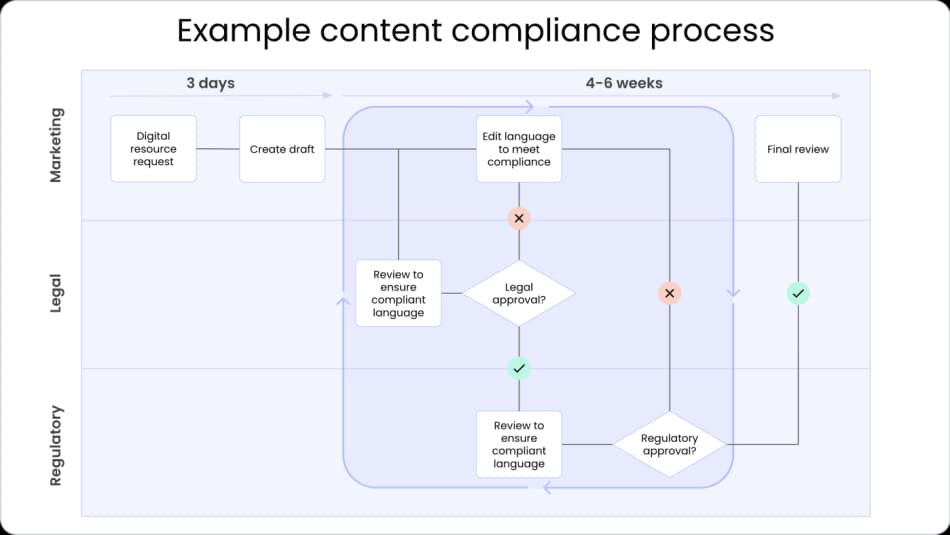
Content compliance review process (source: writer)
An AI-generated article may overstate what a product can do. A sales email may promise an outcome the company cannot guarantee. A landing page may include a compliance-sensitive claim. A product description may use wording that creates legal or customer expectation issues. A thought leadership post may cite a trend without enough context.
These problems are harder to catch because the writing often looks professional. The surface quality can make reviewers less alert to the factual risk underneath. McKinsey’s State of AI research found that organizations vary widely in how they monitor AI outputs. In its 2025 report, 27% of respondents whose organizations use GenAI said employees review all content created by GenAI before it is used, while a similar share said 20% or less of AI-produced content is checked before use. That is a serious governance gap.
If AI-generated content reaches customers without proper review, the company may not know which claims were checked, who approved them, or whether the final content matches internal standards. Reuters reported on an EY survey in 2025 showing that nearly every large company deploying AI had experienced some initial financial loss, often linked to issues such as compliance failures, flawed outputs, bias, or sustainability disruptions.
For content teams, this is a clear signal. AI content governance should not only focus on writing quality. It should define how claims are reviewed, what evidence is required, which content types need legal or product approval, and who is responsible for final sign-off. When AI increases content volume, review needs to move from subjective editing to structured risk control.
Brand Consistency Gets Harder When Everyone Can Generate Content
Generative AI also changes who can create content. In the past, brand content usually came from marketing, communications, or design teams. Today, sales teams can generate outreach emails. Customer support teams can draft help articles. HR can create internal announcements. Product teams can write feature summaries. Executives can produce thought leadership drafts. Regional teams can localize campaign copy. This creates useful speed, but it also creates brand consistency problems.
When more people generate content, the company needs stronger control over tone, terminology, messaging, positioning, and approved language. Otherwise, each team may create content that sounds slightly different. One team may describe the product as an automation tool. Another may describe it as an AI platform. Another may emphasize cost savings, while another promises productivity gains. Over time, the brand becomes inconsistent across channels.
Content Marketing Institute’s 2025 research found that only 4% of B2B marketers report a high level of trust in generative AI outputs, while only 17% rate AI-generated content quality as excellent or very good. This does not mean AI is not useful. It means AI output still needs context, standards, and human judgment.
For enterprises, brand compliance AI is not simply about checking whether a logo or color is correct. It is about making sure every piece of content follows the company’s approved messaging, voice, product claims, legal boundaries, and market positioning. That requires more than a style guide in a shared folder.
A scalable AI content governance system should help teams apply brand rules inside the content workflow. It should make approved terminology easy to access. It should show which content requires brand review. It should prevent unapproved claims from moving directly to publishing. It should give reviewers a clear record of what changed between versions.
This is where Twendee’s work becomes relevant. Many enterprises do not need another disconnected AI writing tool. They need a workflow system that connects AI-generated content with review, approval, ownership, brand control, and publishing status. When brand standards are built into the workflow, teams can move faster without turning every content draft into a manual brand check.
Approval Ownership Gets Blurry Without Clear Workflow
Generative AI creates another problem: ownership. When a human writes a piece of content, ownership is usually easier to trace. The writer created it. The manager reviewed it. The brand or legal team approved it. The content team published it. With AI-generated content, that chain becomes less clear.
Who owns the first draft if it was generated from a prompt? Who is responsible for fact-checking? Who approves the final claim? Who decides whether the content needs legal review? Who confirms that the version published is the version that was approved? Who is accountable if an AI-generated asset creates customer confusion or compliance risk?
These questions become harder when teams work across multiple tools. A draft may start in ChatGPT, move into Google Docs, get reviewed in Slack, receive comments from legal by email, then get published through a CMS or social scheduling platform. Each step may make sense individually, but the full approval record becomes fragmented.
This is why AI publishing workflow matters. A strong AI publishing workflow should make the lifecycle of content visible from draft to publication. It should show whether the content was AI-generated, who edited it, who reviewed it, what risk category it belongs to, which comments were resolved, and whether the final asset is approved for use.
Without that workflow, enterprises may scale AI content production while losing control over approval quality. Adobe’s 2026 AI and Digital Trends report found that 53% of organizations say their content supply chain remains largely linear and resource-intensive. The same report also points to readiness gaps around responsible use guidelines, integration tools, data structures, and measurement practices for AI adoption.
That matters because enterprise content review is no longer a simple editorial step. It is part of the company’s operating system for AI. As teams adopt AI across marketing, sales, support, and internal communications, approval workflows need to become more structured. The system should answer practical questions: Can this content be published? Who has reviewed it? Does it need compliance approval? Is the source verified? Is the brand language approved? Is this the latest version?
Twendee can support this by helping businesses build content review, approval, and publishing workflow systems that fit their internal operations. Instead of relying on scattered feedback, teams can manage ownership, approval status, review history, and publishing control in one clearer process. That is how AI content governance becomes operational. If your team is starting to scale AI-generated content, book a consultation with Twendee to explore how a stronger AI content governance system can support your content operations.
AI Content Governance Needs to Be Built Into the Publishing Process
The mistake many companies make is treating AI governance as a policy document. A policy is useful, but it is not enough. Teams may know the rules and still fail to apply them when work moves quickly. A marketer under deadline may use an AI draft without checking all claims. A sales team may generate outreach copy without brand review. A regional team may localize content and publish before the central team sees it.
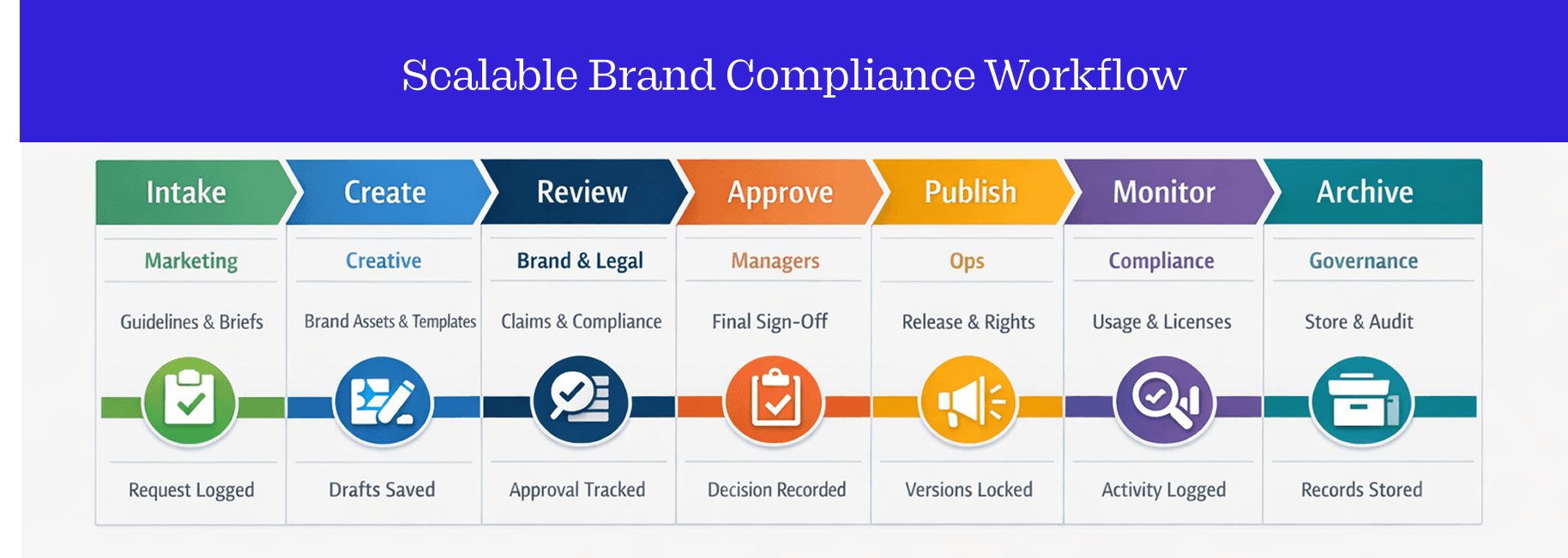
AI content governance workflow (source:puntt.ai)
Governance only works when it is built into the process. AI content governance should guide how content is created, reviewed, approved, stored, and published. It should define which content types can use AI, which ones require human review, which claims require evidence, which assets need legal approval, and which channels require stricter control.
This does not mean every AI-generated sentence needs a long approval chain. That would slow teams down. The point is to create review paths based on risk. A low-risk internal draft may need a light review. A public product claim may need product and legal approval. A financial, healthcare, or compliance-sensitive asset may need stricter review before publication. A brand campaign may need voice, design, and leadership review. The workflow should adapt to content risk, not treat every asset the same.
This is where enterprises need systems, not just guidelines. A strong AI content governance setup connects several parts of the content operation: content briefs, AI usage rules, source verification, reviewer roles, approval status, version control, publishing permissions, and post-publication tracking.
It also creates a stronger foundation for future AI use. McKinsey’s 2025 State of AI report found that 88% of respondents say their organizations regularly use AI in at least one business function, while most organizations are still in experimentation or pilot stages. As AI moves deeper into daily work, governance cannot remain an afterthought.
For content teams, this means the next stage of AI adoption is not just better prompting. It is better workflow design. Twendee helps businesses integrate AI content processes into internal systems with clearer ownership and control. That can include content request flows, AI draft creation, reviewer assignment, brand and compliance checkpoints, approval tracking, publishing status, and audit history. The goal is not to slow AI down. The goal is to make AI-generated content safe enough to scale.
Conclusion
Generative AI has changed the content operation. It helps teams create faster, but it also increases the volume of drafts, versions, claims, and assets that need review. This creates a new content review problem for enterprises.
Accuracy becomes harder to verify at speed. Brand consistency becomes harder when more teams can generate content. Approval ownership becomes unclear when drafts move across disconnected tools. Publishing control becomes risky when AI-generated content enters public channels without a structured review process.
That is why AI content governance is becoming essential. It gives businesses a clearer way to manage AI-generated content from draft to review, approval, publishing, and post-publication control. For enterprises, the goal is not to stop teams from using AI. The goal is to build the workflow, ownership, and review structure that allows AI content to scale safely.
Twendee helps businesses build content review, approval, and publishing workflow systems that connect AI content processes with internal operations, brand standards, compliance needs, and clear ownership. To explore how Twendee helps businesses build AI content governance workflows and reduce risk in AI-generated content operations, visit Twendee Software or connect with the team on LinkedIn.
Read latest blog: Customer Support Teams Are Moving Beyond Chatbots
