

A supplier relationship rarely exists in one system.
Procurement may maintain the supplier profile. Legal stores the contract. Finance tracks invoices and payment terms. Operations records delivery issues. Quality teams monitor defects, while important commitments remain in email or meeting notes.
Each source may be accurate on its own. However, no single source explains the full relationship.
This is where vendor management software creates value. Its purpose is not simply to store supplier names or documents. A useful system connects supplier identity, contracts, performance, compliance, and workflow status into one decision-ready view.
Centralization does not always mean replacing every procurement, ERP, finance, or document platform. In many businesses, those systems should remain specialized. The real goal is to connect them well enough that teams can make supplier decisions from shared and current evidence.
Why Supplier Data Becomes Messy as the Business Grows
Vendor data usually becomes fragmented gradually.
A company may begin with a spreadsheet and a folder of contracts. Later, finance adds suppliers to its accounting platform. Procurement adopts a sourcing tool. Operations tracks delivery performance elsewhere.
Each addition solves an immediate need. Yet the supplier relationship becomes harder to see as a whole.
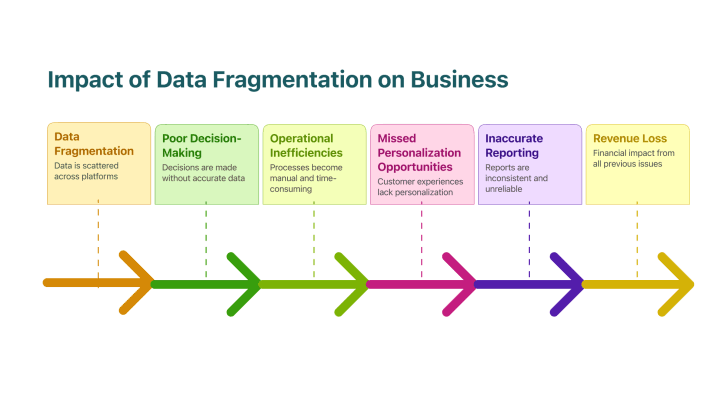
Fragmented supplier data can lead to slower decisions, operational inefficiencies, inconsistent reporting, and financial impact across procurement workflows. (Source: LinkedIn)
1. Supplier profiles become inconsistent
The same supplier may appear under several names.
Procurement may use the trading name. Finance may record the legal entity. Operations may shorten the company name, while an older spreadsheet still contains a previous address or contact.
These differences create more than a search problem.
Teams may create duplicate supplier records, attach contracts to the wrong entity, or review performance data separately for what is actually the same vendor.
A supplier profile should therefore represent the current business relationship, not just static registration data.
2. Contracts become separated from daily decisions
Contract information often sits outside the systems where employees make purchasing decisions.
A PDF may contain the approved price, service level, payment terms, liability clauses, and renewal date. However, the purchase request may happen in another platform.
As a result, employees may approve spend without seeing the latest terms.
Deloitte argues that modern contract management needs end-to-end visibility and contract intelligence, so businesses can extract, analyze, and act on contract data rather than treating contracts as stored files.
3. Performance data is spread across teams
Supplier performance is not one metric.
Procurement may focus on cost. Operations cares about delivery. Quality teams track defects. Finance may see late invoices, disputes, or unusual payment requests.
The Hackett Group describes supplier management as a process that includes onboarding, performance evaluation, risk assessment, compliance monitoring, and collaboration. This shows why supplier management cannot rely on one department’s view alone.
4. Communication history remains informal
Important supplier context often stays in inboxes, chat threads, calls, and meeting notes.
A supplier may promise a new delivery date by email. Operations may discuss a quality exception in chat. Procurement may agree on temporary pricing during a call.
If these commitments never reach the supplier record, future decisions depend on individual memory.
Vendor data fragmentation turns supplier management into a reconstruction task before every important decision.
Where Fragmented Vendor Data Weakens Procurement Decisions
The main cost of fragmented supplier data is not the time spent searching.
The larger cost appears when procurement must approve, renew, expand, restrict, or replace a supplier without a complete view of the evidence.
1. Procurement loses a reliable supplier view
A supplier directory is not enough for serious vendor management.
Teams may need to see:
Approved legal entity
Supplied categories
Internal business owner
Active contracts
Renewal dates
Payment terms
Compliance documents
Performance history
Open disputes
Current risk status
When these records live in separate systems, employees spend time asking other teams for context.
A supplier may look approved in procurement software, while finance still has unresolved bank verification. Another may have an active contract but expired compliance documents.
The problem is not that the data does not exist. It is that the data does not come together when someone needs to make a decision.
This is why McKinsey positions integrated procurement data as a foundation for better visibility, supplier performance, risk management, and decision-making.
2. Contract control becomes reactive
Many companies track contract renewal dates. Fewer connect the contract with what has happened during the relationship.
Before renewal, procurement should be able to ask:
Has the supplier met the service level?
Have prices changed outside the agreed terms?
Are required certificates still valid?
Has delivery quality improved or declined?
Are payment conditions still appropriate?
Are there unresolved disputes?
If contract data remains separate from purchasing and performance records, renewal becomes an administrative event rather than a business review.
A stronger vendor management system links contract terms with supplier activity. It helps teams assess whether the actual relationship still matches the written agreement.
3. Compliance becomes difficult to monitor and prove
Supplier compliance is not complete after one onboarding check.
Documents expire. Bank details change. Ownership structures may change. New regulations or internal policies can also introduce additional requirements.
A controlled process needs to show:
Which documents are required
Whether they remain valid
Who reviewed them
Which exceptions were approved
Whether the supplier is restricted
What changed after onboarding
Scattered files and email approvals make this harder to verify.
Centralized records do not guarantee compliance. However, they make reviews, exceptions, and evidence easier to monitor.
Deloitte’s supply chain research also emphasizes the need to replace siloed approaches with more integrated, cross-functional management.
4. Supplier performance is judged from partial evidence
A supplier can perform well in one area and poorly in another.
It may offer competitive pricing but create repeated delivery delays. Another supplier may charge more but reduce defects and respond faster during disruptions.
A single score can hide these trade-offs.
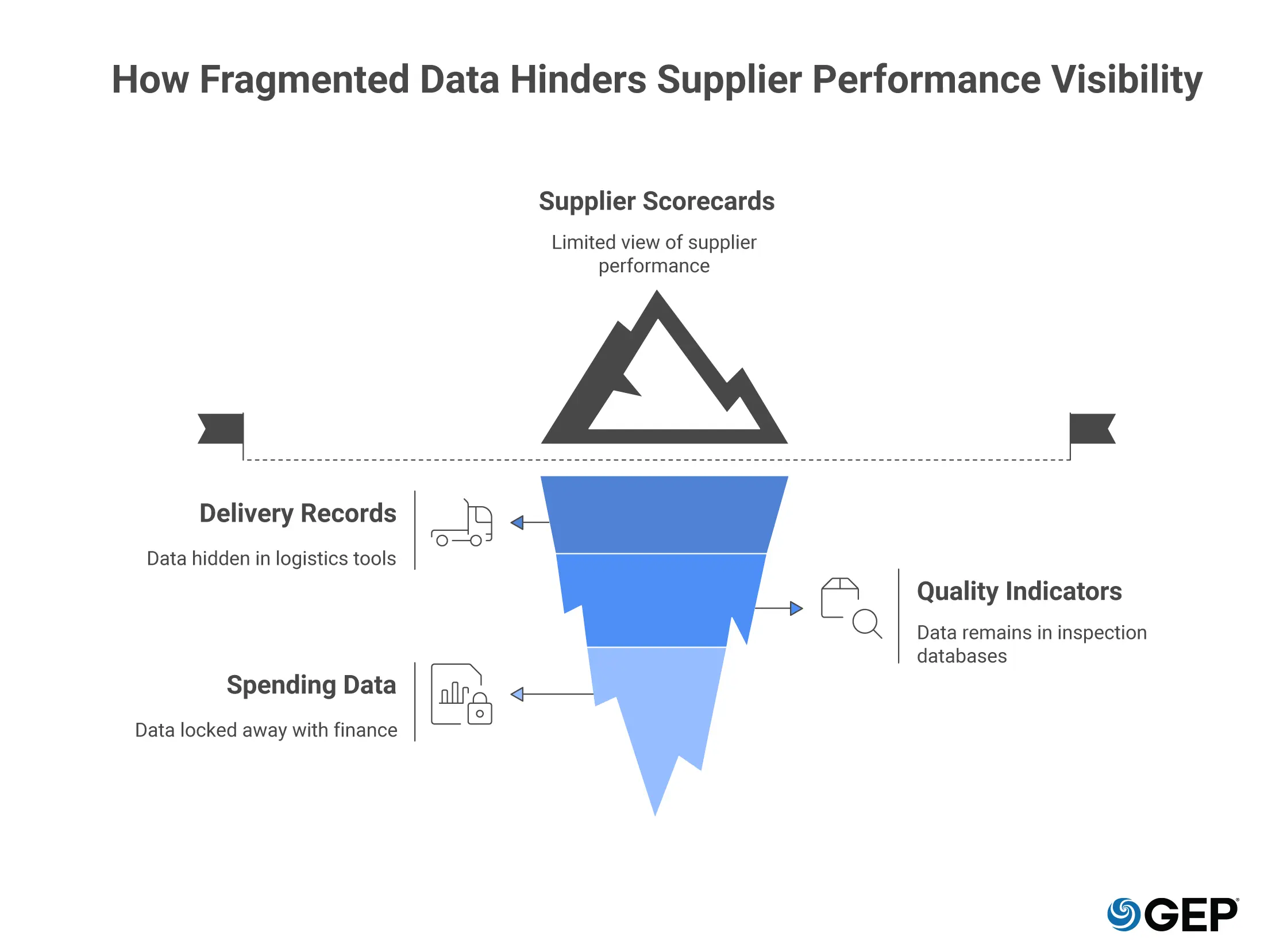
Supplier performance becomes difficult to assess when delivery, spending, and quality data remain in separate systems, leaving scorecards with only a partial view. (Source: GEP)
A useful supplier performance tracking model should combine relevant indicators while preserving the context behind them. These may include:
On-time delivery
Defect or rejection rate
Service responsiveness
Price changes
Contract compliance
Issue resolution
Operational risk
Context matters because not every negative event belongs to the supplier.
A late delivery may result from a delayed internal forecast, an approved scope change, or missing information from the buyer. The system should allow teams to review the event before it affects the supplier score.
Better supplier decisions require shared evidence, not just one performance number.
5. Workflow ownership becomes unclear
Supplier management crosses procurement, finance, legal, operations, quality, and leadership.
A new supplier may need registration, contract review, compliance checks, bank verification, category approval, and budget confirmation.
When each step happens in a different tool, teams may not know:
Who owns the next action
Which review is still missing
Why onboarding has stopped
Whether the supplier can be used
Which system contains the final status
These gaps create delays even when every department completes its own work correctly.
Gartner’s description of procurement orchestration platforms highlights the same operational challenges: fragmented supplier data, decentralized communication, and lengthy approval cycles.
6. Supplier decisions become slower and harder to explain
Eventually, the fragmented data problem reaches the decision stage.
The company must decide whether to:
Approve a new supplier
Increase purchasing volume
Renew a contract
Renegotiate terms
Suspend a vendor
Shift spend to another supplier
Without a connected view, teams must rebuild the evidence manually.
One person collects contract terms. Another requests performance records. Finance checks payment history. Operations explains recent issues. Management then receives a summary that may already be outdated.
A centralized supplier view reduces this reconstruction work.
It also makes the decision easier to review later. Teams can see which evidence was available, which risks were considered, who approved the outcome, and what happened next.
The real value of centralized vendor management is not storing more supplier data. It is making procurement decisions faster, more consistent, and easier to explain.
Build One Supplier Operating View Across Existing Systems
Businesses do not always need to replace every procurement, ERP, finance, and document platform.
A more practical approach is to define which system owns each type of supplier information and connect those sources through one operational view.
1. Create one supplier identity
The business needs one consistent supplier identity across procurement, finance, contracts, and operations.
That record should connect aliases, legal entities, business units, categories, owners, and related documents. This reduces duplicate profiles and helps teams find the full relationship.
2. Connect contract tracking with activity
Contract dates and files should connect with pricing, purchasing, compliance, and performance data.
This allows procurement teams to review supplier behavior before renewals, negotiations, or spend increases.
3. Share performance evidence
Supplier scorecards should combine relevant evidence from procurement, operations, finance, and quality teams.
Teams should also be able to open the events behind each score rather than seeing only an aggregate number.
4. Structure onboarding and approvals
A clear onboarding workflow should define required data, document checks, owners, review stages, and escalation rules.
The system should show the current status and prevent use of a supplier when required approvals remain incomplete.
5. Integrate supplier workflows
Supplier data becomes more useful when it connects with purchase requests, procurement approvals, finance checks, inventory, and operational reporting.
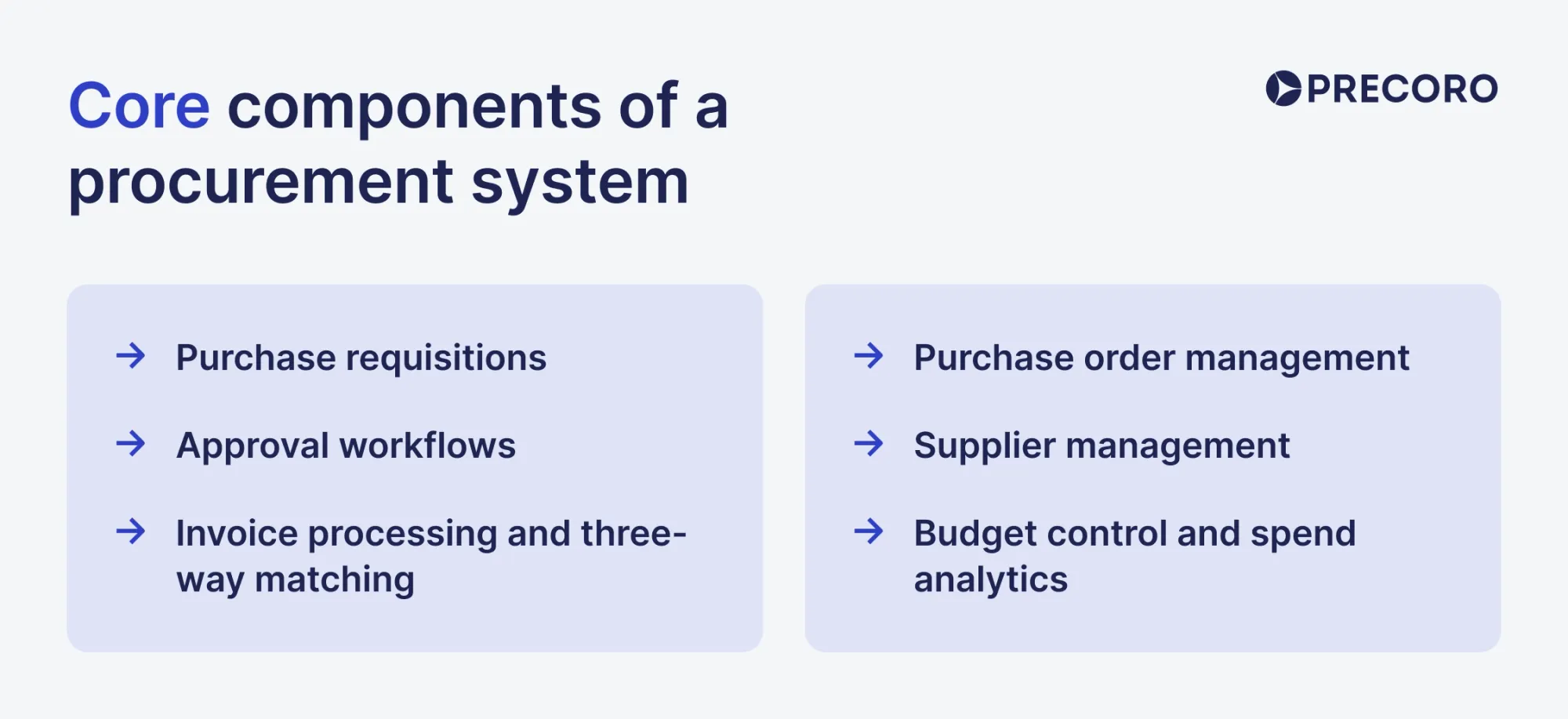
Supplier management creates more value when it connects with requisitions, approvals, purchase orders, invoice processing, budget control, and spend analytics. (Source: Precoro)
This is where Twendee’s role becomes practical.
Twendee builds vendor management systems that combine supplier profiles, contract tracking, performance data, approvals, and workflow visibility.
Twendee can also integrate supplier workflows with procurement, finance, ERP, and operations platforms. This allows companies to preserve useful specialist systems while creating one clearer supplier operating view.
For example, a supplier onboarding workflow could collect required documents, detect missing information, route finance and compliance reviews, record approvals, and create the verified supplier profile.
The goal is one reliable operating view across the systems involved in the supplier relationship.
Conclusion
Vendor management becomes messy when supplier identity, contracts, performance, compliance, communication, and workflow status live in separate places.
Centralized vendor management software improves procurement control by connecting the evidence needed for supplier decisions. It also makes onboarding, contract reviews, compliance checks, and performance monitoring easier to manage.
Twendee helps businesses build vendor management platforms and integrate supplier workflows across procurement, finance, ERP, and operations.
By creating a connected supplier operating view, Twendee helps teams spend less time reconstructing information and more time making informed, reviewable supplier decisions.
