The global technology landscape is entering a decisive shift. As digital systems become deeply embedded in revenue models, operations, and risk exposure, technology partnership expectations are no longer defined by delivery speed alone. Organizations increasingly expect technology partners to share accountability for outcomes, participate in strategic decisions, and carry real delivery ownership across the full lifecycle of products and platforms. This shift reflects a broader redefinition of the tech partnership model from executing requirements to navigating complexity, managing risk, and translating engineering effort into measurable business impact.
Why Technology Partnership Expectations Are Shifting from Execution to Accountability
For more than a decade, technology partnerships were largely transactional. A business defined requirements, a vendor executed them, and success was measured by whether delivery happened on time and within scope. That model is now increasingly misaligned with how technology functions inside modern organizations. As systems become mission-critical to revenue, compliance, and competitive advantage, technology partnership expectations are moving decisively toward accountability and shared ownership.
Recent industry data helps explain this shift. According to Gartner (2024), more than 70% of digital initiatives fail to deliver expected business outcomes even when technical delivery milestones are met. McKinsey (2023) reports that organizations treating technology partners as outcome owners rather than task executors are nearly twice as likely to achieve sustainable value from digital investments. These findings point to a structural gap between delivery success and business success.
At the heart of this gap is a growing mismatch between what vendors provide and what businesses now require.
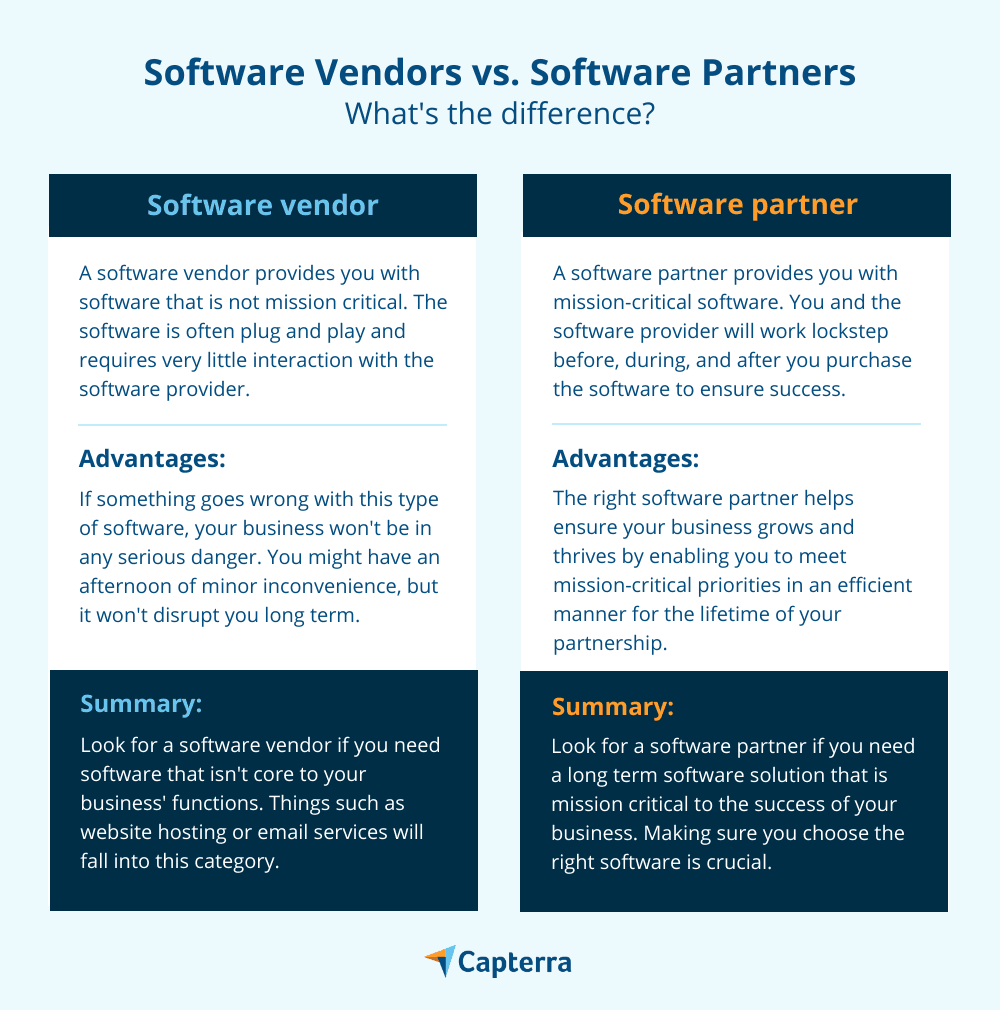
Software vendor vs software partner responsibilities and ownership comparison (Source: Capterra)
The contrast between a software vendor and a software partner is no longer semantic. It reflects a fundamental difference in responsibility:
Vendors typically deliver software that is peripheral or modular, with limited long-term involvement once implementation is complete.
Partners operate within mission-critical systems, working alongside internal teams before, during, and after delivery to ensure outcomes hold under real operating conditions.
This distinction matters because modern software environments are no longer static. Systems evolve continuously under pressure from market changes, scaling demands, security threats, and regulatory requirements. When responsibility is fragmented across multiple delivery-focused vendors, accountability for long-term performance becomes unclear. The result is often accumulated technical debt, inconsistent architectural decisions, and delayed responses to risk.
The shift in technology partnership expectations is therefore driven by three structural realities:
Execution without accountability scales risk, not value: As platforms grow more complex, small architectural decisions compound over time. Businesses increasingly expect partners to take responsibility for those decisions, not just implement them.
Delivery ownership now extends beyond launch: Launch is no longer the finish line. Stability, maintainability, security posture, and adaptability over multiple years define real success.
Outsourcing accountability is tied to business exposure: When technology failures directly affect revenue or trust, organizations expect partners to share responsibility for prevention and recovery, not operate as detached implementers.
In this context, the traditional vendor model struggles to meet modern demands. The emerging expectation is clear: technology partners must operate with a deeper sense of ownership, aligning delivery decisions with long-term business impact rather than short-term completion metrics.
From Vendor to Partner: Redefining the Tech Partnership Model in 2025
As digital systems move closer to the core of business operations, the limits of traditional delivery-centric relationships are becoming increasingly visible. Many organizations still work with software vendors optimized for execution efficiency, yet expect them to solve problems rooted in strategy, scale, and long-term adaptability. This mismatch sits at the center of today’s shifting technology partnership expectations.
Enterprise data consistently shows that the challenge is not a lack of ambition, but a growing gap between what businesses demand from technology and what delivery models are designed to support.
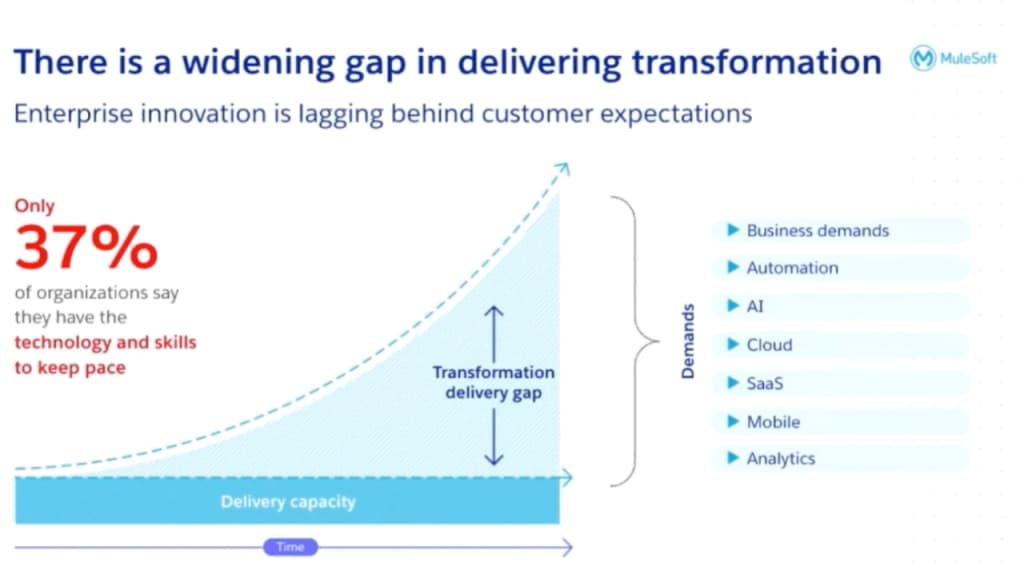
Transformation delivery gap between enterprise delivery capacity and rising business demands (Source: MuleSoft)
Enterprise data highlights this structural gap. MuleSoft’s research shows that only 37% of organizations believe they have the technology and skills required to keep pace with rising business demands across cloud, automation, AI, and analytics. While demand accelerates, delivery capacity struggles not because teams cannot build, but because delivery models were never designed to manage compounding complexity.
In practice, the vendor model begins to fail where accountability fades. Execution teams are often measured on what is shipped, not on how systems behave months or years later. Yet many of the most consequential outcomes are shaped outside sprint cycles:
Architecture decisions that determine scalability and cost of change
Integration choices that affect system resilience and operational friction
Security and data flows that shape long-term risk exposure
When these decisions are treated as fixed inputs rather than shared responsibilities, delivery efficiency offers diminishing returns.
As systems grow, this issue becomes harder to contain. Modern platforms are assembled across multiple vendors and services, each responsible for a narrow slice of the stack. When performance degrades or risks surface, ownership is often fragmented. Deloitte’s enterprise technology research (2024) consistently links major digital disruptions to unclear responsibility boundaries, rather than to a lack of technical skill. This is why outsourcing accountability is being reframed as a system-level concern, not a contractual one.
Delivery ownership has also expanded in scope. Launch is no longer the point at which responsibility ends. Real exposure begins after systems are live, when scale introduces pressure, integrations evolve, and threat surfaces expand. McKinsey’s 2023 analysis shows that organizations with clearly defined outcome ownership were nearly twice as likely to sustain long-term performance improvements. What distinguished these initiatives was not delivery excellence alone, but continuity of responsibility.
These realities are reshaping the tech partnership model around a different set of expectations:
Responsibility for decisions that shape long-term outcomes, not just short-term execution
Ongoing involvement across the system lifecycle, not project-based disengagement
Accountability aligned with business impact rather than delivery metrics
In practice, this shift is also reflected in how some technology firms choose to operate. At Twendee, the partnership model is deliberately structured around shared ownership rather than delivery isolation. Engagements typically begin while problems are still being defined, not after requirements are finalized. This allows architectural, security, and scalability decisions to be evaluated against long-term business impact and operational risk, rather than short-term scope completion.
Rather than treating these trade-offs as “out of scope,” Twendee operates with delivery ownership that extends across the system lifecycle. This approach mirrors a broader market expectation: technology partners are no longer valued for how efficiently they execute instructions, but for how responsibly they stand behind the outcomes those instructions produce.
Execution still matters. What has changed is how success is judged. In environments where technology directly affects growth, trust, and resilience, partners are expected to remain accountable when systems encounter real-world pressure. That expectation now defines the difference between a vendor and a true technology partner.
What Technology Partnership Expectations Mean for Delivery Ownership and Consulting Services
As technology partnership expectations continue to rise, delivery ownership and consulting are no longer treated as separate layers of engagement. In practice, they are converging into a single responsibility: helping organizations make the right decisions early and standing behind those decisions as systems evolve.
This convergence reflects a simple reality. Many technology failures do not originate from poor execution alone. They emerge when early assumptions go unchallenged, trade-offs are made without long-term ownership, or responsibility fades once delivery is complete. As platforms scale, these gaps surface as performance bottlenecks, security exposure, or rising operational costs.
In this context, delivery ownership extends well beyond implementation. It includes how systems behave under real-world pressure, how easily they adapt to change, and how risks are managed over time. That is why tech consulting services are increasingly expected to influence execution, not sit alongside it.
Organizations that adapt to this model tend to share several characteristics:
Technology decisions are evaluated through a long-term lens: Architecture, integrations, and tooling are assessed based on scalability, maintainability, and cost of change rather than short-term delivery speed.
Risk is addressed before it becomes operational debt: Security, compliance, and reliability considerations are embedded into design and planning, reducing the need for reactive fixes later.
Technology roadmaps remain flexible: Systems are built to evolve alongside shifting business priorities, rather than locking organizations into rigid delivery plans.
Industry research reinforces the value of this integrated approach. IDC (2024) reports that organizations working with partners who combine delivery execution and advisory responsibility are significantly more likely to meet long-term performance targets. Accenture’s Technology Vision (2025) similarly highlights a growing preference for partners who can translate business intent directly into technical action without handoff friction.
In this model, consulting is not about producing recommendations and stepping away. Its value lies in continuity. The same partner that helps shape decisions remains accountable for how those decisions perform once systems are live. This alignment reduces the gap between strategic intent and operational reality.
At Twendee, consulting and delivery are structured as a continuous responsibility rather than isolated phases. By staying involved across the lifecycle, technical decisions remain aligned with business effectiveness, helping organizations reduce risk while maintaining momentum.
As expectations continue to shift, the distinction between “consultant” and “delivery team” becomes less relevant. What matters is whether a technology partner remains accountable when systems are tested by scale, complexity, and change. That accountability is now central to how modern partnerships are evaluated.
Conclusion
The shift in technology partnership expectations marks a clear move away from delivery-only vendors toward partners accountable for long-term outcomes. As technology becomes central to performance and risk, organizations increasingly value shared ownership, delivery accountability, and integrated tech consulting services. Choosing the right partner is no longer about execution capacity, but about who remains accountable when systems scale and assumptions are tested.
Learn more about Twendee’s approach at our website, and follow insights on LinkedIn or Facebook.