

Most companies already have enough internal knowledge. The problem is finding the right information when work is happening. Policies may sit in a wiki. Project updates may remain in chat. Customer context may live in CRM. Operational data may sit inside ERP. Important decisions may be buried in documents, emails, or meeting notes.
As a result, employees spend too much time switching between tools. They often search several systems before they can answer one simple question. Traditional knowledge portals tried to solve this problem by creating one place for documents. However, they still require employees to know where information lives, which keyword to use, and which version to trust.
AI knowledge management changes that model. Instead of asking employees to navigate another portal, enterprise search can retrieve answers across connected systems and present them in the context of the task.
What is AI knowledge management?
AI knowledge management is the use of artificial intelligence to organize, retrieve, summarize, and deliver company knowledge across internal systems.
It combines enterprise search with technologies such as natural language processing, semantic retrieval, knowledge graphs, and retrieval-augmented generation.
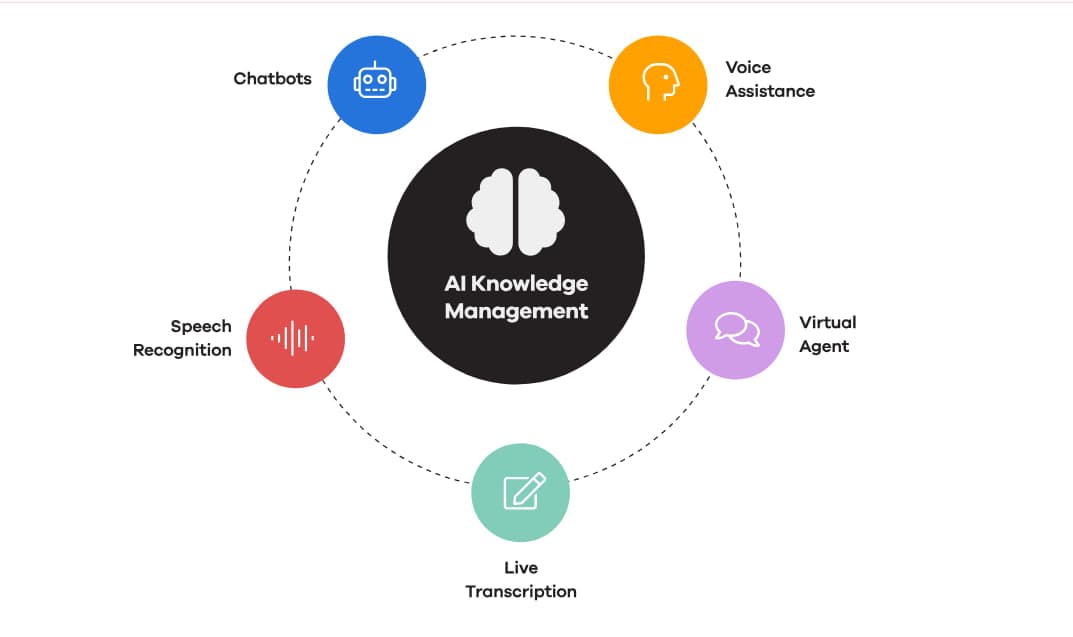
AI knowledge management can deliver company knowledge through chatbots, voice assistance, virtual agents, speech recognition, and live transcription. (Source: Upland Software)
In practice, employees can ask questions in everyday language, such as:
What is the latest travel policy?
Which customer requested this feature?
Who approved the current budget?
What happened in the last project review?
Which supplier contract expires this month?
What steps are required for this request?
The system then searches connected sources and returns a relevant answer. It may also show the original documents, records, or pages that support the response.
This is different from a traditional internal portal.
A portal mainly stores and displays content. AI enterprise search interprets the user’s intent, searches across sources, and brings the right knowledge into the current workflow.
That difference matters because modern work is already highly fragmented. Microsoft’s 2025 Work Trend Index found that employees using Microsoft 365 are interrupted by a meeting, email, or notification every two minutes during core working hours. The report estimates that these activities can add up to 275 interruptions per day. (Microsoft)
Enterprise knowledge systems should reduce that fragmentation. They should not add another place employees must remember to check.
Why internal knowledge portals are losing value
Internal portals were built for a simpler workplace. Companies created folders, wikis, intranets, and document libraries to give employees one place to find information.
However, daily work no longer happens in one system.
Employees now move between chat platforms, project tools, shared drives, CRM, ERP, ticketing systems, email, and internal applications. Each platform stores a different part of the company’s knowledge.
A traditional portal struggles with this environment for three reasons.
Employees must know where to search
Most portals expect users to understand the company’s information structure.
For example, an employee may need to know whether a process is stored under HR policies, operations procedures, employee resources, or department documents.
If they choose the wrong location, they may not find the answer. They may then ask a colleague, send another message, or recreate information that already exists.
Enterprise search changes this process. The employee starts with the question instead of the folder structure.
Keyword search misses business context
Traditional search often depends on exact words.
However, employees do not always use the same language as the document author. A worker may search for “expense approval,” while the official policy uses “employee reimbursement procedure.”
Basic keyword matching may treat these as different topics. Semantic enterprise search can recognize that both phrases refer to the same process.
Recent research on enterprise retrieval also shows why simple search is becoming insufficient. A 2025 paper on graph-centric hybrid retrieval argues that enterprise knowledge is spread across heterogeneous sources such as wikis, project systems, code repositories, and operational records. The researchers found that combining semantic search with structured relationships improved answer relevance compared with standalone retrieval pipelines. (arXiv)
The point is practical: enterprise knowledge often depends on relationships, not isolated documents.
Portals rarely reflect current work
A portal may contain the correct policy but miss the latest project update. It may store a process document but not the current approval status. It may explain the CRM workflow but not show the customer record that an employee needs.
Therefore, employees still leave the portal to complete the task.
This is why enterprise knowledge management is shifting from static publishing toward contextual retrieval. Knowledge becomes more useful when the system delivers it inside the workflow where a decision is being made.
How AI enterprise search creates a better knowledge interface
AI enterprise search does more than improve a search bar. It creates a new interface between employees and company knowledge.
Instead of opening several systems, an employee can ask one question. The search layer then retrieves information from approved sources and combines it into a clear response.
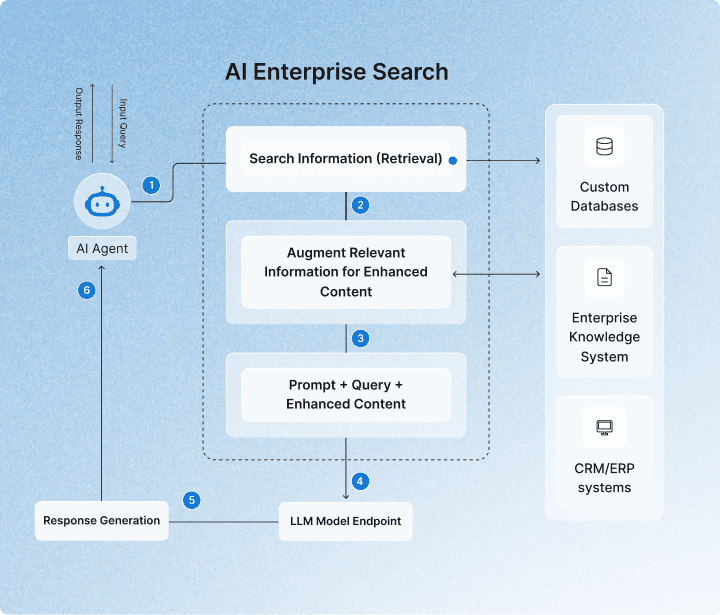
AI enterprise search retrieves information from databases, enterprise knowledge systems, and CRM or ERP platforms, then adds context before generating a response. (Source: Kore.ai)
However, a useful system needs more than a language model. It requires several connected layers.
Connected internal data sources
The system must first connect to the tools that hold company knowledge.
These sources may include:
ERP and CRM records
Internal documents and shared drives
Project management systems
Support tickets
Wikis and policy libraries
Email and workplace chat
Internal databases and applications
Without those connections, AI can only answer from a limited part of the business.
Glean describes its enterprise knowledge graph as a model that connects company content, people, and activity. This structure helps workplace search interpret relationships across a complex business environment. (Glean)
The same principle applies to any effective organizational knowledge system. The value comes from connecting information that currently lives in separate tools.
Context-aware retrieval
A good enterprise search system should understand more than the words in a question.
It should consider:
The employee’s role
The department involved
The current project or customer
The systems the user may access
The latest available information
The relationship between records
For example, two employees may ask, “What is the status of this request?”
A manager may need the approval history and budget impact. The employee who submitted it may only need the current status and next step.
The answer should reflect both context and permission.
Source-grounded answers
AI-generated answers must remain connected to evidence.
Employees should be able to see which documents, records, or system entries support the response. Otherwise, the search tool becomes another unverified information source.
This is especially important for policies, finance data, customer commitments, contracts, and operational decisions.
Research on enterprise retrieval describes retrieval-augmented generation as a common method for answering questions from enterprise data. However, newer frameworks also note that simple text retrieval may be insufficient for complex questions involving structured records, multiple systems, or multi-step reasoning.
Therefore, companies need to design AI search around the questions employees actually ask. They should not connect documents and assume every answer will become reliable automatically.
Permission-aware access
Enterprise search should never bypass existing access rules.
If an employee cannot open a finance report, the AI system should not reveal information from that report. The same rule applies to HR records, customer contracts, leadership documents, and confidential project data.
Permission-aware retrieval is essential for trust. It also allows companies to expand search without creating a new route for data exposure.
What businesses should prepare before deploying AI enterprise search
AI enterprise search performs best when the company’s knowledge foundation is clear.
Before implementation, businesses should focus on five areas.
Define trusted knowledge sources
Companies should decide which systems contain approved information.
For example, the CRM may be the trusted source for customer ownership. ERP may hold operational records. A policy library may contain the official version of internal procedures.
Without clear ownership, the search system may retrieve several conflicting answers.
Improve content quality
AI can retrieve outdated information as easily as current information.
Therefore, teams should review duplicate documents, expired policies, inconsistent naming, and missing ownership. They should also define how often critical content needs an update.
This does not mean every document must be perfect before launch. However, high-impact knowledge should have clear owners and review cycles.
Map common employee questions
The most useful starting point is not the technology. It is the work.
Companies should identify the questions that repeatedly interrupt employees, managers, HR, finance, sales, support, and operations.
Examples may include:
Where is this request now?
Which version is approved?
Who owns the next step?
What information is missing?
What did the customer agree to?
Which process applies in this case?
These questions reveal where knowledge retrieval can create immediate value.
Preserve access controls
The search layer should inherit permissions from connected systems whenever possible.
It should also log which sources were accessed and which answers were generated. This helps security and operations teams review system behavior later.
Measure answer usefulness
Search success should not depend only on the number of queries.
Companies should also measure:
Whether users found the answer
Whether the source was correct
Whether the answer reduced manual follow-up
Whether users accepted or corrected the response
Whether the query led to a completed workflow
These signals help improve both retrieval quality and the underlying knowledge base.
How Twendee builds AI-powered knowledge systems
Twendee helps businesses build AI-powered knowledge systems connected to internal data sources and daily workflows.
The work begins by identifying where company knowledge currently lives. Twendee can connect documents, databases, ERP, CRM, and internal platforms through a shared retrieval layer.
However, system connection is only one part of the solution.
Twendee also designs how employees access knowledge in context. For example, a user may ask an AI assistant about a customer, approval, policy, project, or operational issue. The system can retrieve relevant information while respecting the user’s permissions.
The answer can also link back to its source. This makes the result easier to verify and more useful for real work.
In ERP and internal platforms, knowledge retrieval can support tasks such as:
Summarizing pending approvals
Retrieving customer history
Finding process instructions
Checking request status
Locating related documents
Identifying missing information
Explaining the next workflow step
This approach moves AI knowledge management beyond document search. It connects knowledge with the systems where employees make decisions and complete tasks.
Twendee can also add logging, feedback, and traceability. These layers help teams review which information the AI used, where an answer came from, and how the system should improve.
Conclusion
Internal knowledge portals are losing value because company knowledge no longer lives in one place.
Employees work across documents, chat, ERP, CRM, project tools, and internal systems. A static portal can store information, but it cannot always deliver the right answer at the right moment.
AI knowledge management offers a better model. It connects approved data sources, understands natural-language questions, respects user permissions, and retrieves knowledge inside daily workflows.
Twendee helps businesses build AI-powered enterprise search and knowledge systems connected to ERP, CRM, documents, databases, and internal platforms. By combining contextual retrieval, access control, source traceability, and workflow integration, Twendee helps employees find reliable answers without searching through disconnected systems.
Book a call: Calendly
Read latest blog: AI Workloads Are Breaking Old Cloud Cost Planning
