
AI used to sit at the edge of daily work. Employees used it to summarize documents, draft content, or support research. The underlying workflow stayed mostly unchanged.
That model is beginning to shift. Companies now want AI to retrieve business data, identify exceptions, recommend actions, route requests, and trigger workflow steps. Once AI starts participating in operations, the challenge extends beyond model performance.
The business must decide what data AI can access, which actions it may take, when human approval is required, and who owns the outcome. It must also connect AI with ERP, CRM, finance systems, internal tools, and existing business rules.
This is why AI-ready operations are becoming a technology strategy issue. Operations and technology remain distinct disciplines, but companies can no longer design them independently when AI enters daily work.
Why AI Exposes Weaknesses in Existing Operations
Many AI initiatives work well in a controlled pilot. The data is prepared, the task is narrow, and the team knows how to handle exceptions.
Daily operations are different.
Real workflows cross departments, systems, permissions, and approval layers. Employees often rely on experience to interpret incomplete information or decide when a case needs escalation.
AI makes these hidden dependencies more visible.
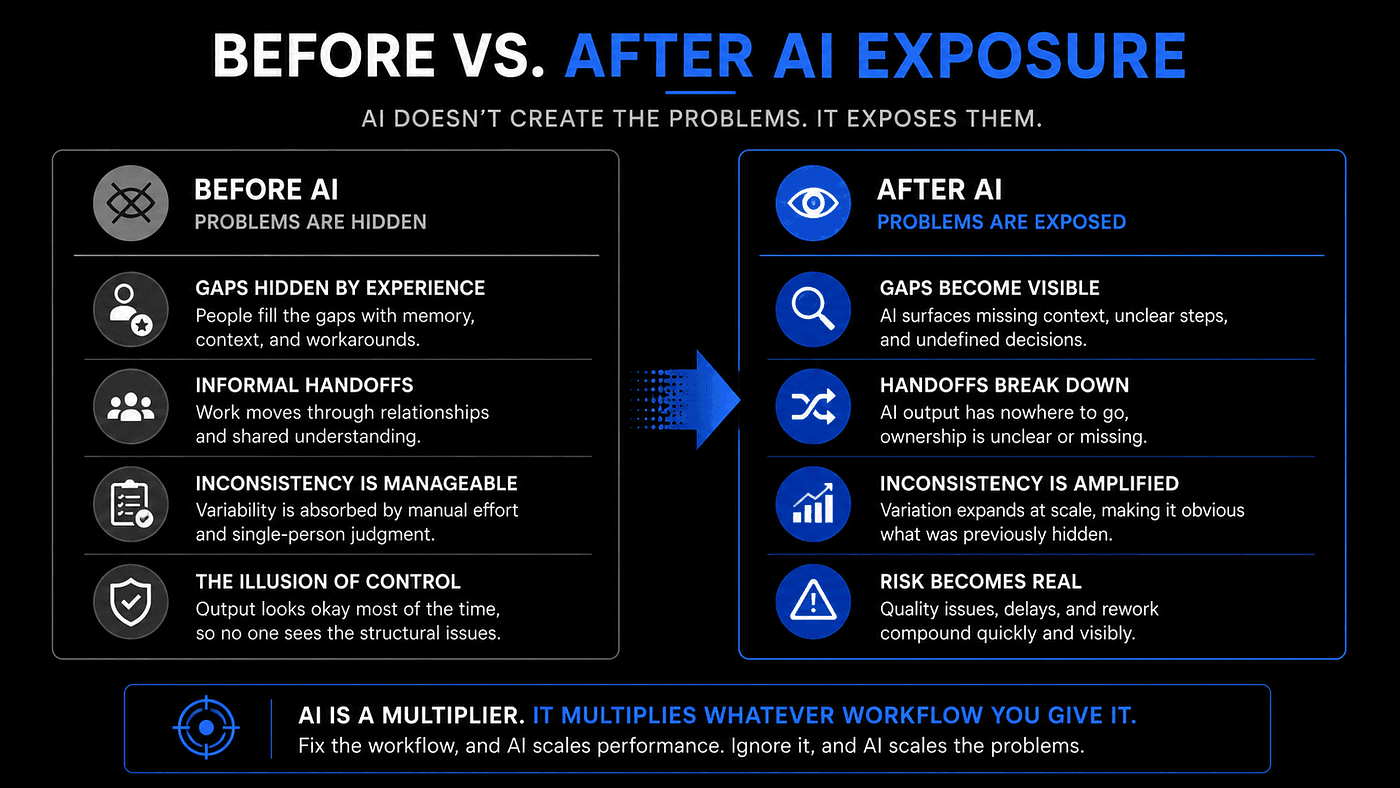
AI can reveal workflow gaps, informal handoffs, inconsistent processes, and unclear ownership that employees previously managed through experience and manual workarounds. (Source: Medium)
Workflow logic often lives outside the system
A documented process rarely captures every decision employees make.
For example, a procurement workflow may say that a manager must approve requests above a certain value. In practice, employees may also know that a new supplier requires compliance review, urgent purchases need finance confirmation, and incomplete requests should return to the requester.
Those rules may live in email, chat, or team memory rather than the workflow platform.
A human employee can often recognize the situation and ask the right person. AI cannot reliably follow logic that the company has never made explicit.
This is one reason agentic AI projects can struggle after the pilot stage. Deloitte notes that many enterprises are trying to automate processes designed for human workers without first rethinking how the work should operate.
The problem is not always the AI model. Sometimes the process itself is not structured enough for automation.
Ownership becomes unclear when AI joins the workflow
Most enterprise workflows already involve several roles.
One person owns the data. Another manages the process. A manager approves the decision. A different team carries out the action.
When AI enters the workflow, another question appears: who is accountable for what the AI recommends or executes?
An AI agent may identify a delayed order, draft an escalation, and update a record. However, the organization still needs a person or role that owns the business outcome.
IBM argues that enterprises must be able to prove that agent actions are authorized, properly scoped, and accountable.
This does not mean humans must approve every low-risk action. It means the workflow should define the boundaries clearly.
Enterprise data remains fragmented
Operational AI rarely depends on one source.
A customer workflow may require CRM history, payment status, contract terms, support records, and delivery data. If these systems do not connect, the AI sees only part of the situation.
The 2025 MuleSoft Connectivity Benchmark found that the average enterprise manages 897 applications, while only 29% are integrated.
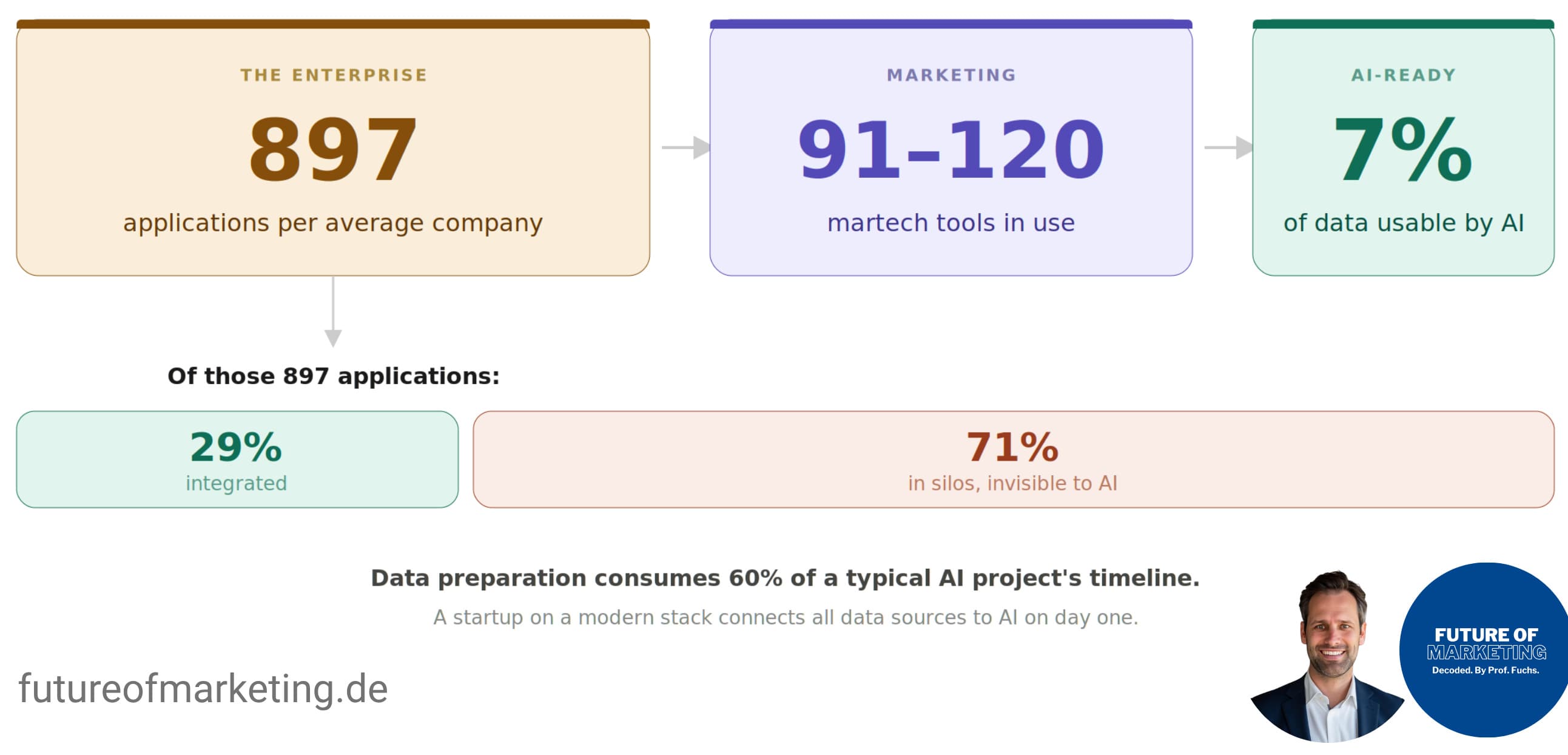
The average enterprise manages 897 applications, but only 29% are integrated, leaving much of the operating environment fragmented across silos. (Source: MuleSoft)
Fragmentation affects more than convenience. It changes the quality of the context available to AI.
A sales agent may recommend pursuing an account without seeing overdue invoices. An operations assistant may route a request without knowing that the contract has changed. A management summary may combine several dashboards while missing the relationship between their records.
AI does not create every operational weakness. It makes existing weaknesses harder to ignore.
What Must Change When AI Enters Daily Operations
The most important work is not connecting a model to every business system.
Companies need to redesign the operating foundation around four areas: workflow logic, ownership, data access, and system architecture.
1. Workflows must become explicit enough for AI to follow
AI-ready workflows need more structure than human-only processes.
At a minimum, the system should define:
What triggers the workflow
Which information is required
Who owns each step
Which conditions require approval
When the case must escalate
Which actions are permitted
What counts as completion
Consider customer onboarding.
A human employee may notice that a missing contract means legal review is required. They may also know that the project should not begin until finance confirms the payment terms.
An AI agent needs those conditions to exist as system logic.
Without them, the agent can retrieve information but cannot determine the correct operational path with enough reliability.
This is the difference between adding AI to a task and building AI workflow integration.
The first gives the model access to work. The second gives it a defined process to follow.
Deloitte’s analysis of the emerging agentic enterprise makes a similar point: organizations need to rethink the division of work across people, agents, and operating systems rather than layering agents onto unchanged processes.
2. Ownership must cover decisions and outcomes
AI can perform part of the work, but the organization must still own the consequences.
A practical workflow should distinguish between several roles:
Data owner: maintains the reliability of the information
Process owner: manages how the workflow operates
Decision owner: is accountable for the final choice
Approver: confirms that required conditions are met
Execution owner: completes the next business action
System owner: manages the technical environment
These roles do not need to belong to six different people. However, the organization should know which responsibility exists at each point.
The level of human involvement should also reflect risk.
An AI assistant may summarize a request or flag missing information without approval. A low-value and reversible action may run within predefined limits. A financial commitment, customer promise, or sensitive HR decision should receive stronger review.
IBM’s guidance on AI governance recommends clear senior ownership because fragmented responsibility and vague accountability can undermine governance efforts.
The aim is controlled autonomy, not maximum autonomy.
3. Data access must be contextual and permission-aware
Giving AI broad access to enterprise data is not the same as giving it useful access.
An AI system needs information relevant to the user, task, and level of risk.
For example, an operations employee may need to see order status and delivery requirements. That does not mean the employee-facing AI should reveal all customer financial records.
The architecture should enforce:
Trusted systems of record
Role-based access
Current and synchronized information
Source traceability
Rules for conflicting data
Logs of data access and actions
These controls should sit inside the workflow rather than exist only as a separate policy.
IBM defines AI governance as the processes, standards, and guardrails used to keep AI systems safe, ethical, and compliant while protecting sensitive data.
For operations, that definition becomes practical. The system should know not only whether the user can access a source, but also whether the AI may use that source for the current task.
4. System architecture must support action, not only answers
Many enterprise AI projects stop at conversational access.
An employee asks a question, and the AI returns an answer. This can reduce search time, but it does not necessarily change the operation.
Operational AI may also need to:
Update a business record
Create a request
Route an approval
Flag missing information
Notify the correct owner
Trigger the next workflow step
That requires more than a chatbot interface.
The company needs a system architecture that connects AI with ERP, CRM, workflow engines, internal platforms, permissions, and business rules.
McKinsey’s 2025 research on operational AI argues that COOs need an operating structure, data governance model, and change approach that support AI adoption together.
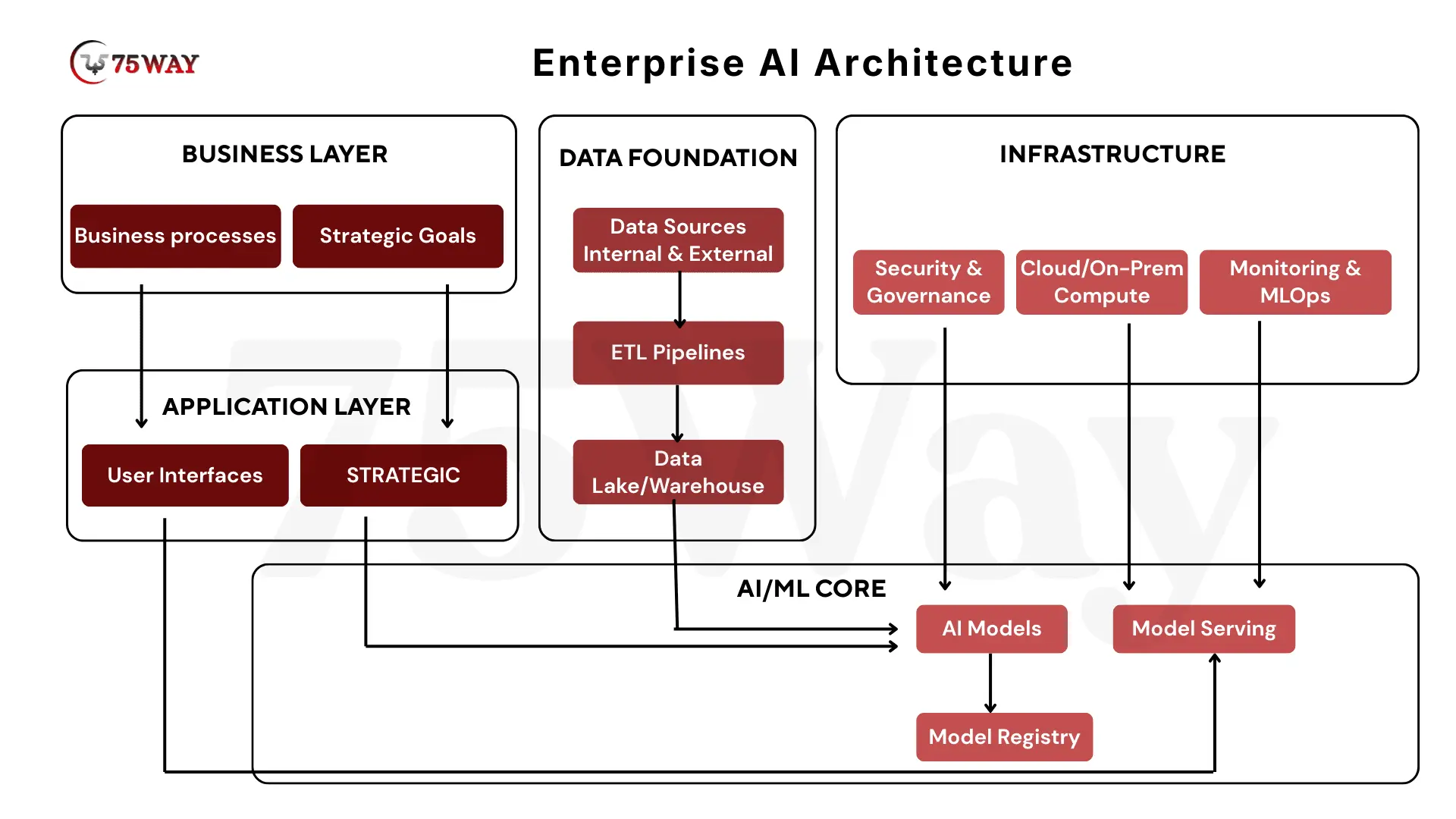
Enterprise AI architecture connects business processes, applications, trusted data, governance, infrastructure, and model operations to support reliable AI execution. (Source: 75Way)
This does not mean companies should begin with fully autonomous agents.
A safer path is gradual:
Give AI visibility into approved information.
Let it summarize and recommend.
Allow it to prepare actions for review.
Automate low-risk actions within clear limits.
Expand autonomy only when the workflow is stable and measurable.
The real foundation of AI-ready operations is not the model. It is the connected system of workflow logic, trusted data, permissions, ownership, and execution.
Modernize Operations Before Scaling the AI Layer
Companies do not need to redesign every process at once.
A stronger approach starts with one workflow that is repetitive, cross-functional, and expensive when delayed.
Useful starting points may include:
Purchase request to approval
Lead to delivery
Customer issue to resolution
Employee request to completion
Invoice exception to decision
The first step is to map the current process.
Where does the data begin? Where do employees enter it again? Which decisions rely on informal knowledge? Where does ownership become unclear? Which approvals reflect real risk, and which exist because of habit?
Next, the company should standardize the process before automating it.
That means defining shared statuses, required information, decision rights, permissions, and escalation rules. It also means choosing which system should own each business record.
Only then should the company decide where AI adds value.
Twendee helps businesses build this operating foundation. The work begins by mapping workflows and identifying where fragmented data, unclear ownership, or disconnected systems limit performance.
Twendee can then connect existing platforms or build an ERP and operational layer that brings together workflow, data, approvals, reporting, and AI execution.
For example, an AI-enabled procurement workflow could retrieve supplier and budget context, summarize the request, detect missing information, route it to the correct approver, and log the decision. The workflow would still enforce the company’s permissions and approval thresholds.
The same approach can support CRM follow-ups, operational alerts, employee requests, finance exceptions, and management reporting.
The goal is not to add AI on top of fragmented operations. It is to create an operating system where AI can work with reliable context, explicit logic, and clear boundaries.
Conclusion
AI does not turn operations into a purely technical function. However, once AI begins accessing data, influencing decisions, and triggering actions, companies can no longer separate operational design from technology strategy. AI-ready operations require explicit workflows, accountable ownership, permission-aware data access, and systems that support controlled execution.
Twendee helps businesses build that foundation by connecting workflows, enterprise data, and AI inside scalable operational platforms. This allows companies to modernize daily work before increasing AI autonomy, rather than asking technology to compensate for unclear processes.
Book a call: Calendly
Read latest blog: Production Delays Usually Start Long Before the Factory Notices