

AI was expected to remove friction from enterprise operations. Yet many companies are deploying it on top of software environments already crowded with CRM, ERP, HR, communication, project management, and analytics platforms. Instead of simplifying work, AI can add more interfaces, data copies, and handoffs. This is why software fragmentation is becoming a more urgent operating problem.
AI adoption is moving faster than the architecture beneath it. The question is whether each use case will become part of a connected operating system or another isolated layer.
AI Is Expanding the Software Stack, Not Simplifying It
The enterprise stack was already complex before generative AI arrived. Sales works in a CRM, finance relies on an ERP, HR uses another platform, product teams organize work in Jira, and employees communicate across Slack, Teams, and email. Most of these tools are necessary, but they rarely share data, workflow states, and ownership rules cleanly.
The 2025 Okta Businesses at Work report found that the average number of applications used by Okta customers reached 101, exceeding 100 for the first time after 9% year-over-year growth. AI is now entering this environment through meeting assistants, coding tools, search platforms, knowledge bots, and department-specific copilots.
This expansion also happens inside existing software through AI add-ons and consumption-based features. In its dataset, Zylo’s 2026 SaaS Management Index recorded a 108% increase in spending on AI-native applications and 181% growth in usage across the broader AI application category.
Each purchase may solve a valid local problem. A meeting assistant saves note-taking time; a coding copilot accelerates development. But when teams make these decisions independently, the company gains another software layer that must be integrated, secured, governed, and measured.
The result is a familiar pattern. AI is being added to the stack in the same way SaaS was added before it: one department, one use case, and one subscription at a time.
AI Sprawl Amplifies Existing Software Fragmentation
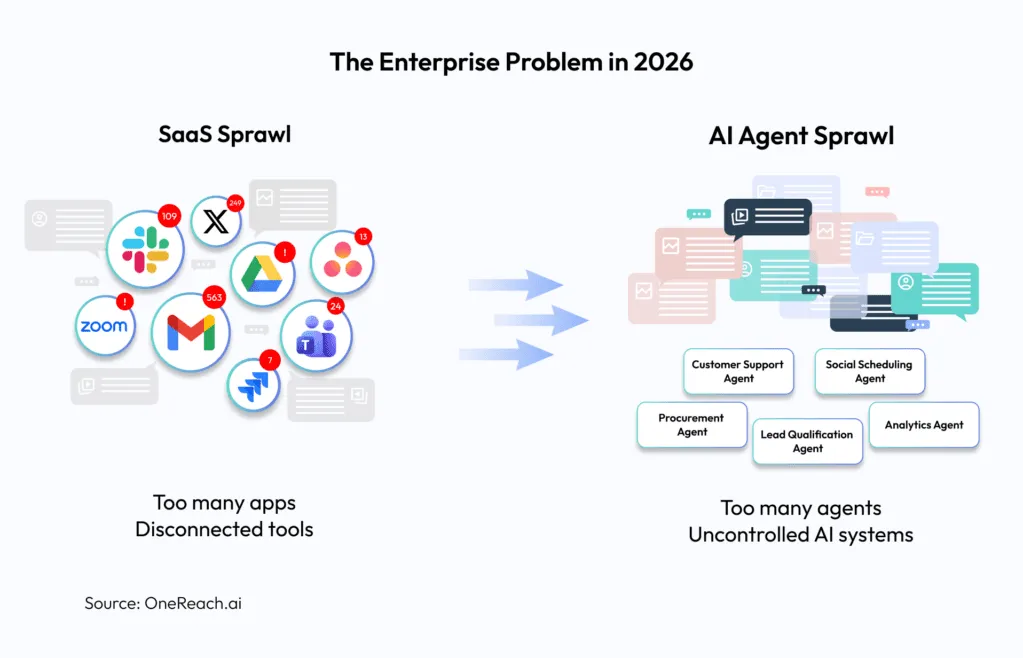
SaaS sprawl evolving into disconnected AI agent sprawl (Source: OneReach.ai)
The visible sign of AI sprawl is a growing tool count. The deeper problem is that each tool can reproduce part of the operating model around it.
A customer record may already exist in the CRM, billing platform, support system, and a spreadsheet. When an AI service needs context, the quickest implementation is often to copy or synchronize that information into another database, knowledge index, or vector store. The company now has one more version of the customer, with its own update schedule and access rules.
Workflows are duplicated in the same way. A support request may be summarized in email, categorized by an AI assistant, entered into the CRM, routed through an automation platform, and copied into a project management tool. Each task may be faster, while the complete process still contains several handoffs and no clear owner.
Business logic also begins to diverge. One team may define a high-priority lead through CRM rules, another through a prompt, and another through an AI scoring model. These systems can produce different answers from the same data.
This matters because business logic is no longer held only in application settings or formal process documents. It can also sit inside prompts, agent instructions, automation rules, and model configurations that different teams manage independently.
AI does not create fragmentation from nothing. It amplifies weaknesses that already exist across systems, data, and decision-making.
Automating a fragmented process can make individual tasks faster while making the overall workflow harder to control.
Fragmented Systems Make Enterprise AI Harder to Govern, Measure, and Scale
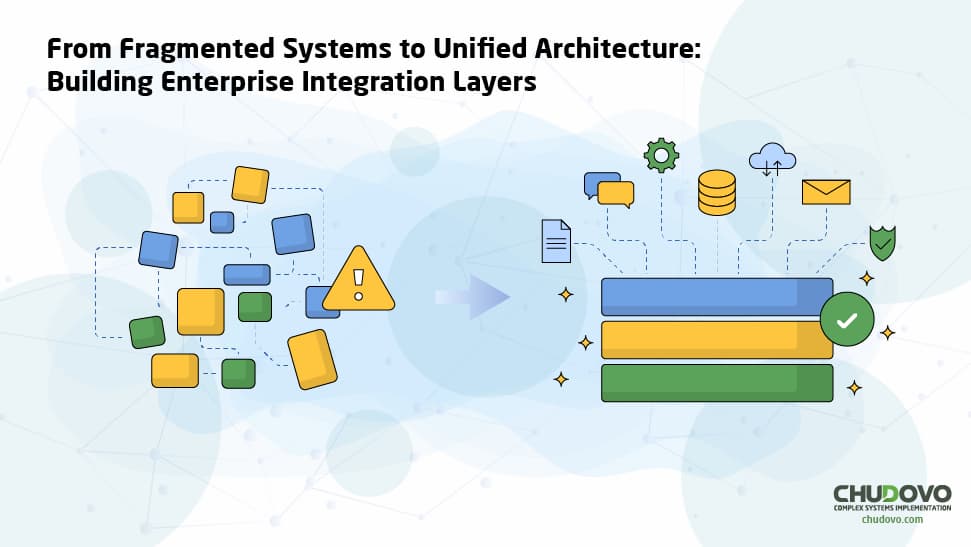
Fragmented enterprise systems consolidated through an integration layer (Source: Chudovo)
Once AI is distributed across disconnected systems, governance becomes inconsistent. Teams may use different models, prompts, permissions, data sources, and review procedures. Policies must now cover AI services that retrieve information, generate outputs, and sometimes initiate actions.
The 2026 MuleSoft Connectivity Benchmark Report found that 50% of AI agents operate in isolated silos, 95% of organizations face integration challenges, and only 54% have a centralized governance framework. The same report found that 96% of IT leaders believe AI-agent success depends on seamless integration.
In a fragmented environment, even a clear company-wide AI policy may be difficult to enforce. IT may approve one set of tools, while individual teams connect other assistants to documents, customer data, source code, or internal knowledge without the same controls. This is why enterprises need visibility into what AI systems actually do not only which tools are being used, but also what data they access, which actions they trigger, and where human oversight is required.
Measurement becomes equally difficult. A team may report hours saved by an assistant, but that does not reveal whether the full workflow became faster, cheaper, or more reliable. The output may still require manual review, re-entry, or correction because it used outdated data.
In the 2025 McKinsey State of AI survey, more than 80% of respondents said their organizations were not yet seeing a tangible impact on enterprise-level EBIT from generative AI. The figure does not make fragmentation the only cause, but it shows why local adoption should not be mistaken for enterprise-wide value.
A faster task is not the same as a faster operation. Enterprise AI cannot scale consistently when every team operates on different systems, rules, and data sources. Without a shared foundation, every additional use case introduces more exceptions.
Integration Matters More Than Adding Another AI Tool
Many AI programs begin with a product question: Which model, copilot, or agent should the company buy next?
A better question is: How will AI connect with the systems and decisions the company already depends on?
There are three layers that matter.
Integrate data around clear systems of record. AI should retrieve current information from trusted sources rather than rely on uncontrolled copies. Customer, financial, employee, and operational data need defined ownership, synchronization rules, and access policies.
Integrate AI into the workflow itself. Employees should not have to move results manually between an AI interface, CRM, spreadsheet, and approval tool. AI creates more value when it can read the context, support a defined step, update the correct system, and pass work forward without creating a parallel process.
Integrate business rules and accountability. Approval thresholds, risk controls, escalation paths, and human-review requirements should remain consistent across the workflow instead of being recreated for every AI tool.
Integration does not mean connecting every application directly to every other application. That can produce a fragile network of point-to-point integrations that becomes harder to maintain whenever one system changes.
The objective is to create a coherent path for data, decisions, and work. APIs, orchestration layers, and internal platforms should support that path while allowing specialized applications to continue serving the functions for which they were designed.
Replacing one isolated tool with another rarely solves software fragmentation. The meaningful improvement comes from redesigning how systems cooperate.
Connected Systems Are the Real Foundation for Enterprise AI
Enterprise AI delivers more value when it operates on connected systems, reliable data, standardized workflows, and shared governance. On that foundation, it can support an end-to-end outcome rather than only accelerate an isolated task.
In a connected customer-service workflow, AI can use the same approved customer record as sales, billing, and support. It can summarize a case, recommend an action, apply the correct policy, route exceptions for human review, and update the source system.
Performance can then be measured through resolution time, rework, service quality, and cost across the whole process - not simply through the number of AI-generated responses.
The right architecture will differ by organization. Some companies need stronger API integration between existing platforms. Others need an internal platform that gives teams one operational interface while preserving specialist systems underneath. For business-critical processes, a tailored ERP or operational system may be more effective than assembling more SaaS tools.
This is how Twendee approaches enterprise AI: start with the workflow and data architecture, connect the systems that should operate together, and build internal or ERP platforms where the existing stack cannot support a coherent process. AI then becomes a capability within the operation rather than another destination employees must visit.
The companies that scale AI successfully may not be those with the most AI tools. They are more likely to be those with the clearest workflows, strongest data ownership, and most connected operational foundation.
Conclusion:
AI sprawl is making software fragmentation more visible, but the answer is not simply to reduce the number of tools. The real objective is to remove disconnected data flows, duplicate decisions, and manual handoffs.
Before adding another assistant, copilot, or agent, businesses should examine whether the systems underneath it can work as one. Twendee helps companies integrate disconnected software, consolidate operational workflows, and build ERP or internal platforms that create a stronger foundation for scalable AI. Visit the Twendee website, follow Twendee on LinkedIn, or book a conversation through Twendee’s Calendly.
