

For years, enterprise software pricing was built around seats. A company paid for a fixed number of users, added more seats as the team grew, and renewed the contract annually.
That model is still useful. It is simple to understand, easy to forecast, and familiar to enterprise buyers.
But SaaS products are changing. More software now includes AI features, API usage, automation runs, data processing, workflow execution, and infrastructure-heavy capabilities. In that environment, value does not always grow with headcount.
A small team can generate heavy usage. A large team can use the product lightly. An AI workflow can create meaningful business value without involving many human users at all.
This is why usage based pricing is becoming more important. The shift is not only about changing the pricing page. It changes the economics behind SaaS products: what companies measure, how they bill, how they explain value, and how they protect margins.
Why SaaS Is Moving Beyond Pure Seat-Based Pricing
The market is not moving from seat-based pricing to usage-based pricing overnight.
A more realistic shift is happening: many SaaS companies are moving toward hybrid models.
OpenView found that 15% of SaaS companies had rolled out a largely usage-based or pay-as-you-go model, while 46% used a hybrid approach that combines traditional subscription with usage-based elements. That distinction matters because it shows that companies are not simply abandoning subscription revenue. They are adding usage signals where pricing needs to reflect real product consumption more accurately.
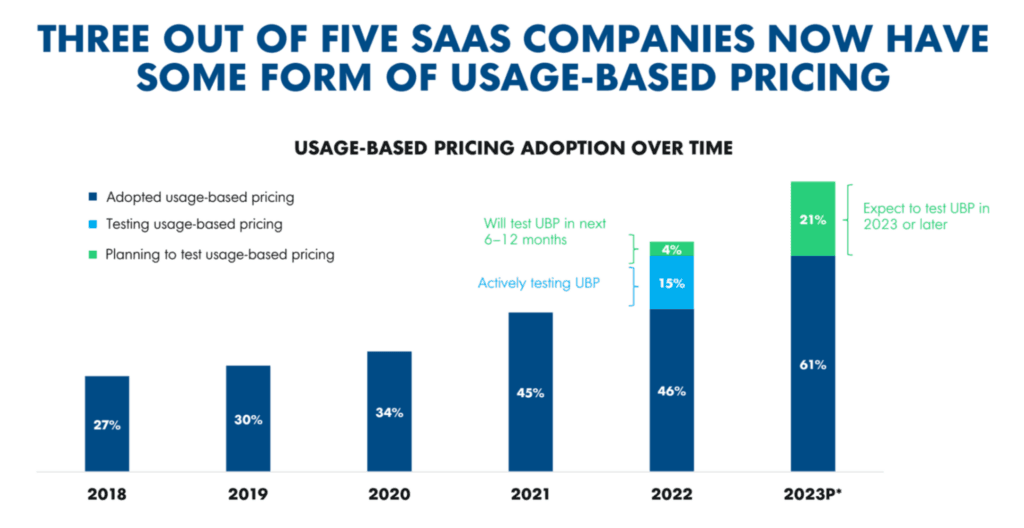
Usage-based pricing adoption among SaaS companies has increased over time, showing a broader shift toward pricing models that include product consumption. (Source: OpenView)
Metronome’s State of Usage-Based Pricing 2025 also shows how recent the shift is. Among companies with usage-based pricing, 78% adopted it within the last five years. This suggests that usage-based models are no longer limited to infrastructure providers or API-first companies. They are moving into a wider software market.
AI is one reason this conversation is getting louder.
Traditional SaaS pricing assumes that software value grows with the number of people using it. AI changes that assumption. A product may now complete work, generate analysis, process documents, or execute workflows with fewer direct users.
At the same time, AI features can create variable costs. One simple AI query may cost very little. A multi-step agent that reads documents, calls tools, processes data, and generates recommendations may cost much more to run.
Pure seat-based pricing can become uncomfortable in both directions. Heavy users may create costs that the subscription does not cover. Light users may feel they are paying for capacity they do not use.
Consumption pricing helps connect revenue more closely to real usage. But it also creates a new operational challenge: the company must be able to measure, rate, bill, and explain usage accurately.
That is where the pricing strategy becomes a systems problem.
Billing and Metering Are Becoming Strategic SaaS Capabilities
The hardest part of consumption-based pricing is not saying “pay for what you use.”
The hard part is making that promise work in real operations.
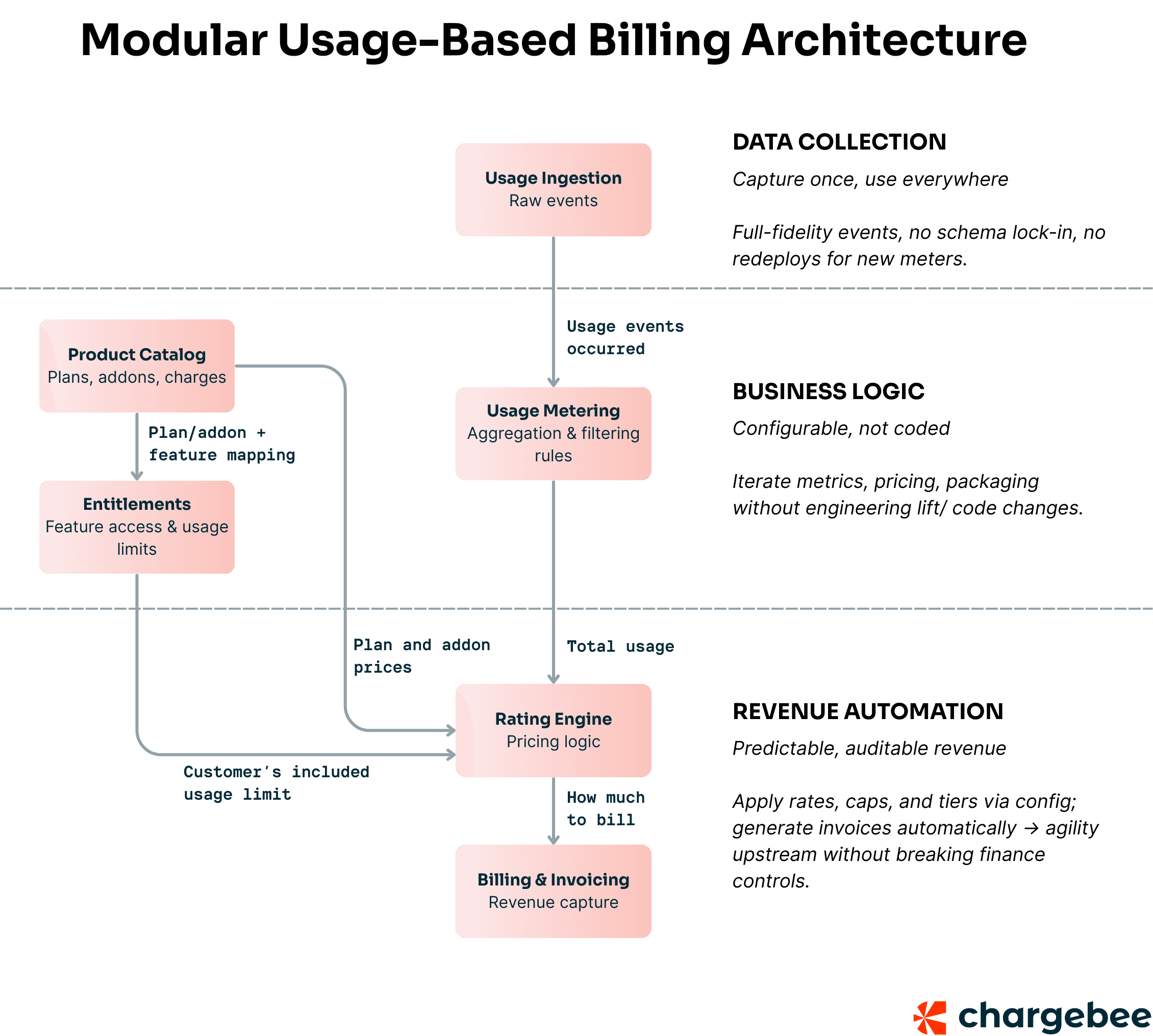
Usage-based billing requires a connected flow from usage ingestion and metering to rating logic, entitlements, billing, and invoicing. (Source: Chargebee)
A usage-based model needs clear answers to practical questions:
What counts as billable usage?
When is usage captured?
Which system records the usage event?
Which usage is included in the plan?
Which usage becomes overage?
How do discounts or enterprise contracts change the calculation?
How can the customer verify the invoice?
Without the right infrastructure, usage-based pricing can create confusion instead of growth.
Zuora reports that 74% of finance and accounting leaders say their systems cannot support the complex pricing structures their businesses need. For SaaS companies, Zuora also reports that 95% of SaaS finance leaders say technology gaps are hindering quote-to-cash processes.
This is the operational side of pricing that many teams underestimate.
Product teams may define the usage metric. Sales may sell a flexible contract. Marketing may position the model as fair and scalable. But finance and operations still need to turn that model into invoices, reporting, revenue recognition, and customer explanations.
When the billing foundation is weak, several problems appear.
Revenue leakage happens when usage is generated but not captured or billed correctly.
Billing disputes increase when customers cannot understand why charges changed.
Manual reconciliation grows when finance teams need to compare usage data across product logs, spreadsheets, contracts, and billing tools.
Sales flexibility decreases when the business cannot support custom pricing, committed usage, overage rules, or hybrid contracts.
Zuora states that 94% of SaaS leaders reject non-standard deals because of quote-to-cash gaps. That is a strong signal. Weak billing infrastructure does not only slow internal teams. It can directly limit commercial opportunities.
This is why SaaS billing is no longer just a back-office function. In a consumption-based business model, billing becomes part of product monetization.
Accurate metering is the foundation.
A SaaS product may collect usage from application logs, workflow engines, API gateways, AI services, internal databases, or third-party infrastructure. If those events are inconsistent, duplicated, delayed, or poorly mapped to customer accounts, the invoice becomes hard to trust.
That trust matters even more for enterprise customers.
A customer may need to understand usage by team, workspace, project, department, region, or cost center. If the vendor cannot explain what created the charge, usage-based pricing can feel unpredictable rather than fair.
m3ter notes that 63% of software leaders lack full confidence in their billing data lineage and traceability. That is especially important for usage-based pricing because the customer is not only buying access. They are paying for measurable consumption.
A strong usage-metering system should support:
Clear event tracking
Consistent usage units
Accurate timestamps
Customer and account mapping
Rules for included usage and overage
Audit trails
Invoice-level usage explanation
Internal visibility into margins and cost
For AI SaaS, the metric design can become even more complex. The product may need to track model calls, tokens, documents processed, workflow runs, agent tasks, API calls, compute time, or successful actions.
Not every metric should become a pricing unit. Some metrics are better for cost management or product analytics. But the company still needs a reliable system to understand what the product is doing and what it costs to deliver.
This is where software monetization becomes more technical.
Pricing is no longer only a commercial decision made by sales, finance, and leadership. It must be connected to product architecture, event tracking, billing automation, customer reporting, and revenue operations.
How SaaS Companies Should Prepare for Consumption Pricing
Not every SaaS product should move fully to usage-based pricing.
Some products still work better with seats, flat subscriptions, or tiered plans. The right model depends on how customers experience value, how costs scale, and how predictable the buyer needs spending to be.
For many companies, a hybrid model is the better first step.
A SaaS business can keep a subscription base to provide predictable revenue, then add consumption components where usage clearly reflects value or cost. Examples include API calls, AI credits, transaction volume, workflow automations, data processed, or advanced report generation.
Before making that shift, the company needs four layers.
1. Usage metering
The system must capture usage events accurately and consistently. It should know who used what, when it happened, which account it belongs to, and whether the event should be billable.
2. Rating logic
Raw usage must be converted into billable usage. The system needs to handle included quotas, tiered pricing, discounts, credits, overage, and customer-specific contract terms.
3. Billing automation
Invoices, adjustments, renewals, credit notes, tax handling, and payment flows should not depend heavily on manual spreadsheets. As pricing becomes more flexible, manual billing becomes harder to control.
4. Customer visibility
Customers need a way to understand their usage before the invoice arrives. Usage dashboards, alerts, and invoice explanations can reduce confusion and increase trust.
This is where Twendee’s role becomes practical.
Twendee can build subscription, billing, and usage-metering platforms for SaaS products. That includes systems for tracking usage events, managing subscription plans, applying rating rules, calculating overage, integrating billing workflows, and creating dashboards for internal teams and customers.
For SaaS companies moving toward hybrid or consumption-based models, Twendee can also design scalable monetization systems that match the product’s real value metric.
The goal is not just to launch a new pricing model on the website.
The goal is to build the operational foundation that allows the pricing model to work reliably after customers start using it.
Conclusion
Usage based pricing is changing enterprise software economics because software value is no longer always tied to the number of users.
AI, APIs, automation, and data-heavy workflows are pushing SaaS vendors toward pricing models that reflect real product consumption. But consumption pricing only works when companies can measure usage accurately, bill it correctly, and explain it clearly.
For SaaS businesses, metering, billing, quote-to-cash, and customer usage visibility are becoming strategic capabilities.
Twendee helps software companies build the systems behind this shift: subscription platforms, usage-metering infrastructure, billing workflows, and scalable monetization systems that can support modern SaaS pricing in real operations.
Book a call: Calendly
Read latest blog: Process Ownership Becomes Harder as Organizations Scale
