

Most companies do not suffer from a lack of data. They suffer from delayed data movement. Sales teams update CRM, finance teams approve expenses, operations teams track tasks, and managers make decisions from reports that are already a few steps behind reality. The problem is rarely one single system. It is the gap between systems. When ERP, CRM, internal tools, spreadsheets, and approval workflows do not sync fast enough, business decisions start moving on yesterday’s context. That is why enterprise data integration is becoming a core operational issue, not only a technical project.
Why enterprise data integration is now a decision-making problem
Business leaders often describe slow decisions as a people problem: teams wait too long, managers ask for too many updates, or departments do not communicate enough. In many cases, the deeper issue is system latency.
A CRM may show that a deal has moved forward, but finance may not yet see the commercial terms. HR may update employee information, but project managers may still assign work based on old team structures. A customer issue may appear in support, but the account owner may not see it before the next sales conversation. None of these gaps look dramatic alone. Together, they create a business that moves with delayed visibility.
The data trust problem is already measurable. Precisely’s 2025 Data Integrity Trends and Insights found that 64% of organizations named data quality as their top data integrity challenge, while 67% said they do not completely trust the data they use for decision-making. That means many companies are trying to become data-driven while still doubting the data underneath their decisions. (Precisely)
Salesforce’s State of Data and Analytics research points to the same pressure from another angle. The report states that while 63% of organizations say they are data-driven, 84% admit their data strategies need major overhauls to make AI work. The biggest blocker is trapped data that prevents AI and analytics systems from getting the context they need. (Salesforce)
This is where enterprise data integration becomes urgent. The goal is not simply to connect tools. The goal is to make the business operate from a shared, current version of reality.
For growing companies, this problem often appears in familiar ways:
Sales decisions depend on CRM data that finance has not validated.
Budget decisions rely on exported spreadsheets instead of live operational data.
Managers ask for manual updates because workflow status is scattered.
Customer follow-up slows down because support, sales, and delivery data are disconnected.
Reports are accurate only after someone spends hours reconciling data from multiple systems.
These are not just “data problems.” They are operating delays. When the data pipeline enterprise teams depend on is slow, decision cycles become slow too.
How enterprise data integration turns scattered systems into real-time data systems
A modern company rarely runs on one platform. ERP manages core operations. CRM manages customers and pipeline. HR systems manage people data. Finance tools manage payments and approvals. Project management platforms track execution. Internal tools support requests, documents, and workflows.
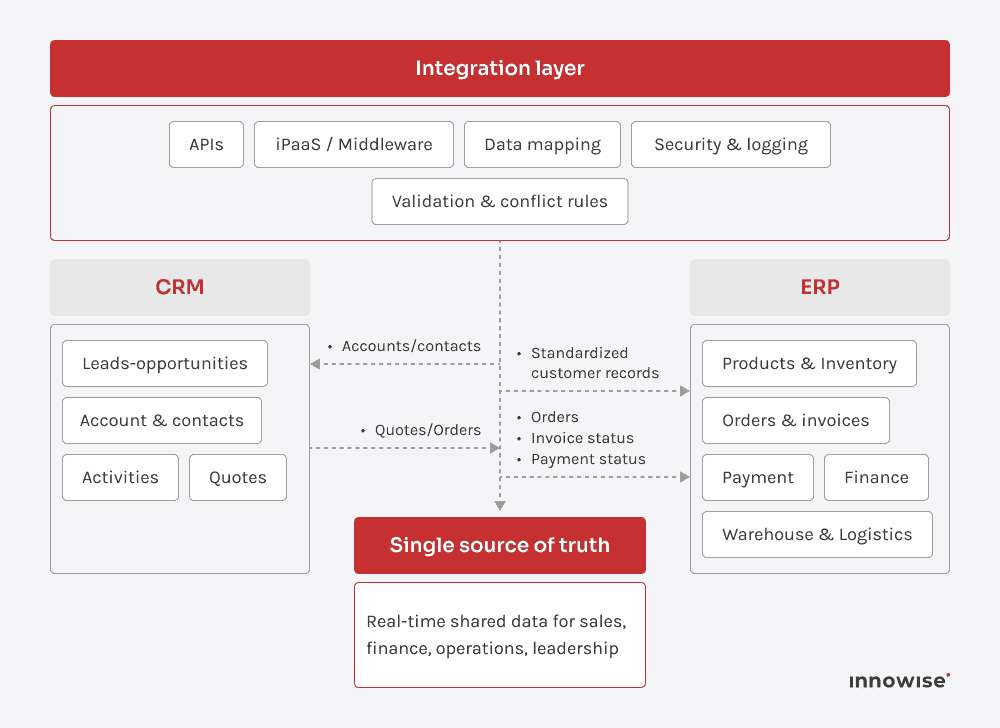
CRM and ERP integration creates a single source of truth (Source: Innowise)
The challenge is that each system may be useful on its own, while the enterprise data flow across systems remains weak. This is why integration becomes the bottleneck. A company can have strong tools and still operate poorly if the data between them does not move at the speed of the business.
The scale of this challenge is visible in integration research. Salesforce’s 2025 MuleSoft Connectivity Benchmark found that 95% of IT leaders struggle to integrate data across systems, and only 29% of applications are typically connected within organizations. The same report notes that disconnected systems affect the accuracy and usefulness of AI agents. (Salesforce)
That finding matters because AI, automation, and analytics all depend on the same foundation: reliable system data integration. If applications are not connected, AI cannot see enough context. If data pipelines are delayed, dashboards become backward-looking. If workflows rely on manual updates, automation becomes fragile.
1. ERP and CRM integration closes the gap between customer activity and business control
CRM is where customer activity happens. ERP is where business control happens. When these systems are disconnected, teams may see different versions of the same customer reality.
A sales team may mark a deal as likely to close, but finance may not know whether payment terms are acceptable. A customer may request a change in scope, but delivery planning may not receive the update in time. A renewal may depend on service history, but account managers may only see pipeline notes.
ERP and CRM integration helps close that gap by connecting customer-facing activity with internal execution. A customer record becomes more than a sales object. It becomes part of a wider operating context that includes contracts, invoices, delivery status, support issues, approvals, and revenue visibility.
This is especially important for AI-assisted workflows. A sales assistant can only recommend useful next actions if it can see more than CRM notes. It needs account status, payment history, delivery risks, and internal ownership. Without enterprise data integration, AI suggestions may sound confident but miss the operational reality behind the customer.
2. Real-time data systems reduce the cost of manual reconciliation
Many companies still depend on a hidden layer of manual data work. Employees export reports, clean spreadsheets, compare records, chase updates, and prepare summaries for managers. This work is often invisible because it sits between meetings, reporting cycles, and approval processes.
MuleSoft’s 2025 Connectivity Benchmark also found that IT teams spend 39% of their time creating custom integrations and automations. That number signals how much operational effort is consumed by making systems talk to each other.
Real-time data systems reduce this burden by moving updates automatically across the right systems. When CRM, ERP, finance, HR, and internal tools share data through structured pipelines, teams spend less time reconciling and more time acting.
The value is not only speed. It is confidence. Managers can make decisions without asking whether the latest spreadsheet reflects the latest workflow. Finance can review approvals with current information. Sales can act with clearer customer context. Operations can see bottlenecks before they become delays.
3. A strong data pipeline enterprise architecture supports AI and automation later
Enterprise data integration is increasingly tied to AI readiness. Salesforce found that 84% of data and analytics leaders believe their data strategies need overhauls for successful AI, which shows that data architecture is now a direct constraint on AI value. (Salesforce)
This is why a data pipeline enterprise strategy should not be treated as a backend technical upgrade. It is the foundation for future automation. Before AI can route requests, detect anomalies, generate operational summaries, or recommend decisions, it needs timely data from the systems where work actually happens.
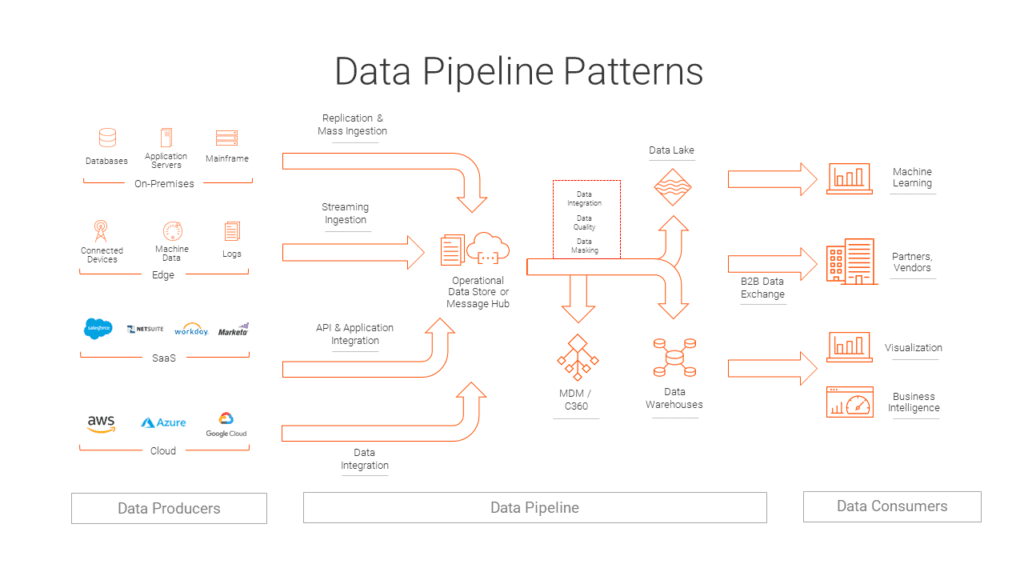
Enterprise data pipeline connects systems for AI and analytics (Source: Data Engineering Wiki)
For example, an AI assistant cannot accurately summarize business performance if sales data is current but finance data is delayed. It cannot flag project risks if task status and resource allocation live in separate systems. It cannot recommend budget action if expense, approval, and department data are not connected.
Integration turns AI from a surface-level assistant into an operational layer. Without it, AI remains limited to whatever data happens to be available at the moment.
What strong enterprise data integration should look like in daily operations
Good enterprise data integration is not measured by how many systems are connected. It is measured by whether the right data moves to the right place at the right time with enough governance to be trusted.
The global market reflects this shift. MarketsandMarkets estimates the data integration market at USD 17.58 billion in 2025, growing to USD 33.24 billion by 2030 at a 13.6% CAGR. The same research projects real-time data integration as one of the fastest-growing application segments.
That growth is not happening because companies want more technical infrastructure for its own sake. It is happening because fragmented systems now limit operational speed, AI readiness, and decision quality.
In daily operations, strong system data integration should create a few practical outcomes.
Data should move automatically across core systems instead of relying on manual exports. A CRM update should trigger the right internal visibility. A finance approval should reflect the latest request status. A staffing change should update relevant workflow ownership. The point is not to remove people from decisions. It is to remove unnecessary waiting from the decision process.
Data should also keep its business meaning as it moves. Integration fails when systems exchange fields but lose context. A “customer” in CRM, a “payer” in finance, and an “account” in operations may refer to the same entity, but without shared definitions, reporting and automation become inconsistent. Strong enterprise data flow requires common data logic, not only APIs.
Governance matters as much as speed. IBM’s 2025 Cost of a Data Breach Report found that 13% of organizations reported breaches involving AI models or applications, and 97% of those lacked proper AI access controls. While this is a security finding, it carries an important lesson for data integration: moving data faster without access control, ownership, and monitoring can increase risk.
This is where Twendee’s role becomes relevant. For companies modernizing operations, Twendee helps build data pipelines and real-time synchronization systems that connect ERP, CRM, and internal platforms around actual business workflows. Twendee ERP also supports this foundation by helping data flow across HR, finance, CRM, approval, and internal operation modules, so teams can work from a more consistent operating layer.
The strategic value is not only having a connected ERP. It is creating a business environment where decision-making, automation, reporting, and future AI integration can all rely on the same operational truth.
Conclusion
Data does not create business value just because it exists. It creates value when it moves fast enough, stays consistent enough, and reaches the people and systems that need it.
That is why enterprise data integration has become central to modern operations. When ERP, CRM, finance, HR, and internal systems are connected through reliable data pipelines, decisions no longer depend on delayed reports or manual reconciliation. They can move with the business.
For companies preparing for automation and AI adoption, Twendee helps build the real-time data foundation needed to turn scattered systems into connected operations.
Book a call: Calendly
Read latest blog: Why Many AI Projects Fail Before Reaching Production Systems
