

Digital transformation strategy is often framed as a technology upgrade. New platforms are deployed, dashboards are built, and data pipelines are introduced. Yet many organizations quietly discover that nothing fundamentally changes. Teams still rely on manual workarounds, decisions remain slow, and operational inefficiencies persist beneath the surface.
The real shift is less about what systems are installed and more about how work actually gets done. Digital transformation, when executed effectively, rewires operations, not just software stacks. That distinction is where success or failure is determined.
Why Digital Transformation Strategy Fails Without Operational Change
A growing body of evidence suggests that most enterprise digital transformation efforts underperform not because of poor technology choices, but because workflows remain untouched. According to McKinsey & Company, around 70% of digital transformation initiatives fail, with the most common reason being resistance to change in processes and ways of working rather than technical limitations (McKinsey).
This pattern is consistent across industries. Organizations invest heavily in enterprise systems but layer them on top of outdated operational models. The result is a mismatch between system capabilities and real-world execution.
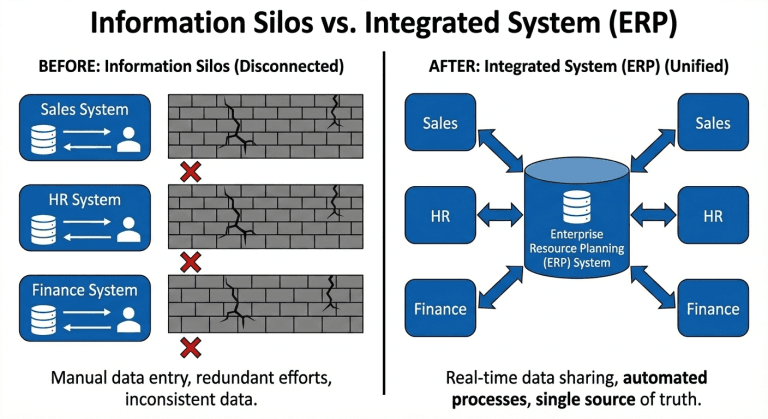
Siloed systems vs. integrated ERP: eliminating manual workflows and enabling real-time, unified operations. (Source: OCO)
Several structural issues typically emerge:
Software overlays broken processes: Instead of redesigning workflows, companies digitize existing inefficiencies. Manual approvals, duplicated data entry, and fragmented communication persist within new tools.
Lack of process ownership: Digital initiatives are often led by IT rather than operations. Without clear ownership of end-to-end processes, transformation becomes fragmented.
Disconnected systems and teams: Even with modern platforms, siloed departments prevent data and workflows from flowing seamlessly across the organization.
Research from Boston Consulting Group shows that companies that focus on process redesign alongside technology are 1.5x more likely to achieve sustainable value from digital transformation (Boston Consulting Group).
The implication is clear. A digital transformation strategy that prioritizes tools over operations will almost always deliver incremental improvements at best. Real transformation begins when organizations question how work should be structured in a digital-first environment.
Digital Transformation Strategy as an Operations Transformation Engine
At its core, enterprise digital transformation is not a technology initiative but an operational redesign. A strong digital transformation strategy reshapes how decisions are made, how data moves across the organization, and how workflows are executed at scale. This is where business process transformation and operations transformation become the actual drivers of value.
What differentiates high-performing organizations is not the tools they adopt, but how deeply those tools are embedded into operational logic. In practice, this shift tends to happen across three structural layers:
1. From task-based execution to system-driven workflows
Traditional enterprises operate through fragmented human tasks. Each department executes its own responsibilities, often relying on manual coordination, spreadsheets, and ad hoc communication. This creates hidden inefficiencies that no software alone can solve.
A system-driven model replaces this with workflow orchestration, where processes are defined, automated, and continuously optimized across systems. Instead of individuals pushing work forward, systems trigger actions based on real-time data.
For example, in a modern sales operation, lead qualification, follow-ups, and forecasting are not handled manually. CRM systems integrate with marketing automation and internal tools to trigger actions automatically, reducing lag and human error.
According to Deloitte, enterprises implementing workflow automation at scale can cut operational costs by up to 30% and improve efficiency by 20–25%, primarily by eliminating redundant manual steps (Deloitte).
The key insight is that automation is not about replacing people. It is about removing coordination overhead, which is often the largest hidden cost in enterprise operations.
2. From siloed functions to integrated operations
Most digital transformation strategies fail because they automate functions, not processes. Finance, sales, and operations may each have modern tools, but the lack of integration creates friction at every handoff point.
An effective enterprise automation strategy focuses on end-to-end process integration. Systems such as ERP, CRM, and internal platforms must operate as a unified layer rather than isolated tools.
When this integration is achieved, three changes become visible:
Data stops being duplicated across systems and becomes a single source of truth
Decision-making shifts from delayed reporting to real-time visibility
Bottlenecks can be measured and optimized continuously
Research from Gartner shows that organizations with highly integrated operations achieve up to 2x higher operational agility, particularly in environments with rapid demand changes (Gartner).
However, integration is rarely just a technical challenge. It requires aligning workflows, ownership, and data structures across the business. This is where many transformation efforts stall.
3. From reactive processes to proactive operations
The final shift is from reacting to problems toward anticipating them. Traditional operations rely on reports and historical data, which means decisions are always delayed.
In contrast, modern digital transformation embeds intelligence directly into workflows. Predictive models, automated alerts, and real-time analytics enable systems to surface risks and opportunities before they materialize.
This is especially critical in areas like supply chain, customer operations, and financial planning, where timing directly impacts cost and performance.
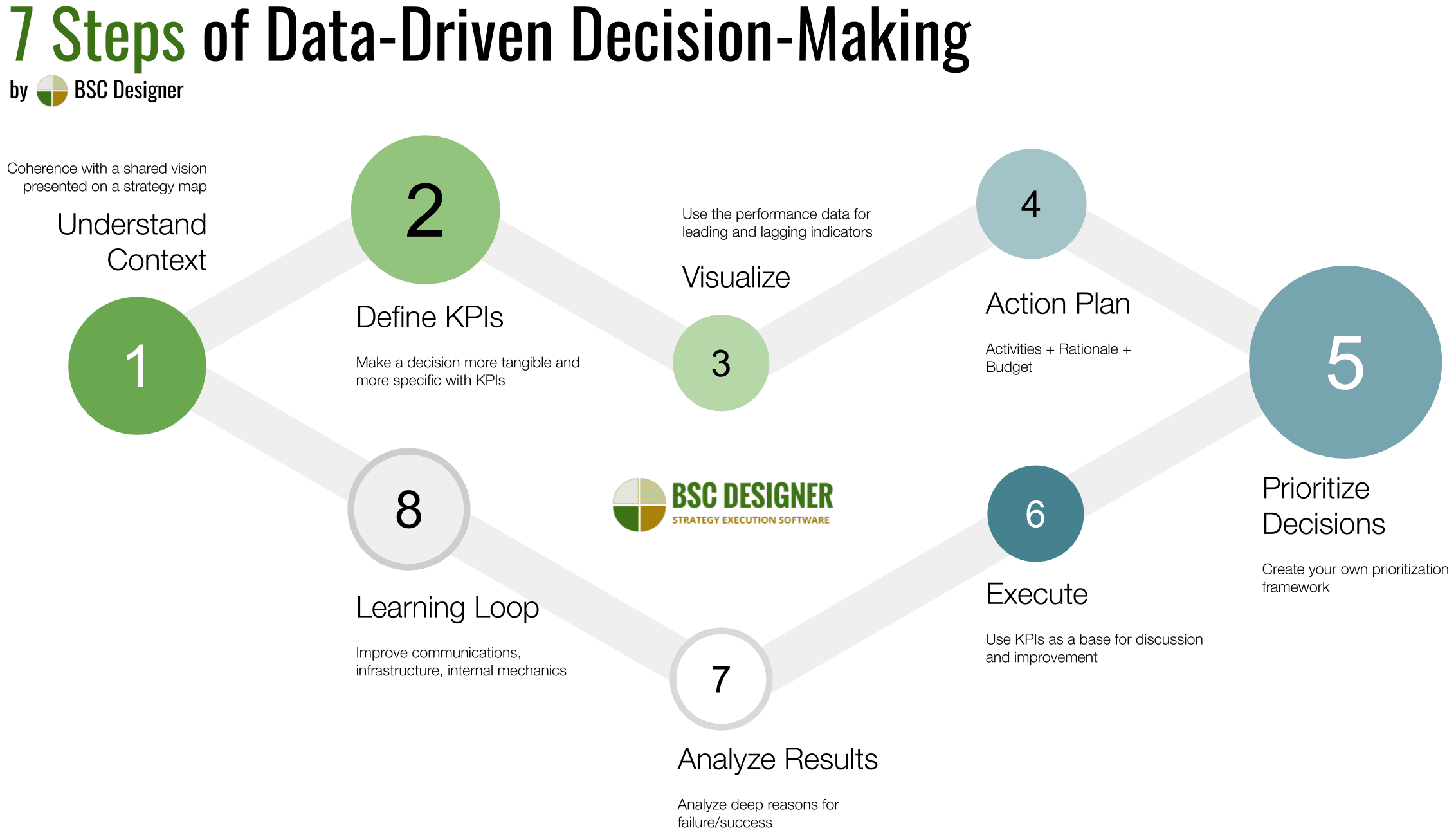
From data to action: structured decision-making enables proactive, system-driven operations. (Source: BSC Designer)
According to McKinsey & Company, companies that effectively use predictive analytics in operations can improve forecasting accuracy by 20–50%, leading to significant cost and efficiency gains (McKinsey).
The challenge is not access to data, but the ability to operationalize it. Many organizations build dashboards but fail to connect insights to execution.
This is where Twendee becomes strategically relevant. Rather than focusing on isolated tools, We works at the intersection of systems and operations: designing automation layers, internal platforms, and workflow-driven architectures that embed intelligence directly into how work is executed. This approach ensures that data is not only visible but actionable within daily operations.
In that sense, a mature digital transformation strategy is not defined by the number of systems deployed, but by how seamlessly operations run without friction.
Building a Digital Transformation Strategy That Actually Changes Operations
Most digital transformation strategies fail at the execution layer. Not because companies lack tools, but because they underestimate how deeply operations need to change.
The gap usually appears after implementation. Systems are live, but teams still rely on manual coordination, duplicated data, and informal processes. At that point, transformation becomes a sunk cost rather than a performance driver.
To avoid this, the strategy must be built around how operations break in reality, not how they are designed on paper.
1. The hidden failure: Workflows that look digital but behave manually
In many enterprises, processes appear digitized but still operate like legacy systems underneath.
A typical example is order processing:
Data is entered into an ERP
Teams still export to Excel for validation
Approvals happen via email or chat
Final updates are manually re-entered
From a system perspective, everything is “digital.” From an operational perspective, nothing has changed.
This creates three invisible costs:
Latency between steps (waiting for human action)
Data inconsistency across systems
Lack of accountability in decision points
According to McKinsey & Company, organizations that fail to redesign workflows see less than 30% of expected ROI from digital transformation investments (McKinsey).
The issue is not tooling. It is that workflows were never re-architected.
2. What real operations transformation looks like
When digital transformation strategy is executed correctly, the change is visible at the workflow level, not the system level.
Instead of layering tools on top of processes, companies rebuild processes around system capabilities.
That shift typically includes:
Event-driven workflows: Actions are triggered automatically based on system events, not human reminders
System-level ownership: Processes are owned end-to-end, rather than split across departments
Embedded decision logic: Rules and approvals are built into systems, reducing manual intervention
This is where enterprise automation strategy becomes meaningful. It connects systems, but more importantly, it removes the need for coordination between them.
Research from Gartner shows that organizations adopting event-driven and automated workflows can reduce process cycle time by up to 40%, particularly in operations-heavy functions (Gartner).
The outcome is not just efficiency. It is predictability, which is critical for scaling operations.
3. Why most companies cannot execute this shift
Even when companies understand the need for operations transformation, execution becomes the bottleneck.
The challenge is not defining the strategy, but translating it into working systems:
Mapping real workflows (not ideal ones)
Converting business logic into system logic
Integrating fragmented tools into a unified flow
Maintaining flexibility as operations evolve
This requires a combination of process thinking and system architecture, which rarely exists in a single internal team.
This is where Twendee becomes structurally important in a digital transformation strateg. Instead of approaching transformation as isolated software delivery, Twendee works directly on rebuilding operational layers — designing internal systems, automation workflows, and integration architectures that reflect how the business actually runs.
That includes:
Translating real workflows into system-driven execution
Building internal platforms that eliminate manual coordination
Embedding automation into daily operations, not just dashboards
The difference is subtle but critical. It shifts digital transformation from “systems that support operations” to systems that become operations.
Conclusion
Digital transformation strategy no longer hinges on deploying new tools. It depends on whether operations are fundamentally redesigned to work differently. Without changing workflows, decision logic, and system integration, even the most advanced technologies only digitize inefficiencies.
Organizations that succeed treat transformation as an operational challenge, not a technical one. They focus on how work flows, how systems interact, and how automation removes friction from execution. This is where measurable impact emerges, in faster processes, clearer ownership, and scalable operations.
In that context, Twendee focuses on helping enterprises bridge the gap between strategy and execution, by building internal systems, automation layers, and integrated workflows that reflect how the business actually operates, turning digital transformation into a practical, scalable reality.
Contact us: LinkedIn & Fanpage
Book a call: Calendly
Read latest blog: Most Companies Are Still Not Ready for AI Adoption
