

Enterprise operations are becoming more time-sensitive. An order is placed, inventory changes, a payment succeeds, or a support ticket is escalated. Each event may start in one system, but its impact often spreads across ERP, CRM, warehouse, finance, customer service, dashboards, and AI agents.
That is why event-driven architecture matters. It helps enterprise systems respond when important business events happen, instead of waiting for the next scheduled data sync.
Scheduled Syncs Start to Break When Operations Need Real-Time Context
Scheduled synchronization is familiar because it is simple to understand. One system sends data to another every few minutes, every hour, or at the end of the day. For many back-office processes, that approach can still be enough.
The problem appears when the business needs to respond immediately.
If a payment is confirmed but the order system has not received the update, fulfillment may be delayed. If inventory changes but the storefront is still showing old stock, customers may place orders the business cannot fulfill. If a support case is escalated but the CRM has not reflected the latest status, the next person handling the case may work from incomplete information.
These are operational delays, not just technical delays. They create duplicated work, manual checking, customer confusion, and extra coordination between teams.
Confluent’s 2025 Data Streaming Report found that 86% of IT leaders rank data streaming as a strategic or important priority for IT investment. The report also notes that 89% say data streaming platforms ease AI adoption by tackling their AI pain points.
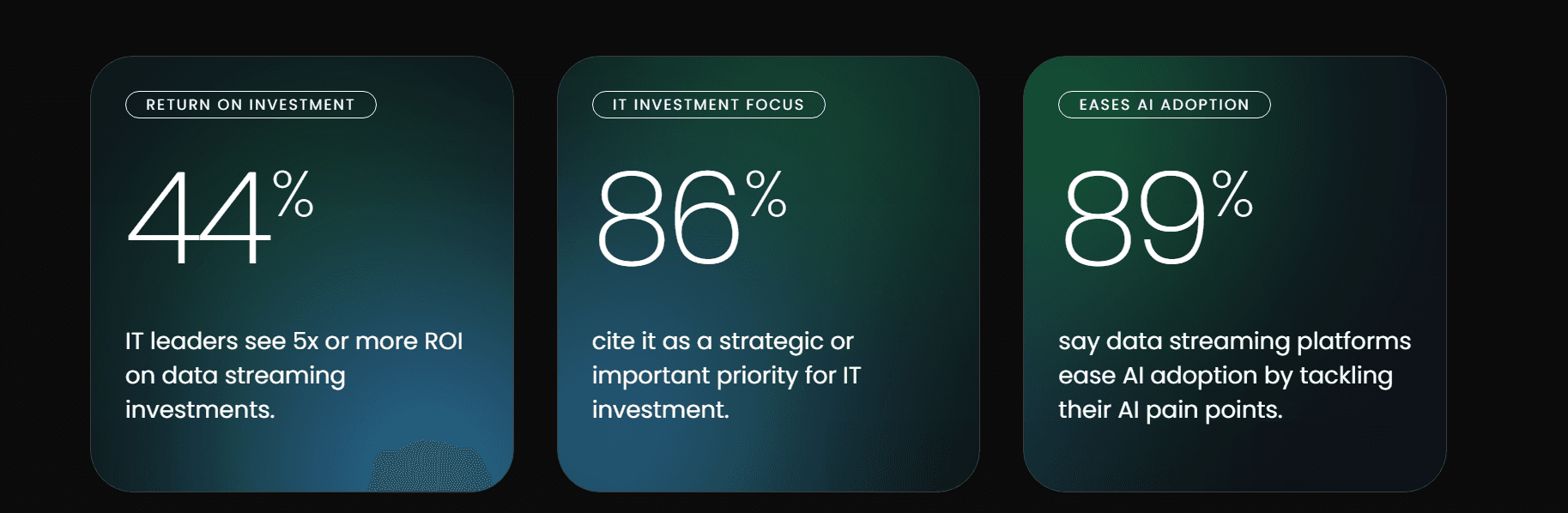
Data streaming is becoming a strategic priority for real-time enterprise integration, with 86% of IT leaders citing it as an important IT investment focus and 89% saying it helps ease AI adoption. (Source: Confluent)
As business operations become more connected, delayed data can slow the entire workflow.
Event-Driven Architecture Turns Business Changes Into System Signals
Event-driven architecture is an approach where systems communicate through events. An event is a meaningful change in state, such as an order being created, a payment being confirmed, inventory being updated, or a ticket being escalated.
Instead of one system constantly asking another system whether something has changed, the system where the change happens publishes an event. Other systems that need that information can then react.
For example:
OrderCreated can trigger fulfillment, customer notification, and sales reporting.
PaymentConfirmed can update finance, release delivery, and change order status.
InventoryUpdated can refresh storefront availability and notify procurement.
TicketEscalated can update CRM, alert a manager, and change support priority.
CustomerProfileChanged can update sales, support, and billing context.
Red Hat describes event-driven architecture as a design where events are captured as they occur, then sent from event producers to event consumers through event channels. Red Hat also notes that this approach supports decoupling because producers and consumers do not need to communicate directly, which can make systems more flexible and scalable.
In enterprise terms, the value is not simply that data moves faster. The value is that systems can respond to business changes at the moment they happen.
Real-Time Integration Matters Most in Time-Sensitive Workflows
Event-driven architecture is most useful when a delay creates operational risk or unnecessary manual work.
Order management is a clear example. When a customer places an order and completes payment, several systems need to react quickly. The order status should update. Inventory should be reserved or reduced. Fulfillment should begin. The customer should receive confirmation. Finance should record the transaction.
If those updates depend on scheduled syncs, every delay creates room for confusion.
Inventory is another strong use case. Stock levels affect storefront availability, sales conversations, warehouse planning, purchasing, and customer promises. When inventory changes, several teams need the same updated view. A delay of even a few minutes can matter in high-volume commerce, manufacturing, logistics, or retail operations.
Customer service also benefits from real-time integration. A support agent needs to know whether a payment succeeded, whether an order has shipped, whether the customer has an open complaint, or whether a previous case was escalated. If those signals sit in different systems and update slowly, the agent may give the wrong answer or ask another team to check manually.
For AI deployment, this becomes even more important. AI agents and automated workflows are only as useful as the context they receive. If an AI agent checks an order, recommends an action, or drafts a response based on outdated information, the business may still need people to verify everything manually.
This is why event-driven architecture should be viewed as more than an integration pattern. It is part of the operating foundation for real-time business systems and AI-enabled workflows.
Event-Driven Does Not Mean Everything Must Be Real-Time
A good event-driven strategy does not require every system to become real-time.
Some data can still move in batches. Monthly reporting, archival data, low-frequency master data, and non-urgent reference information may not need event-driven processing. In those cases, scheduled syncs can be simpler, cheaper, and easier to maintain.
Event-driven architecture becomes more valuable when four conditions are present:
A business event needs an immediate response.
One change must trigger updates across multiple systems.
Delayed information creates errors, duplicate work, or customer-facing issues.
AI agents, dashboards, or workflows need fresh operational context.
This distinction matters because event-driven architecture introduces its own design work. Teams need to define event names, ownership, consumers, retry behavior, failure handling, monitoring, and audit logs. If every data change becomes an event without a clear business reason, the architecture can become noisy and hard to manage.
The better question is not “should everything be real-time?” It is “which business events lose value when systems wait?”
The Hard Part Is Not Events, But Process Ownership
The technical side of event-driven architecture often gets most of the attention: brokers, streams, queues, event buses, schemas, and message formats. These tools matter, but they are not the first reason enterprise event-driven projects become difficult.
The harder part is process ownership.
Before building an event-driven flow, the business needs to answer several questions:
Which event is important enough to trigger other systems?
Which system is the source of truth for that event?
Which systems should react?
What should happen if the event fails?
Who owns the process when something goes wrong?
How should duplicate events be handled?
What needs to be logged for audit and support?
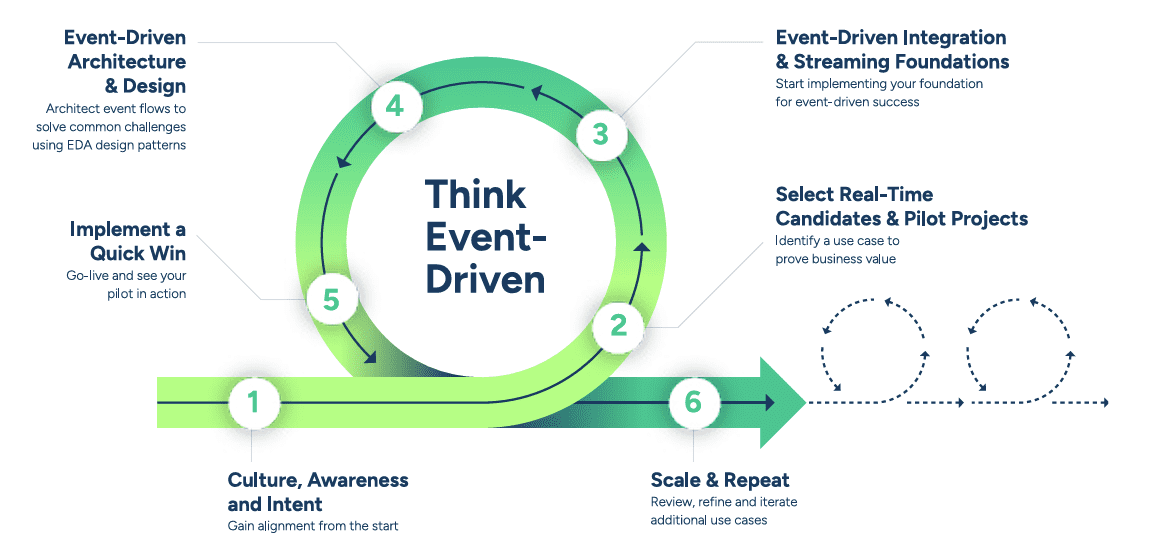
Successful event-driven architecture requires more than technical event flows. Enterprises need alignment, pilot use cases, integration foundations, design patterns, quick wins and a clear path to scale. (Source: Solace)
Without these answers, real-time integration can create a different kind of complexity. One system may send updates that another system interprets differently. A failed event may go unnoticed. A duplicated message may create duplicated records. A workflow may update quickly, but without enough traceability for the business to understand what happened.
Confluent’s 2025 report points to the same broader challenge: data streaming investments are growing because organizations need connected, real-time data for AI, analytics, and operational use cases. But the value depends on how well enterprises manage data quality, integration, and use-case alignment. (Source: Confluent)
In other words, the technology is useful only when it is tied to a real operating process.
Where Twendee Fits as an AI Deployment Partner
As an AI Deployment Partner, Twendee approaches event-driven architecture from the business workflow first, not from the technology stack alone.
The starting point is to identify which events actually matter to the business. For one company, that may be PaymentConfirmed or InventoryUpdated. For another, it may be TicketEscalated, InvoiceApproved, or CustomerProfileChanged. Once the critical events are clear, Twendee helps define which systems should publish them, which systems should react, and what controls are needed to make the flow reliable.
In practice, this may include:
Designing event-driven connections between ERP, CRM, and custom applications.
Replacing selected scheduled syncs where real-time updates have clear business value.
Keeping batch synchronization where real-time processing is unnecessary.
Building event flows around order, inventory, payment, customer, and approval updates.
Designing retry logic, audit logs, monitoring, and ownership rules.
Connecting event-driven integration to AI agents and automated workflows.
This is especially important when AI enters the workflow. An AI agent that supports customer service, finance, procurement, or operations needs accurate context from enterprise systems. If the underlying data still moves slowly, the agent may act on old information.
Twendee helps enterprises build the integration layer that lets AI systems respond to real operational events, while still keeping control over data, workflow ownership, and system behavior.
Conclusion
Event-driven architecture matters when delayed information creates operational cost, customer friction, duplicated work, or weak AI context. Order updates, inventory changes, payment confirmations, customer events, and support escalations need to move across systems at the right time.
As an AI Deployment Partner, Twendee helps businesses design event-driven connections around the processes that truly need real-time flow, connecting ERP, CRM, internal systems, and AI-enabled workflows so operations can respond when important business events happen.
Book a call: Calendly
Read latest blog: Multi-Cloud Strategy Is Back on the Agenda as AI Infrastructure Expands
