

Most ERP integration conversations start with a confident estimate: “a few weeks.” That number often describes a demo, a proof of concept, or a single data pull. Production-grade ERP web integration is different. It is not only about connecting systems. It is about turning messy operational history into reliable digital flows without breaking finance, inventory, or order processing. That is why the ERP integration timeline is commonly measured in months, not weeks. Below is a practical, phase-based view of the ERP integration timeline, why it stretches, and what reduces time without increasing risk.
ERP integration timeline across Discovery, Mapping, Testing, and Stabilization
A credible ERP integration timeline is rarely determined by coding speed. It is determined by how quickly a project can remove uncertainty around data truth, legacy logic, and operational ownership. ERP integration is essentially a risk-management exercise: anything not clarified early will reappear later as testing loops, reconciliation gaps, and a longer stabilization period. The timeline tends to expand when two “clocks” slow down at the same time: the decision clock (how fast owners can confirm rules and scope) and the data reality clock (how long it takes for ERP data and behaviors to become reliable enough for a modern web app).
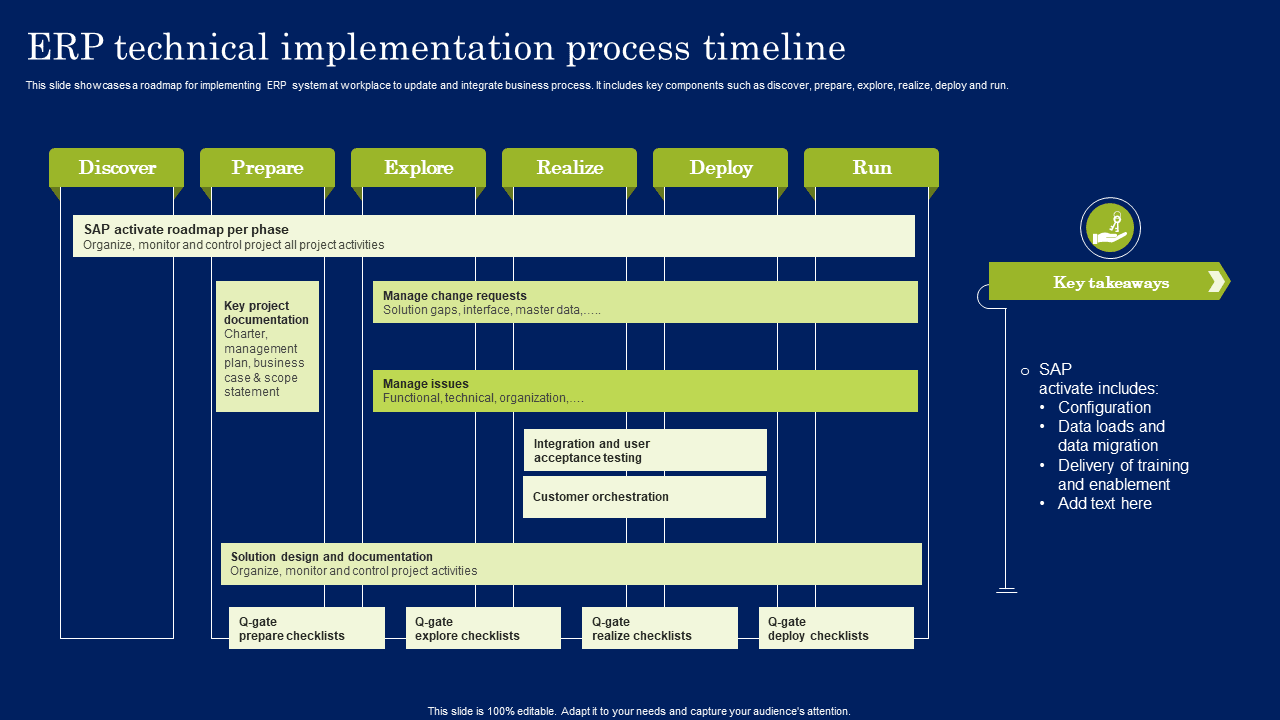
ERP implementation phases from Discover to Run (Source)
Phase 1: Discovery and readiness (typically 2–6 weeks)
Discovery should not be treated as “requirements gathering.” It is the phase where the integration is defined in operational terms, not technical terms. The work becomes meaningful when the project maps integration scope by business flow, because “order-to-cash” is never just an orders endpoint. It includes pricing and tax behavior, credit checks, fulfillment status logic, invoicing, returns, and exceptions that ops teams rely on daily. This is also where teams must decide, field by field, what the source of truth is. Many projects stall later because “ERP is the source of truth” sounds decisive but remains ambiguous in practice. Customer addresses, pricing, inventory availability, and invoice status often have different ownership once real processes are examined.
Keep only these essential outputs in view:
Clear owners for each flow and approval gate
Source-of-truth decisions for critical fields
Data readiness thresholds (not “clean up later”)
Vendor/access readiness (sandbox parity, API limits, SLA constraints)
A “few weeks” estimate is only realistic when it describes a narrow proof of concept: typically read-only extraction for a single object with minimal write-back, no financial reconciliation commitments, and limited edge-case coverage. Production integration starts to take months the moment write-back, workflow dependencies, and reconciliation become non-negotiable.
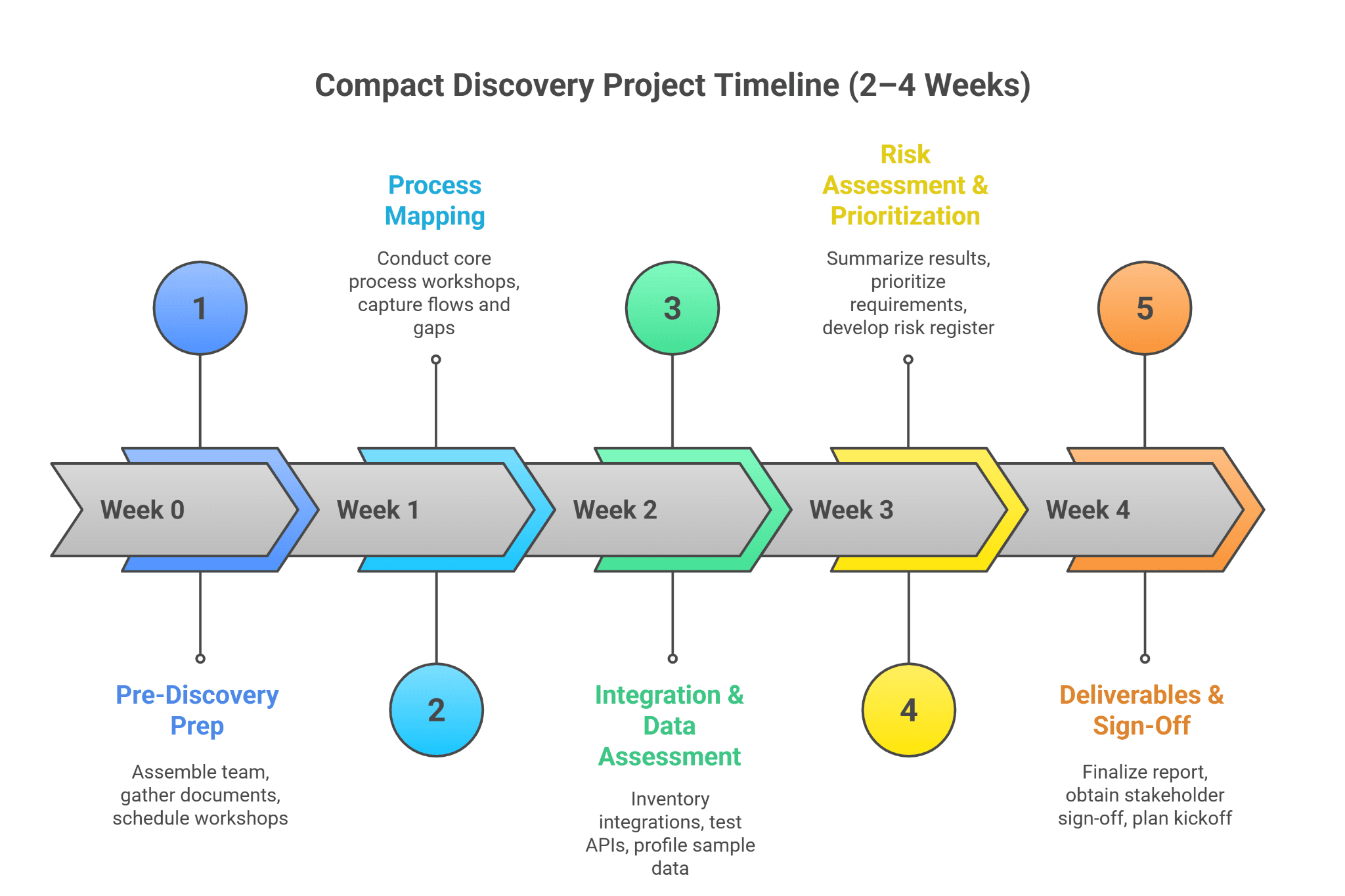
Discovery timeline for ERP integration readiness (Source: Original image)
Phase 2: Data and process mapping (typically 3–8 weeks)
Mapping is where the ERP integration timeline becomes real, because mapping is where teams discover that many “fields” are actually business logic in disguise. A modern web app expects consistent entities and predictable states. An ERP often contains years of exceptions, custom fields, and operational shortcuts that were never documented because people handled them manually. When teams map field-to-field without agreeing on the underlying rules, they end up building an integration that passes happy-path tests but collapses under real variance.
In strong projects, mapping is treated as a design phase. The team defines a canonical model that reflects how the web app should interpret customers, SKUs, orders, invoices, and statuses, then translates ERP data into that model. This is also the point where state machines must be aligned. “Confirmed,” “allocated,” “packed,” “shipped,” “invoiced,” and “paid” might exist in both systems, but their meanings can differ subtly, and those subtleties create the most expensive rework later. Good mapping also makes exception handling explicit: partial shipments, backorders, returns, credit notes, adjustments, and manual overrides must have a defined treatment, or they will surface as never-ending test churn.
Only keep these mapping decisions as “must-not-miss”:
Canonical model + state alignment for key flows
Conflict rules and precedence (what wins when data disagrees)
Reconciliation policy for the numbers that must match
Write-back boundaries (what the web app can change in ERP)
Phase 3: Build and iterative testing (typically 6–12+ weeks)
Build is not where most projects slow down. Testing is. And testing expands when integration design is brittle, when data variance is underestimated, or when teams only discover real business rules after implementation. This is why “iterative testing” is the honest description: the work is a loop of building, observing, correcting assumptions, and refining behavior until the system becomes stable under real operational patterns.
A mature build-and-test approach focuses on making the integration resilient, not merely functional. If retries, idempotency, and replay mechanisms are missing, every incident becomes a manual firefight, and stabilization stretches indefinitely. Observability also cannot be postponed. Without clear logs, metrics, and alert thresholds aligned to business impact, teams will waste time debating whether a failure matters, rather than resolving it. The other major trap is test data that looks clean and tidy. ERP integration breaks on ugly data: legacy identifiers, missing tax codes, inconsistent units of measure, and region-specific rules. Pulling those edge cases forward into testing early is one of the few reliable ways to shorten the overall ERP integration timeline.
Phase 4: Stabilization and reconciliation (typically 4–8+ weeks)
Stabilization is the most underestimated phase because many teams treat go-live as the end of delivery. In ERP integration, go-live is the point where real-world variance finally appears at full scale. This is when financial truth and operational truth must reconcile consistently, not just “usually.” Even small mismatches can damage trust and push teams back to spreadsheets, which defeats the purpose of the integration.
Short stabilization happens when the project enters go-live with designed reconciliation discipline and operational playbooks. Reconciliation is not a single report; it is a method for categorizing mismatches, identifying root causes, and deciding whether a mismatch is a data issue, a rule issue, or a process exception. Playbooks are equally important because ERP environments change. Vendor patches, configuration tweaks, and new business workflows can break assumptions. A stable integration is one that can handle change without becoming fragile.
Practical ranges and a more honest way to estimate
In many mid-sized to enterprise contexts, a production-grade ERP integration timeline often lands around 3–6 months, and stretches further when ERP APIs are missing or constrained, customization is heavy, master data quality is poor, vendor access is slow, or multiple flows require write-back and financial reconciliation. A more honest way to estimate is to stop treating “integration” as a build task and instead treat it as the time required to resolve unknowns on the critical path. Discovery and mapping are not overhead. They are the fastest route to preventing testing and stabilization from becoming the place where every unresolved assumption gets paid for—with interest.
Why the ERP integration timeline stretches beyond “a few weeks”
The most common reason an ERP integration timeline slips is not engineering velocity. It is hidden complexity that only appears once data and process truth are exposed.
Dirty data (master data & identifiers): particularly master data that has been “good enough” for manual operations but is not reliable for automation. Duplicated customer records, inconsistent SKUs, missing tax fields, old identifiers, and ad-hoc naming conventions create a problem that cannot be solved by code alone. Every data issue becomes a downstream integration issue: mappings must be revised, validation rules become more complex, test cases multiply, and reconciliation takes longer because numbers stop matching in predictable ways. This is why projects that skip data readiness early often end up paying the price later, when fixing data becomes more expensive and more disruptive.
Legacy logic & undocumented exceptions: embedded in the ERP’s day-to-day behavior. Many ERP environments have years of custom workflows, scripted validations, manual exceptions, and “tribal knowledge” that only shows up when a transaction fails under a specific condition. A modern web app needs deterministic rules. An ERP often runs on a mix of documented processes and invisible assumptions. That gap forces teams into iterative discovery during testing, where each new exception triggers another round of rule clarification, mapping changes, and retesting. What looks like “slow engineering” is often the system teaching the project what the business actually does.
ERP integration timeline: expands is the reality of ERP API integration. Some ERPs have APIs, but they may be incomplete, rate-limited, unstable, or missing critical write operations. In those cases, integration has to rely on alternative patterns such as batch exports, middleware adapters, vendor modules, or even automation layers that are harder to maintain. Each workaround adds design decisions, error handling, monitoring requirements, and additional test coverage. It also increases the effort needed to make the integration resilient, because failure modes become more diverse and harder to reproduce.
Vendor dependency & external constraints: often carry a hidden constraint that modern web teams are not used to: vendor dependency. Access to environments, approvals for modules, changes to configurations, and even response times for incidents can be governed by external timelines. When vendor SLA cycles are slow, the project cannot simply “work harder” to recover time. The timeline becomes constrained by scheduling and coordination, and that constraint typically shows up late, exactly when teams are trying to stabilize the system near go-live.
Put together, these are not edge-case risks. They are the standard reasons an ERP integration timeline moves from “weeks” to “months.” The most reliable way to plan is to treat them as expected design constraints, not unexpected obstacles because ERP integration is rarely delayed by the complexity teams can see at the start. It is delayed by the complexity that only becomes visible once real data and real operations hit the integration.
Reducing ERP integration timeline
Reducing an ERP integration timeline is rarely about “moving faster” in engineering. It is about removing uncertainty earlier so the project stops paying for surprises in testing and stabilization. Teams that try to compress time by skipping discovery, rushing mapping, or delaying data cleanup typically do not save time. They simply shift the workload into the most expensive part of the project, where fixes require retesting, reconciliation, and operational firefighting.
Discovery as decision-making, not note-taking: lock owners, scope, acceptance criteria, source-of-truth rules, and reconciliation expectations early to prevent late rule changes that blow up the timeline.
Data readiness gates before build/test: enforce measurable thresholds (master data completeness, ID consistency, duplicate rates) to reduce exceptions that expand testing and prolong stabilization.
Integration strategy based on real ERP capabilities: decide early which flows must be real-time vs batch vs hybrid, accounting for API limits, stability, and write-back support to keep the critical path predictable.
Test for reality, not happy paths: bring ugly data and exception-heavy workflows (partial shipments, backorders, returns, credit notes, manual adjustments, regional tax rules) into early cycles to avoid late retest churn.
Stabilization designed as a delivery phase: ship with reconciliation, business-impact monitoring, and retry/replay/fallback playbooks so incidents don’t turn into weeks of manual firefighting.
Taken together, these levers reduce the ERP integration timeline by changing where complexity is paid for. Instead of paying in late-stage churn, the project pays early in clarity, data readiness, realistic integration design, and disciplined testing. That shift is what makes timeline reduction real and sustainable. It does not only help teams deliver faster. It helps them deliver with higher confidence, because the integration is proven against operational truth rather than built against optimistic assumptions.
Conclusion
A modern web app can be built fast. ERP integration rarely is. The practical ERP integration timeline stretches because the hard part is not the connection itself, but the operational truth behind it: messy data, legacy logic, missing or limited APIs, and vendor constraints, followed by the real-world stabilization needed to earn trust from finance and operations. A phase-based plan that treats discovery and mapping as decision-making, enforces data readiness early, and tests against real variance is what turns “months of surprises” into a predictable delivery path.
In practice, Twendee supports teams by evaluating the ERP’s current state early including data quality, API coverage, and workflow exceptions then designing a step-by-step integration architecture that reduces schedule slip risk, and delivering the integration in a modular way so new capabilities can go live incrementally without disrupting the system already running in production.
Stay connected via Facebook, X, and LinkedIn.
Read our latest blog: Top 5 Software Development Trends Every Business Must Adapt to in 2025
