

Enterprise security used to focus heavily on human users: employees, admins, contractors, partners, and customers. That made sense when most access started with a person logging into a system.
But modern enterprises now run on automated services, API connections, bots, scripts, cloud workloads, CI/CD pipelines, and AI agents. These systems also need identities. They use credentials, tokens, keys, certificates, service accounts, and permissions to move data, trigger actions, and connect applications.
That is why non-human identity management is becoming a serious security priority. The fastest-growing identity risk in many companies is no longer only the employee account. It is the machine identity that keeps working in the background, often with broad access and unclear ownership.
Machine Identities Are Growing Faster Than Human Identities
A machine identity is any digital identity used by a system, application, service, workload, bot, or AI agent to authenticate and access resources. Examples include API keys, service accounts, OAuth tokens, workload identities, machine certificates, automation credentials, and AI agent credentials.
CyberArk’s 2025 Identity Security Landscape report found that machine identities outnumber human identities by 82:1, and that nearly half of machine identities have sensitive or privileged access. The report links this growth to cloud adoption, automation, and AI.
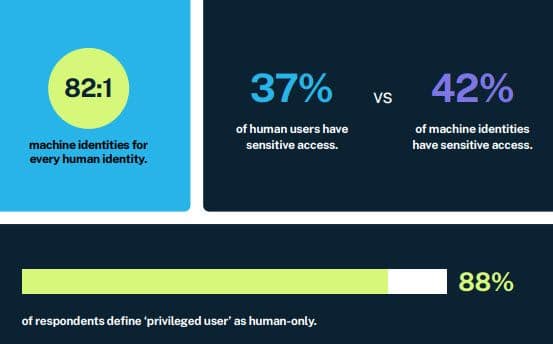
Machine identities now outnumber human identities by 82:1, showing how quickly service accounts, API keys, bots, workloads and AI agents are expanding the enterprise identity attack surface. (Source: CyberArk 2025 Identity Security Landscape Report)
That ratio matters because machine identities are often created outside the normal employee lifecycle. A person joins the company, receives access, changes roles, and eventually leaves. In theory, the business can review and remove that access.
Machine identities are different. They may be created by developers, DevOps teams, cloud platforms, third-party tools, integrations, or automated workflows. Some are used every second. Some are forgotten after a project ends. Some keep access long after the original owner has moved on.
The result is an identity layer that grows quietly, often faster than security teams can track.
The Risk Is Not the Identity Itself, But the Lack of Ownership
Machine identities are necessary. Without them, enterprise systems cannot connect, automate, or scale.
The risk appears when no one knows who owns the identity, what it can access, why it exists, or when it should expire.
The Cloud Security Alliance describes non-human identities as service accounts, API keys, OAuth tokens, machine certificates, and credentials used by AI agents. Its 2026 analysis says non-human identities now outnumber human users by an average of 45:1, and in cloud-native environments the ratio can reach 144:1. The same analysis also cites a 2025 World Economic Forum finding that 51% of organizations report no clear ownership of AI identities.
This is where the blind spot starts. A machine identity may have access to customer data, payment systems, internal databases, cloud infrastructure, or production workflows. If that access is shared, permanent, or poorly documented, it becomes difficult to answer basic security questions:
Which system created this identity?
Which workflow uses it?
Who owns it?
What can it read, update, or trigger?
When was it last reviewed?
Should it still exist?
Without clear ownership, machine identities become hard to govern. They continue operating, but the business loses visibility into the authority they carry.
Shared Credentials and Permanent Access Make the Problem Worse
Many machine identity risks come from convenience.
A team creates one service account and uses it across several applications. A developer stores an API key in a script. A workflow uses a long-lived token because it is easier than rotating credentials. A bot account gets broad access because nobody wants the automation to break.
These shortcuts may help teams move faster at first. Over time, they create unmanaged privilege.
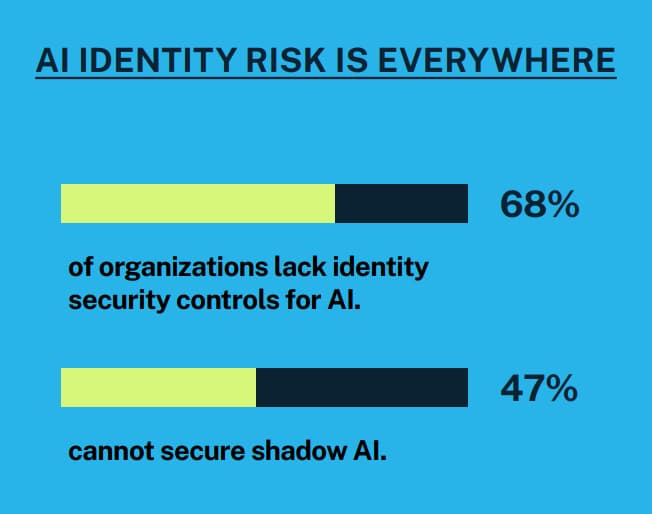
Many organizations still lack the identity security controls needed for AI and shadow AI, increasing the risk of unmanaged access, shared credentials and unauthorized activity. (Source: CyberArk)
OWASP’s 2025 Non-Human Identities Top 10 highlights several risks that directly match this pattern, including improper offboarding, secret leakage, NHI reuse, overprivileged identities, and human use of non-human identities.
The most common problems are practical:
Shared credentials: one identity is reused by multiple services, so security teams cannot tell which system performed which action.
Permanent access: tokens, keys, or service accounts remain active long after the original workflow changes.
Over-permissioned accounts: machine identities receive broader access than needed because it is easier to configure.
Poor audit trails: actions are logged under a generic service account, with no clear owner or business process attached.
Secret leakage: API keys or tokens appear in code, configuration files, public repositories, or internal chat tools.
OWASP notes that leaked secrets may include API keys, access keys, database credentials, encryption keys, certificates, and tokens. It also recommends replacing static secrets with short-lived credentials where possible.
For enterprises, this is not just a technical hygiene issue. It affects accountability. If an automated process updates a record, sends data, creates a request, or triggers a payment workflow, the business needs to know which machine identity acted, under whose ownership, and within which approved process.
AI Agents Make Machine Identity Governance More Urgent
AI agents add a new layer to the problem.
A traditional service account usually performs a narrow technical task. An AI agent may read information, call tools, retrieve data, summarize context, create tasks, route requests, or prepare actions across multiple systems. To do that, it needs access.
That access can become risky if the agent is treated like a normal application account with broad, standing permissions.
The Cloud Security Alliance argues that the identity problem becomes harder when AI agents are dynamic, hierarchical, and short-lived. It notes that agent identities may be created through code, configuration files, CI/CD pipelines, developer tools, and AI frameworks, which are usually optimized for speed rather than governance metadata.
This is why machine identity governance has to become part of AI agent deployment. An AI agent should not only be evaluated by what it can do. It should also be evaluated by what identity it uses to act, what systems it can access, who owns it, and how its actions are recorded.
For example, an AI agent that supports customer service may need to read CRM data, order status, ticket history, and policy documents. It may also draft a response or route a refund request. But it should not automatically approve a refund, change payment records, or update customer status unless the workflow has been designed for that level of authority.
The identity model has to reflect the business risk of each action.
What Good Non-Human Identity Management Should Include
Strong non-human identity management starts with visibility, but visibility alone is not enough.
Enterprises need a lifecycle model for every machine identity. That model should define why the identity exists, which system owns it, what it can access, how long it should live, and when it must be reviewed or removed.
A practical approach should include:
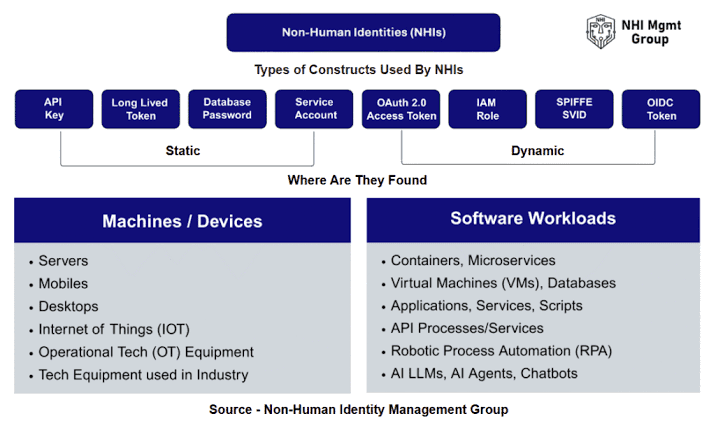
Non-human identities can take many forms, from API keys, long-lived tokens and service accounts to IAM roles, software workloads, bots and AI agents. Managing them well requires clear ownership, scoped permissions, credential rotation and lifecycle controls. (Source: Non-Human Identity Management Group)
Unique identities: avoid reusing the same credential across different applications, services, or agents.
Clear ownership: every machine identity should be tied to a team, system, workflow, or business owner.
Scoped permissions: access should match the specific task, not the broadest possible use case.
Credential rotation: keys, tokens, and certificates should not remain active indefinitely.
Audit trails: logs should connect machine actions to the process, system, and accountable owner.
Lifecycle controls: identities should be reviewed, updated, and retired when the workflow changes.
Human approval points: sensitive actions should require confirmation from the right person.
This is where Twendee’s role becomes practical. When designing enterprise systems, AI agents, and automated workflows, Twendee can help define scoped credentials, role-based access, and process-level audit trails. The goal is to make machine actions traceable to the right workflow and owner, rather than leaving them hidden behind generic service accounts.
For AI agent projects, this matters even more. Twendee can help enterprises decide what an agent may read, what it may prepare, what it may trigger, and which actions still require human approval.
Identity Controls Need to Be Built Into the Workflow
Machine identity security should not sit outside the workflow as a separate checklist.
If an automated process creates a purchase request, the identity used by that process should be part of the workflow design. If an AI agent checks customer data, its access should reflect the user role, data sensitivity, and business purpose. If a bot updates records in ERP or CRM, the audit trail should show which process triggered the change and who owns that process.
This is the difference between security as a technical control and security as an operating model.
A machine identity should answer three questions:
Who owns this identity?
What business process does it support?
What is it allowed to do?
When those answers are missing, the identity becomes a blind spot. When they are built into the workflow, the business can automate without losing control.
Twendee supports this by integrating identity controls into enterprise systems and automated workflows, including ERP, CRM, internal applications, and AI agent layers. That helps businesses keep automation useful while reducing the risk of unmanaged access.
Conclusion
Machine identities are becoming one of enterprise security’s fastest-growing blind spots because they now power the systems, services, bots, and AI agents that keep modern operations running.
The problem is not that machine identities exist. The problem is that too many of them operate with shared credentials, permanent access, unclear ownership, and weak audit trails.
As automation and AI agents expand, non-human identity management needs to become part of enterprise architecture. Every machine identity should have an owner, a purpose, limited permissions, lifecycle controls, and a clear record of what it did.
For enterprises building automated workflows and AI agents, Twendee helps design systems where machine identities are scoped, governed, and connected to real business processes. That gives companies a safer foundation for automation without letting invisible identities become unmanaged risk.
Book a call: Calendly
Read latest blog: Why B2B Companies Are Rebuilding Customer Portals
