

For years, a customer portal was a secure place to download invoices, retrieve documents, submit tickets, or check orders. That model is outdated. B2B customers now expect the portal to show what is happening, support the next step, and move work forward without an email or account manager. It is becoming part of how the business operates with its customers.
Customer Portals Are No Longer Just Places to Share Information
Most portals followed a simple logic: move information online and reduce routine service requests. Success meant giving customers access to account records, order history, documents, and support forms.
McKinsey’s 2024 B2B Pulse found that, among companies offering e-commerce, more than one-third of revenue now comes through that channel. Buyers also showed greater willingness to make remote or self-service purchases above $500,000. McKinsey’s findings on B2B self-service show that digital interaction has moved closer to the center of the commercial relationship.
That raises the standard for a customer self-service portal. A customer willing to place a high-value order online will not accept having to call later to confirm whether it was approved, allocated, shipped, or delayed.
The shift is from information availability to operational participation. Customers increasingly expect to update details, approve changes, manage orders, and resolve exceptions in the same environment. The portal is becoming an operational workspace where customers do business, not simply read what the company has published.
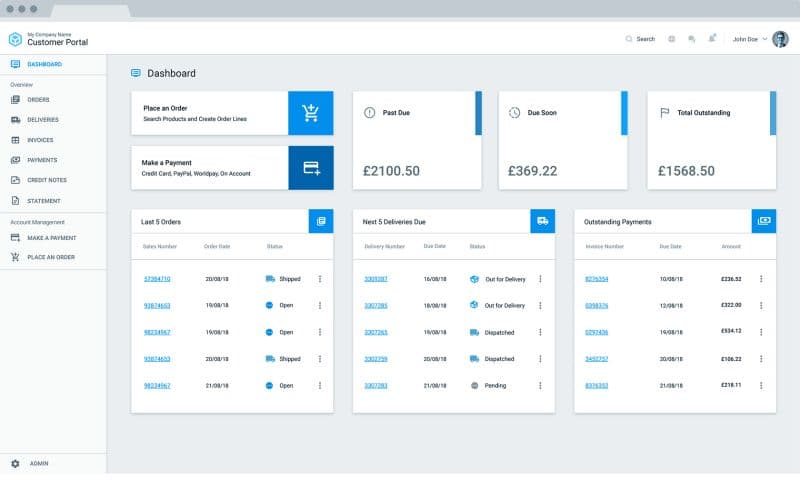
B2B customer self-service portal dashboard showing order tracking, deliveries, invoices, payments, and outstanding balances in one interface (Source: Applications Platform)
Customers Now Expect Visibility, Not Just Access
A login creates access. It does not create visibility.
Many portals look functional while still leaving customers uncertain. An order may be marked “processing,” a request may be “open,” or a payment may be “pending,” yet none explains what is actually happening. The customer still does not know who owns the next action, what causes the delay, or when the status will change.
This is why self-service is evolving beyond reducing support tickets. Its deeper value is giving customers enough operational context to make decisions without asking the business for an update. Real-time status, approval progress, inventory availability, payment confirmation, and project updates reduce uncertainty only when they reflect the process behind the screen.
Salesforce’s 2024 research involving more than 16,000 consumers and business buyers found that 69% expected consistent interactions across departments, while nearly 60% preferred using fewer touchpoints to obtain information or complete a task. The State of the AI Connected Customer research reinforces a basic point: customers experience one company, even when work crosses sales, finance, operations, and support internally.
This turns operational visibility into a customer experience issue. When customers cannot see the status of work that affects them, the burden returns as emails, calls, escalations, and repeated status checks.
The Problem Is Not the Portal—It Is the Systems Behind It
When a portal feels outdated, the instinct is often to redesign the interface. A cleaner dashboard, chatbot, or simpler navigation may improve usability, but it does not solve the deeper problem if the portal cannot access the systems where the work is happening.
A single customer journey may depend on CRM, ERP, inventory, accounting, logistics, ticketing, and workflow tools. When those systems do not exchange reliable data, the portal shows only a partial version of reality. The customer sees one status while operations sees another. Finance has updated a payment, but the order remains blocked. Support can see the ticket, but not the shipment exception that caused it.
The 2025 MuleSoft Connectivity Benchmark reports that the average enterprise manages 897 applications, yet only 29% are integrated. The underlying report also found that 66% of organizations still do not provide an integrated user experience across channels.
Those numbers explain why many portal projects underperform. The front end is expected to create one coherent experience while operations remain fragmented. Employees keep confirming statuses manually and reconciling conflicting records. Customers keep emailing account managers because the portal cannot answer the question that matters.
A modern portal is only as useful as the systems, data, and workflows connected behind it. The interface shapes the first impression; the architecture determines whether the experience can be trusted.
Customer Experience Now Depends on Operational Integration
The strongest customer portals are not isolated websites. They function as a customer-facing layer across enterprise operations.
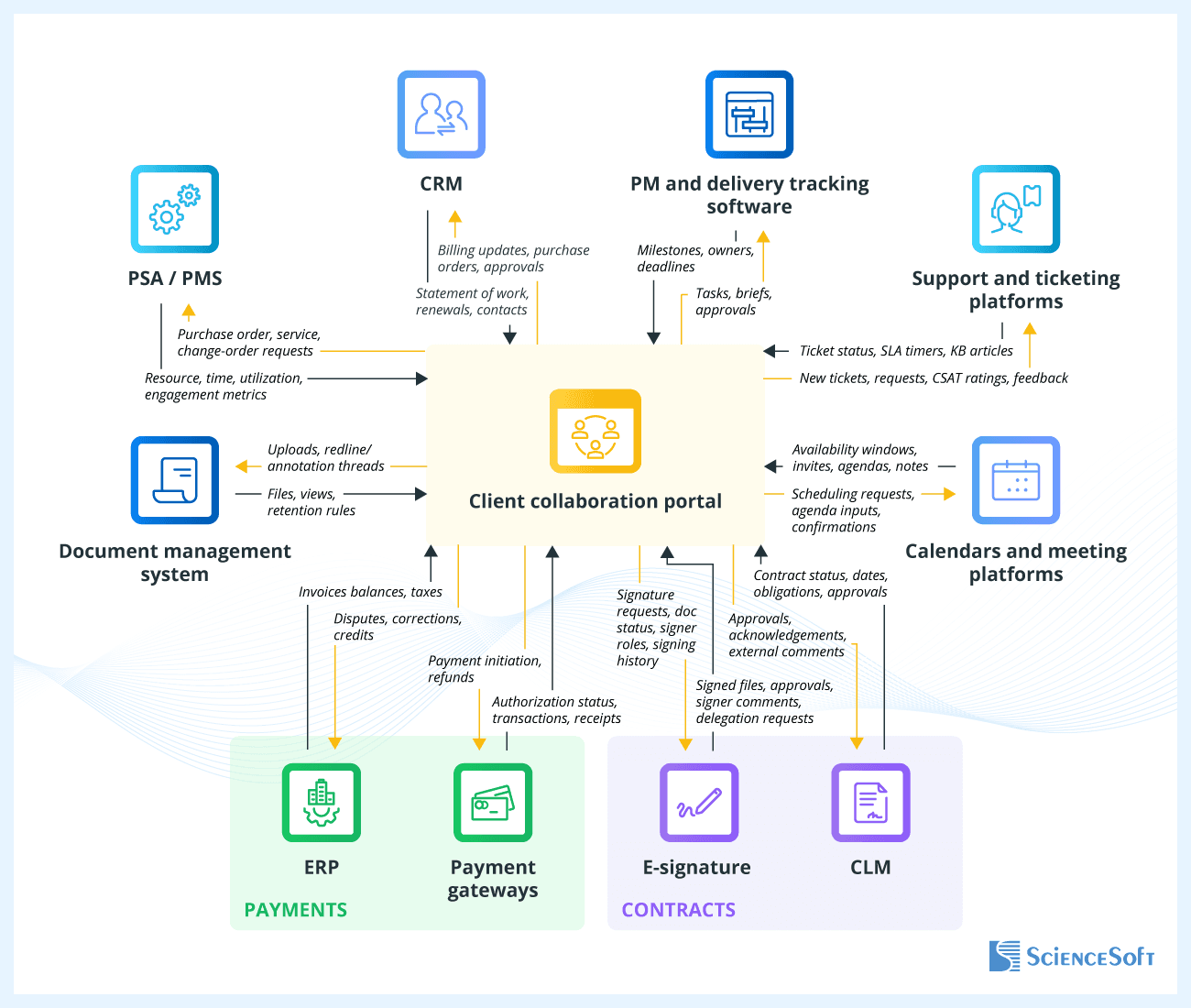
Client collaboration portal integrated with CRM, ERP, payment, project management, support, document management, and contract systems (Source: ScienceSoft)
This requires more than displaying data from several sources. Integration must preserve context and allow actions to move safely between systems. An ERP order status should reflect inventory allocation and fulfilment progress. A payment confirmation should update finance and release the next workflow step. A support request should carry customer, product, order, and service history so the customer does not have to repeat the same information.
A customer platform creates value beyond convenience. It connects what the customer sees with what the organisation is doing. Customers can move from observing the process to participating in it: submitting documents, approving quotations, changing delivery instructions, confirming milestones, or escalating issues with the right context attached.
In its 2023 global B2B Pulse survey of more than 3,800 decision-makers, McKinsey found that companies delivering the strongest omnichannel experience were increasing market share by at least 10% annually. Companies combining several modern commercial capabilities were also twice as likely to achieve market-share growth above 10% as those focusing on only one. McKinsey’s B2B growth research suggests that digital experience creates more value when supported by the wider operating model.
SEE, the packaging company behind BUBBLE WRAP® brand cushioning, offers a useful example. Customers previously placed complex orders by phone or email and had limited visibility after an order entered the internal process. SEE built an integrated B2B buyer portal where customers could place and manage orders, handle approvals, view history, and receive shipment updates.
According to Adobe’s 2025 B2B case study review, 80% of orders can now be placed entirely online. Customers using the portal shifted at least 83% of their order volume to it, while roughly 15% of the manual touches in a typical order were automated.
The lesson is not that every company needs identical features. SEE’s results came from connecting customer actions with approvals, order management, and fulfilment—not from redesigning a homepage in isolation.
As portals become part of enterprise operations, ownership also changes. Sales depends on them for account continuity, operations for execution, finance for payment workflows, supply chain for delivery visibility, and support for issue resolution. Customer experience increasingly depends on operational integration, not front-end design alone.
Building Customer Portals That Work Across the Business
Companies rebuilding a portal should begin with journeys that generate the most waiting, uncertainty, and manual coordination. The right question is not, “Which features should our new client portal software include?” It is, “Which interactions should customers be able to understand and complete without crossing multiple disconnected channels?”
A modern portal should use enterprise systems as the source of truth, connect customer actions directly to the workflows that process them, and provide enough context to explain ownership, dependencies, and next steps. Permissions should reflect customer roles, account structures, and sensitive operational data.
Twendee approaches customer portal development through this operational lens. Rather than treating the portal as a separate web project, Twendee connects the customer-facing experience with ERP, CRM, finance, workflow, logistics, and other relevant platforms. The result is a unified digital environment where customers can manage interactions while internal teams continue working through the systems that support the business.
This foundation also makes the portal more adaptable. Companies can add workflows, redesign interfaces, or introduce AI-assisted support without rebuilding the operational layer each time. It becomes a durable connection between the customer and the enterprise as products, processes, and service models change.
Conclusion
B2B companies are rebuilding customer portals because the old model solved an access problem, while today’s customers have a visibility and execution problem. A modern customer portal must show what is happening, connect customers to the right workflow, and allow them to move the relationship forward.
To explore how an integrated customer portal can connect your customer experience with the systems and operations behind it, visit the Twendee website, follow Twendee on LinkedIn, or book a conversation through Twendee’s Calendly.
