

Modern software is assembled from open-source packages, commercial libraries, internal services and inherited dependencies. That makes a software bill of materials increasingly important. Every enterprise needs to answer a basic security question: what is actually inside the software we run? The useful answer is more than a document produced for an audit. It is a current, machine-readable inventory linked to vulnerability management, procurement and release controls. In 2026, that operational connection is turning the SBOM from optional documentation into a practical security requirement.
Software Risk Starts With Components Enterprises Cannot See
Every application has a supply chain. A customer portal may rely on a web framework, an authentication library, a database driver, container images and hundreds of transitive dependencies. Development teams rarely write or select every component directly. Yet the enterprise still inherits each component's security, licensing and maintenance risk.
The scale is easy to underestimate. The 2026 Open Source Security and Risk Analysis report from Black Duck analyzed 947 commercial codebases across 17 industries. It found at least one open-source vulnerability in 87% of them. Seventy-eight percent contained high-risk vulnerabilities, while 44% contained critical-risk issues. The average number of open-source components per codebase also rose 30% year over year.
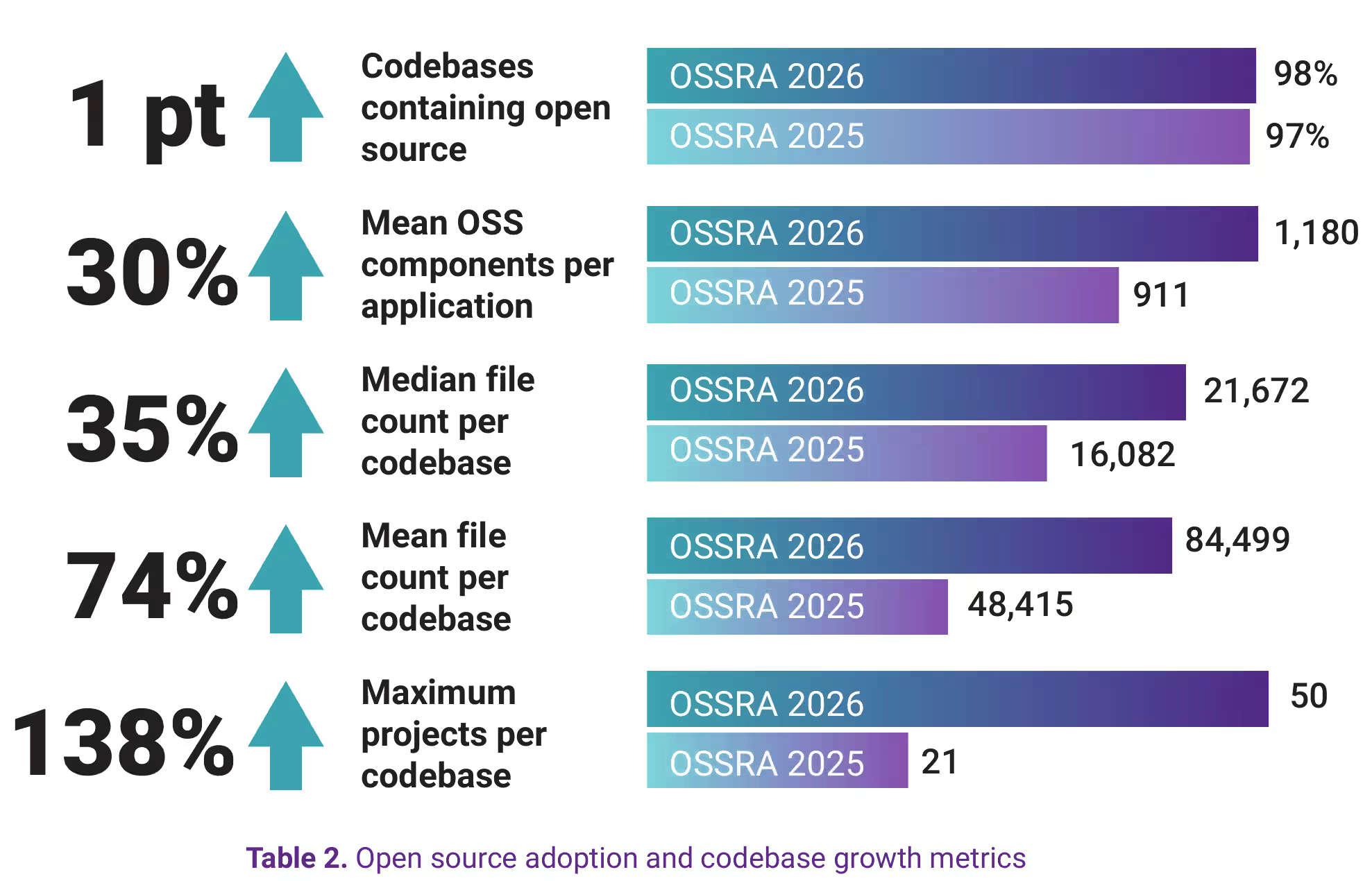
OSSRA 2026 chart showing 98% of codebases use open source and average components per application rose 30% to 1,180. (Source: Black Duck)
That growth makes manual tracking unrealistic. It also exposes a gap between a package manifest and a reliable software component inventory. The same report found that 17% of open-source components entered codebases outside standard package managers. Copy-pasted code, direct vendor additions and AI-generated code can all escape manifest-based scanning.
When a severe vulnerability appears, the problem becomes urgent. Security teams need to identify affected products, deployed versions, customers and owners. Without dependable component data, they must search repositories, ask individual teams and inspect applications one by one. Response time is lost before remediation even begins.
Log4Shell showed this problem at enterprise scale. When the vulnerability became public, CISA explained that an SBOM could give customers the transparency they needed. They could then determine whether their products relied on the affected library. The lesson still applies: component visibility has business value when it speeds up a real decision.
A Software Bill of Materials Must Drive Security Decisions
An SBOM records components and their supply-chain relationships. The practical version is generated automatically, tied to a specific build and updated whenever the product changes. This lets security and engineering teams replace a vague claim with a precise answer. Version 2.4.1 is present in these three releases, and this team owns the fix.
That distinction matters because an SBOM security program does not end when a file is created. The inventory should feed the systems where work already happens. A useful workflow looks like this:
The delivery pipeline generates a software bill of materials for every production build in a standard format such as SPDX or CycloneDX.
The platform validates required fields, links the file to the build artifact and stores both together.
Security tooling compares components against vulnerability intelligence, including known exploited vulnerabilities where relevant.
Policy checks evaluate severity, exploitability, product exposure and the availability of a safe version.
The release workflow blocks, approves or records an exception. The decision has an owner, reason and expiry date.
A new build creates a fresh inventory and confirms that remediation reached the released product.
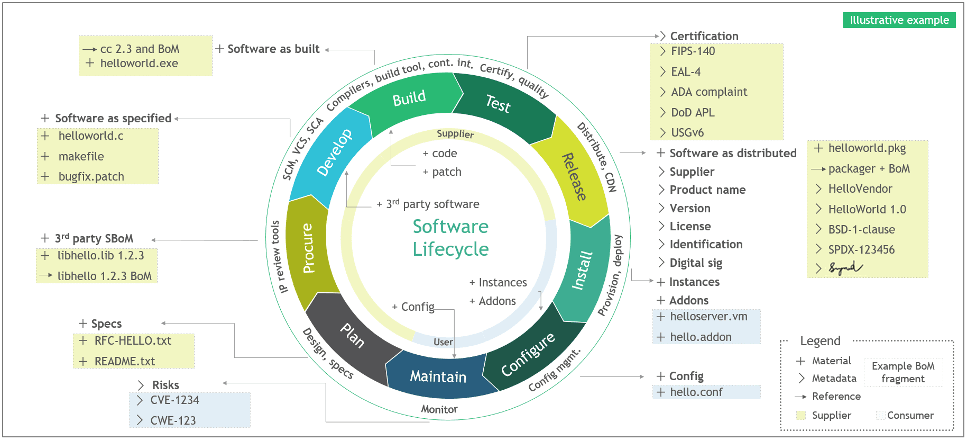
SBOM data evolves with the software lifecycle, connecting component information from procurement and build through release and maintenance. (Source: NIST)
This workflow turns component data into evidence. It also prevents a common failure: scanning a repository, fixing the source and assuming the deployed artifact changed. Tying the software bill of materials to the artifact creates a clearer record of what customers actually receive.
Release policy should also use context instead of treating every vulnerability alike. Consider two products that contain the same affected library. One exposes the vulnerable function through an internet-facing service. The other packages the library, yet never calls the affected code path. Their priorities may differ even though the component match is identical. Security teams can combine SBOM data with exploitability, deployment and business criticality to set the response. A critical, reachable issue may stop a release. A lower-risk finding may enter a tracked remediation queue with a deadline. This keeps controls credible and directs engineering time toward the exposures that matter most.
Current guidance is moving in the same direction. In July 2026, CISA released updated minimum elements for a software bill of materials. New minimum fields include the component hash algorithm, component license, SBOM tool name and generation context. These details help teams verify identity, automate processing and understand how the inventory was produced. They make the SBOM more useful to downstream security systems.
NIST's 2026 due diligence guide reinforces the operational point. It says that machine-readable formats such as CycloneDX, SPDX and SWID support automated ingestion, validation and analysis. It also warns that possessing an SBOM does not automatically make software secure. The inventory enables a more tailored risk assessment based on the actual subcomponents.
Procurement teams can use the same information before software enters the environment. A supplier review can ask for a software bill of materials that covers the delivered product, includes transitive dependencies and follows a recognized format. The review should also establish how often the supplier refreshes it, how customers receive updates and how the vendor handles an exposed component.
The strongest contract terms connect visibility with action. Enterprises can define notification windows, remediation expectations, support periods and the process for replacing unsupported dependencies. They can also request a fresh software bill of materials after a major release or material component change. This gives security, legal and procurement teams a shared basis for evaluating third-party software.
Regulatory pressure makes response speed even more relevant. Under the EU Cyber Resilience Act, manufacturers must begin reporting actively exploited vulnerabilities and severe incidents from September 11, 2026. Early warnings are due within 24 hours of awareness, followed by fuller reporting. Organizations that cannot map a vulnerable component to affected products will struggle to meet such timelines with confidence.
The practical test is therefore simple. When a new critical vulnerability appears, can the enterprise identify exposure in hours and route work to the right owner? Can it show why a release was allowed or stopped? If the answer depends on spreadsheets and memory, the SBOM program is still documentation-heavy.
Build an Operational Software Component Inventory
A workable program can start with the applications that create the greatest business or customer risk. Teams need clear scope, ownership and measurable outcomes. Useful measures include SBOM coverage across production builds, inventory freshness, exposure identification time and remediation time. Teams should also track release exceptions that pass their expiry dates.
Data quality also matters. Component names and versions must be consistent enough to match against vulnerability sources. Build and artifact identifiers should connect the inventory to a release. Ownership data should route findings to a responsible team. Coverage should include direct and transitive dependencies, container layers and third-party components delivered outside standard package managers.
Twendee can embed SBOM generation and dependency tracking into existing software delivery pipelines. We connect component inventories with security checks and release workflows, so findings reach the people who can act on them. For custom software, that means producing evidence for each build. For third-party dependencies, it means improving visibility across what teams selected directly and what arrived deeper in the supply chain.
This approach supports gradual adoption. One high-risk product can establish the data model, workflow and release policy. The enterprise can then extend the pattern across more applications while keeping the same ownership and evidence standards. The result is a living software component inventory that supports vulnerability response, supplier review and safer releases.
Conclusion
A software bill of materials has become a practical requirement because enterprises need faster, more reliable answers about the components inside their software. Its value comes from daily use: generating it with each build, matching components to vulnerabilities, informing procurement and recording release decisions. Recent CISA, NIST and EU guidance all point toward stronger operational evidence. Organizations that build those connections now will respond faster, reduce uncertainty and improve software supply chain security across both custom applications and third-party products.
Book a call: Calendly
Read our latest blog: Event-Driven Architecture: When Enterprise Systems Need Real-Time Integration
