

AI agents enterprise adoption is changing a quiet assumption inside business operations: every workflow needs a person to move it forward. That was true when automation could only follow rigid rules. It is less true now that agentic AI can read context, retrieve data, trigger actions, and complete multi-step tasks inside enterprise systems. The shift is not about replacing people across the company. It is about identifying repeatable workflows where human involvement adds delay, not judgment. Deloitte projected that 25% of enterprises using generative AI would deploy AI agents in 2025, rising to 50% by 2027, which shows how quickly AI is moving from assistance into execution.
Why AI Agents Enterprise Adoption Is Moving From Support to Execution
The first enterprise use cases for generative AI were mostly supportive. AI drafted emails, summarized documents, generated code snippets, translated content, and helped employees search internal knowledge. These use cases were useful, but they still relied on humans to decide the next step. AI produced an output. A person reviewed it. Then the person acted. That model is now changing.
AI agents enterprise systems are designed to handle workflows with more autonomy. Instead of waiting for a user to ask one question at a time, an AI agent can monitor a trigger, understand the context, decide the next action, interact with business systems, and complete a defined process. McKinsey describes AI agents as systems based on foundation models that can act in the real world, plan, and execute multiple steps in a workflow. Its 2025 State of AI survey also found that 23% of respondents were already scaling an agentic AI system somewhere in their enterprises.
This is a meaningful change because many enterprise workflows do not require deep human judgment at every step. They require consistency, speed, data retrieval, routing, validation, and documentation. In those cases, the human role can shift from doing every task to designing the rules, reviewing exceptions, and improving the system over time.
Examples are already visible across common business functions:
HR teams can use agents to screen internal requests, check policy conditions, route leave approvals, and update employee records.
Finance teams can use agents to validate invoices, flag missing documents, classify expense claims, and prepare approval summaries.
Sales teams can use agents to qualify leads, update CRM fields, generate follow-up tasks, and detect stalled opportunities.
Operations teams can use agents to track workflow status, remind owners, summarize delays, and escalate overdue approvals.
Customer support teams can use agents to resolve low-risk tickets, retrieve customer context, and hand over complex cases to humans.
These are not futuristic scenarios. They are the natural next step after workflow automation, robotic process automation, and enterprise AI copilots. The difference is that AI workflow agents can handle ambiguity better than traditional automation. They can interpret requests, understand unstructured inputs, and coordinate across systems.
For CEOs, this changes the automation business case. AI is no longer only a productivity layer for individual employees. It can become an execution layer for business processes. For CTOs, it creates a new design challenge: how to integrate AI agents safely into existing systems without creating uncontrolled automation.
Where AI Workflow Agents Can Work Without Constant Human Review
The most practical use cases for AI workflow agents are not the most dramatic ones. They are usually the workflows that happen every day, follow clear logic, and consume too much human attention.
A useful rule is simple: if a workflow has repeated inputs, stable business rules, clear data sources, and predictable outputs, it may not need a human in every loop. It may need a human at the boundary: setting policies, approving exceptions, and reviewing performance.
This makes agentic AI especially relevant for workflows such as request routing, document checks, data updates, approval preparation, customer inquiry classification, internal reporting, and routine follow-ups. These processes are important, but they often do not require senior employees to manually move every step forward.
The value is not just speed. It is operational consistency. Manual workflows often break because people forget updates, miss context, delay approvals, or interpret rules differently. AI automation systems can reduce these gaps by applying the same logic every time, logging actions, and escalating only when a case falls outside the defined boundary.
However, not every workflow should become fully autonomous. The better model is bounded autonomy. AI agents should have enough authority to complete low-risk tasks, but not unlimited freedom to make sensitive decisions. That means enterprises need to classify workflows by risk and decision impact.
A practical structure may look like this:
Autonomous execution: Low-risk, repetitive tasks with clear rules, such as status updates, data entry, reminder generation, document classification, and simple routing.
Human review: Medium-risk tasks where AI can prepare recommendations, but a person approves the final decision, such as budget exceptions, contract summaries, or supplier comparisons.
Human control: High-risk decisions involving legal, financial, HR, compliance, security, or customer-impacting consequences.
This is where many companies misunderstand agentic AI. The point is not to remove humans everywhere. The point is to remove humans from workflow steps where their time is being used as a manual connector between systems.
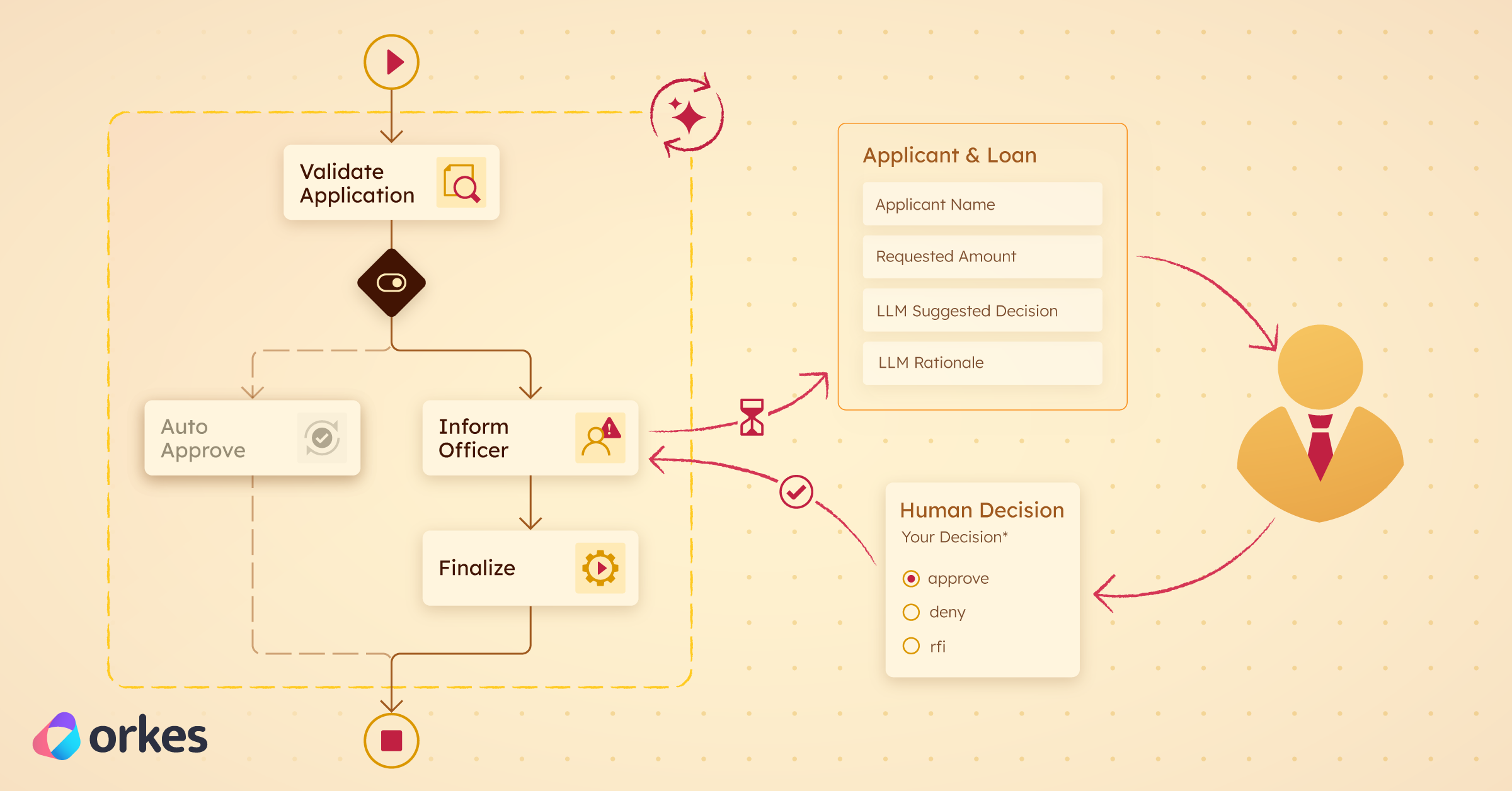
An AI-powered workflow can automate repeatable approval steps while routing higher-risk cases to human review. (Source: Orkes )
Salesforce’s discussion of the agentic enterprise frames this shift clearly: human oversight remains important, but the human role moves toward supervising agents, guiding decisions, and handling high-stakes judgment rather than performing every mundane task directly.
For enterprise leaders, this means the question should not be “Can AI replace this role?” A better question is: “Which workflow steps no longer justify manual handling?”
That distinction matters. AI agents do not need to replace departments to create value. They can remove hidden operational friction across dozens of small processes. Over time, that can free employees from repetitive coordination work and allow them to focus on judgment, relationship-building, exception handling, and strategic improvement.
How Enterprise AI Automation Should Be Built Into Real Systems
The biggest risk with enterprise AI automation is treating agents as standalone tools. A disconnected AI agent may look impressive in a demo, but enterprise value depends on integration. If an agent cannot access the right data, respect permissions, trigger workflow actions, and leave a reliable audit trail, it will remain limited to surface-level assistance.
This is why AI agents need to be built into operational systems. ERP, CRM, HRM, finance, procurement, and workflow platforms already contain the data and rules that guide daily work. They define who can approve requests, which records matter, what status changes mean, and how business activity is documented.
When AI agents enterprise systems are integrated into these platforms, automation becomes more practical. An agent can read a request, check the relevant policy, identify missing information, route it to the right owner, update the record, and escalate exceptions. The business does not need to rely on employees copying information between tools or manually chasing every next step.
This is also where Twendee can support businesses that want to move from AI experiments to usable automation. Twendee builds AI agents that integrate directly into enterprise operating systems, helping companies connect AI with workflows, data structures, approval logic, and internal tools. Instead of creating isolated AI features, Twendee focuses on how agents can work inside the actual operating layer of the business.
For ERP environments, this becomes especially valuable. ERP already sits close to the workflows that consume the most manual effort: HR requests, finance approvals, CRM follow-ups, internal tasks, document checks, and cross-department coordination. By deploying automation workflows inside ERP, enterprises can reduce dependence on manual processing while keeping actions structured, traceable, and easier to govern.
A strong ERP-based agent workflow should include:
Role-based access so agents only use data permitted for each user or department.
Workflow triggers that define when an agent should act.
Approval thresholds that separate low-risk automation from human review.
Audit logs that record what the agent did, why it acted, and which data it used.
Exception routes for cases that fall outside normal business logic.
Feedback loops so employees can correct, refine, and improve agent behavior.
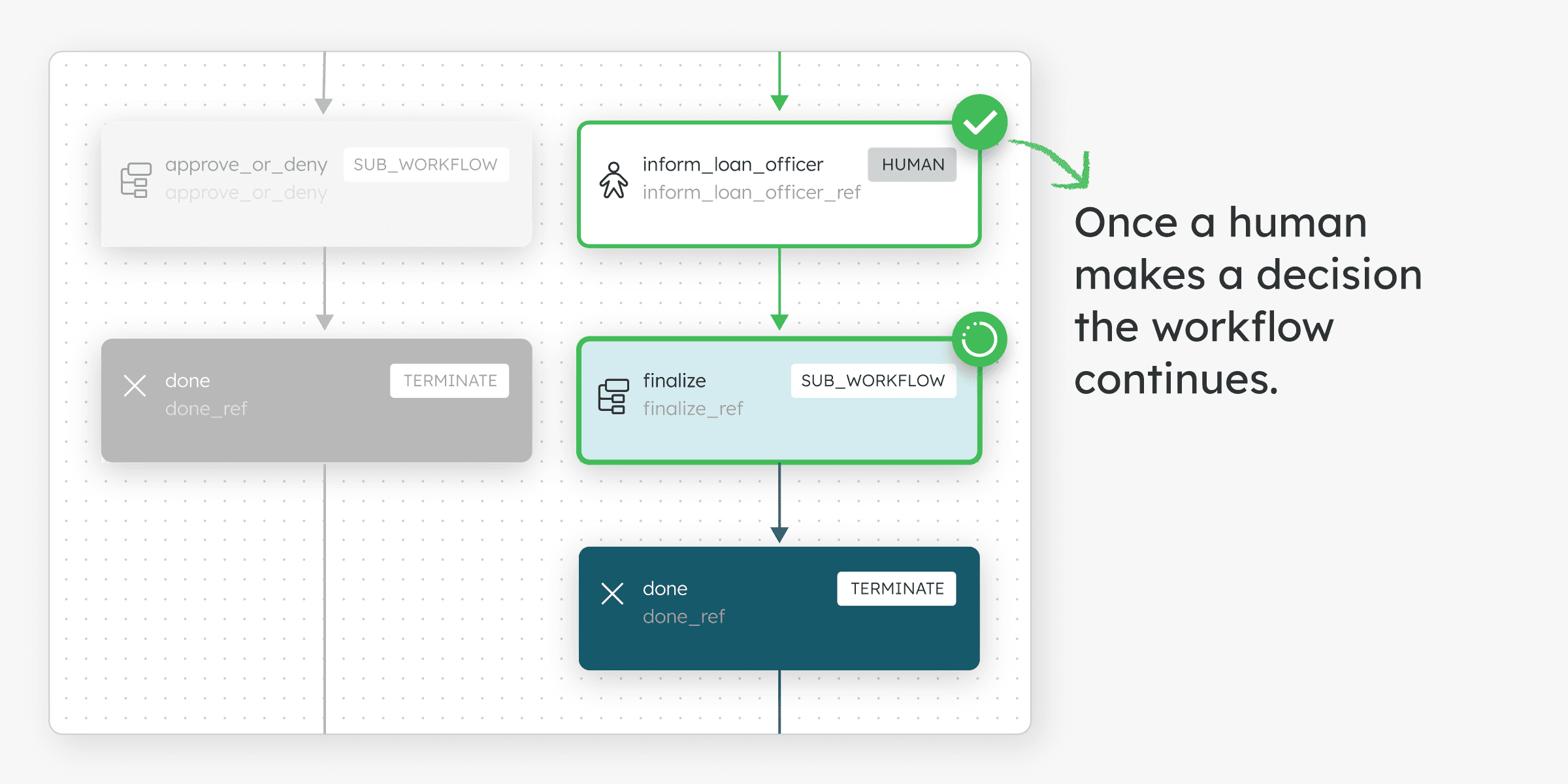
Human review can be placed at specific decision points while the rest of the workflow continues automatically. (Source: Orkes)
This matters because the future of AI automation systems will depend less on how intelligent the model looks and more on how well it fits into business architecture. IBM’s research on agentic AI operating models points to the need for organizations to rethink management mindset, workforce evolution, and trust as autonomous AI becomes part of operations.
Enterprises that build AI agents as disconnected productivity tools may gain short-term speed. Enterprises that build AI agents into governed workflows can gain something more durable: scalable execution capacity.
Conclusion
Some workflows no longer need humans in the loop at every step. They need humans designing the logic, supervising exceptions, and making the decisions that truly require context, ethics, negotiation, or strategic judgment. That is the real promise of AI agents enterprise adoption.
The next phase of enterprise AI will not be defined by chat interfaces alone. It will be defined by how well businesses redesign workflows around agentic AI, AI workflow agents, and governed automation. Repetitive processes with clear logic are already moving from human handling to AI execution. The companies that benefit most will be those that integrate agents directly into their operating systems rather than leaving them as disconnected assistants.
Twendee helps enterprises build AI agents and ERP-based automation workflows that reduce manual dependency while keeping business processes structured, traceable, and ready to scale. For companies moving beyond AI pilots, the goal is no longer just to assist employees. It is to build enterprise AI automation that can execute real work safely inside the systems where operations already happen.
Book a call: Calendly
Read latest blog: Why Many AI Projects Fail Before Reaching Production Systems
