

Companies keep adding software to make work faster. Yet employees still copy data, chase updates, and rebuild context across departments. Sales works in CRM. Finance uses accounting software. Operations tracks delivery in another system. HR, procurement, and management may each have their own tools, dashboards, and spreadsheets.
Every application can perform its own job well. The problem appears when the business process moves between them.
This is software fragmentation: business data, workflow rules, and ownership are spread across systems that cannot support one complete process. Its largest cost is rarely the subscription fee. The real cost is the operational friction created between systems.
That friction leads to repeated work, slower handoffs, unclear responsibility, and incomplete management visibility. More importantly, it makes automation and AI harder to scale because neither can operate reliably without shared data and workflow logic.
The real cost of software fragmentation is created between systems
Companies often assess software one application at a time. They ask whether each tool works, whether employees use it, and whether the subscription is worth the cost.
However, this view misses the most expensive part of enterprise software fragmentation.
The largest cost appears when work leaves one system and enters another.
BetterCloud’s 2025 State of SaaS report found that organizations use an average of 106 SaaS applications. Productiv reported an average portfolio of 342 applications in its own dataset. These studies use different samples, so their figures should not be treated as one universal benchmark. Still, both show how complex modern business software environments have become. (SellersCommerce)
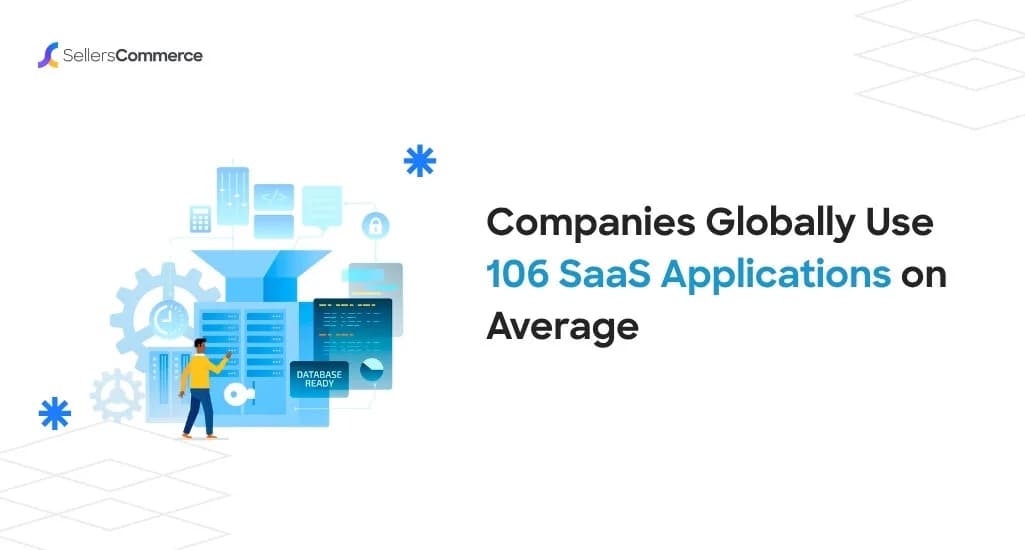
Organizations use an average of 106 SaaS applications, according to BetterCloud’s 2025 State of SaaS report. (Source: SellersCommerce)
The number of tools matters less than the connections between them. A company can operate well with many applications when data and responsibilities move clearly across the stack. Even a smaller software portfolio can cause major problems when every department works from a different version of the process.
1. The handoff cost
Consider what happens after sales closes a deal.
The CRM may show the opportunity as won. The signed contract may sit in a shared drive. Finance may need the payment terms. Operations may need the customer requirements. A project manager may then create a separate delivery record.
The workflow looks complete inside CRM. In reality, several teams still lack the context they need.
Employees compensate for that gap through email, chat, spreadsheets, and meetings. Sales explains what the customer agreed to. Finance asks for pricing details. Operations checks which scope is final. Managers follow up when the handoff stops moving.
None of this work appears as a software failure. Each application may still be online and functioning.
Yet the process depends on employees manually carrying context between systems. This creates a hidden handoff cost every time work crosses a department.
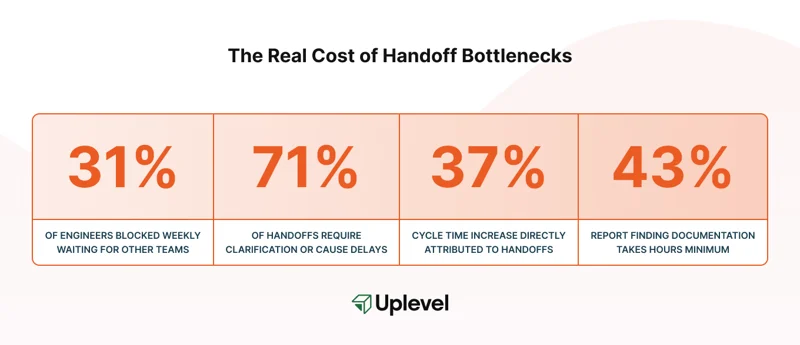
Engineering handoffs can increase waiting, clarification, cycle time, and time spent locating documentation. (Source: Uplevel)
2. The reconciliation cost
Fragmented systems also create competing versions of the same business event.
CRM may show one customer status. Finance may show another. Operations may have a more recent update in a spreadsheet. Meanwhile, a management report may use data exported several days earlier.
Employees must then compare records before they can act.
They ask which update is current, who changed it, and which system should be trusted. In many cases, they also enter the same information again so another team can use it.
As a result, duplicate work becomes part of the official process.
This problem affects more than efficiency. It also weakens data quality. When employees update several systems manually, records begin to drift apart. Reporting becomes less reliable, and automation cannot determine which status represents reality.
3. The visibility and ownership cost
Software fragmentation can create the appearance of visibility without giving leaders a complete operating view.
Each department may have a dashboard. Sales sees pipeline activity. Finance sees invoices and cash flow. Operations sees tasks and delivery status. HR sees workforce information.
However, leadership still struggles to answer cross-functional questions:
Which customer commitments are affecting delivery?
Where is a request waiting for approval?
Which delay may affect revenue?
Who owns the next action?
Which record contains the latest information?
The dashboards are not necessarily wrong. They are simply limited to their own systems.
This is why software fragmentation often looks like a people problem.
Managers may think teams do not update information, communicate clearly, or follow the process. In reality, employees may be forced to fill gaps that the software architecture leaves open.
They copy data because systems do not share it. They chase colleagues because ownership does not move with the workflow. They create manual reports because no system shows the end-to-end process.
A fragmented software environment can make a reasonable team look poorly coordinated.
Automation and AI increase the cost of unresolved fragmentation
Businesses often respond to slow operations by adding automation.
The logic seems sound. If teams spend time moving data or sending updates, automation should reduce the manual work.
However, automation only scales the process that already exists.
Imagine that CRM automatically moves a deal to “Won.” This triggers a delivery project in another tool. Yet finance has not received the approved pricing. The customer appears in two records, and the latest contract remains in a shared folder.
The automation has moved the workflow forward. It has not resolved the missing context.
Now several systems may create tasks, assign different owners, and send separate notifications. Instead of removing confusion, automation moves it faster.
This is why businesses should distinguish between automating tasks and designing a reliable workflow.
A reliable workflow requires one trusted status, clear ownership, shared business rules, and defined handoffs. Without these elements, automation can make operational inconsistency harder to detect.
AI creates the same problem at a greater scale.
A sales agent may read CRM data but miss an overdue invoice in finance. An operations agent may see a customer request but not the approved contract. A management assistant may summarize several dashboards without understanding how the records relate.
The answer may sound complete. However, the underlying context is still fragmented.
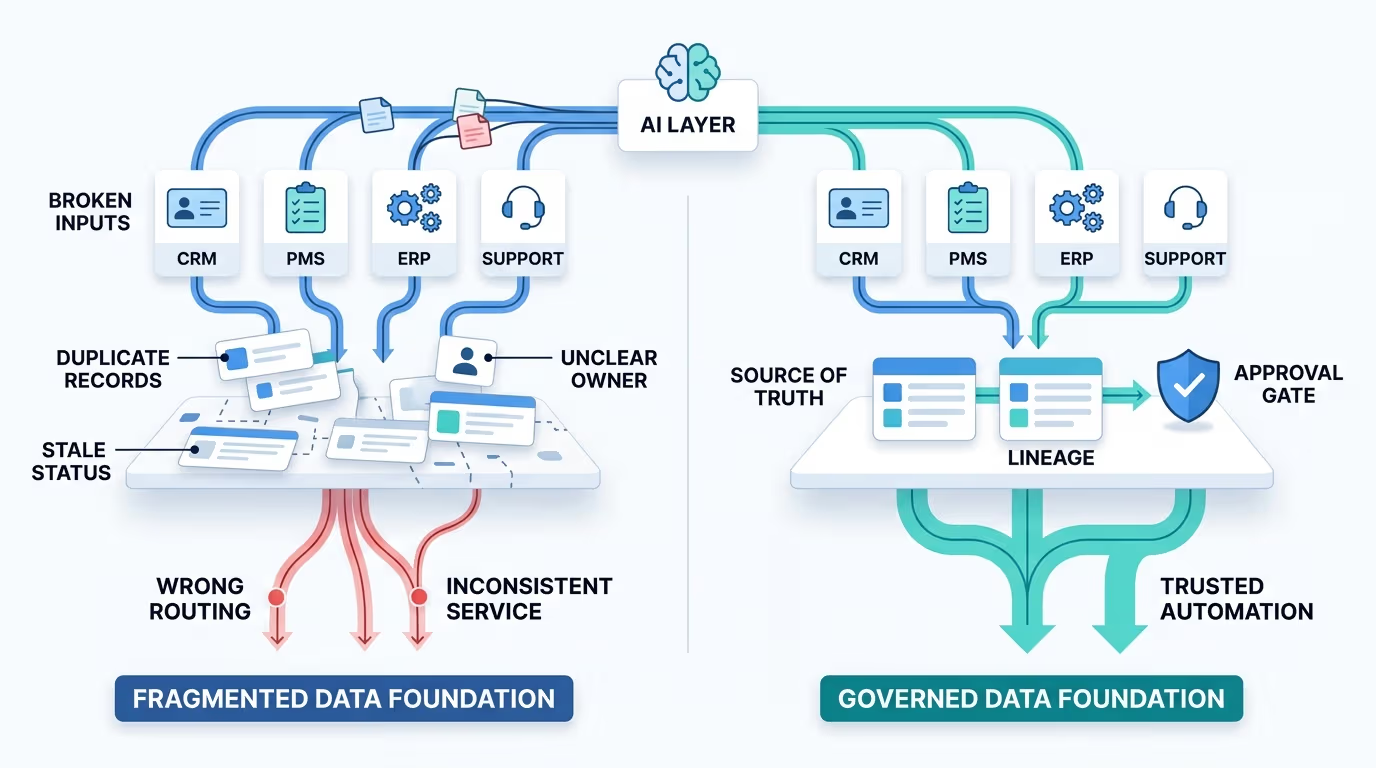
AI automation becomes more reliable when CRM, ERP, project, and support data connect through a governed foundation with clear ownership, lineage, and approval controls. (Source: Webuters)
MuleSoft’s 2025 Connectivity Benchmark found that the average enterprise manages 897 applications, while only 29% are integrated. The report also found that 95% of organizations face challenges when connecting AI to existing processes, and 80% identify data integration as their most significant obstacle. (Salesforce)
The same research found that IT teams spend 39% of their time building custom integrations and automations. Only 2% of surveyed organizations had connected more than half of their applications. (Salesforce)
These figures explain why adding another AI tool rarely fixes fragmented operations.
AI needs more than access to applications. It needs consistent context across them.
Before AI can act reliably, the business needs:
One trusted source for each important data type
Shared workflow stages across departments
Clear ownership of every next step
Consistent access and permission rules
Defined handoff and escalation logic
Without this foundation, an AI agent may retrieve more information without becoming more accurate. It may automate actions without understanding the full business situation.
AI does not remove fragmented operations. It increases the cost of leaving them unresolved.
Reduce fragmentation by redesigning one workflow, not replacing everything
Reducing software fragmentation does not require replacing every application with one large platform.
Some specialist tools perform valuable functions. A CRM may remain the best place to manage pipeline data. Accounting software may remain the trusted source for financial records. A support platform may still be the right tool for customer tickets.
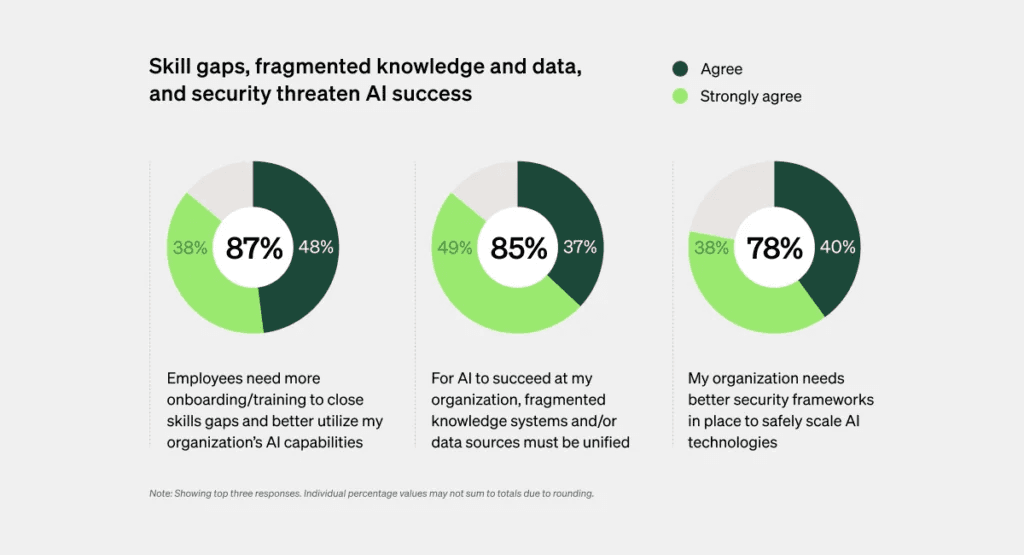
Most organizations see fragmented knowledge and data as a major barrier to AI success, while skills and security gaps also limit safe adoption. (Source: Medium)
The goal is one operational model across the tools the business still needs. A practical decision framework is to keep, connect, or replace.
1. Keep tools that have a clear role
Keep a system when it performs a defined function well, has reliable data ownership, and can connect with the wider workflow.
A specialist tool does not create fragmentation simply because it is separate. The problem begins when its data, status, or actions cannot move into the next part of the process.
2. Connect systems that share the same workflow
Integration becomes important when several teams need the same customer, supplier, request, order, or financial record.
For example, CRM and delivery software may need to share customer scope and project status. Procurement and finance may need the same supplier and approval data. HR and payroll may need one employee record.
The integration should move both data and workflow context. Sending a record without its owner, status, permission, or next action is rarely enough.
3. Replace tools that create competing ownership
Replacement makes sense when several applications manage the same process.
Productiv reports that about 40% of applications in the average SaaS portfolio either go unused or overlap with another tool’s functions.
Still, removing an overlapping application does not automatically solve the process.
If teams keep different rules, records, and reporting methods, the fragmentation will remain inside the new platform. Software consolidation must therefore happen together with workflow standardization.
The best starting point is one cross-functional workflow.
Choose a process that moves through several departments, requires frequent manual follow-up, and directly affects revenue, cost, or customer experience.
Strong candidates include:
Lead-to-delivery
Purchase request-to-payment
Order-to-cash
Customer issue-to-resolution
Employee request-to-approval
Then map five questions:
Where is the data first created?
Where do employees enter it again?
At which handoff is context lost?
Who owns the next step?
Which system should hold the trusted record?
This method turns software fragmentation from a broad IT concern into a specific operational problem.
It is also where Twendee’s role becomes clear.
Twendee starts with the workflow rather than adding another standalone tool. The team maps how data, approvals, ownership, and reporting move across departments. It then identifies where existing systems should remain, where integration is needed, and where a shared platform would create better control.
For example, a company may keep its CRM and accounting platform. Twendee can connect them through an ERP or internal workflow layer that manages handoffs, approvals, ownership, documents, and reporting.
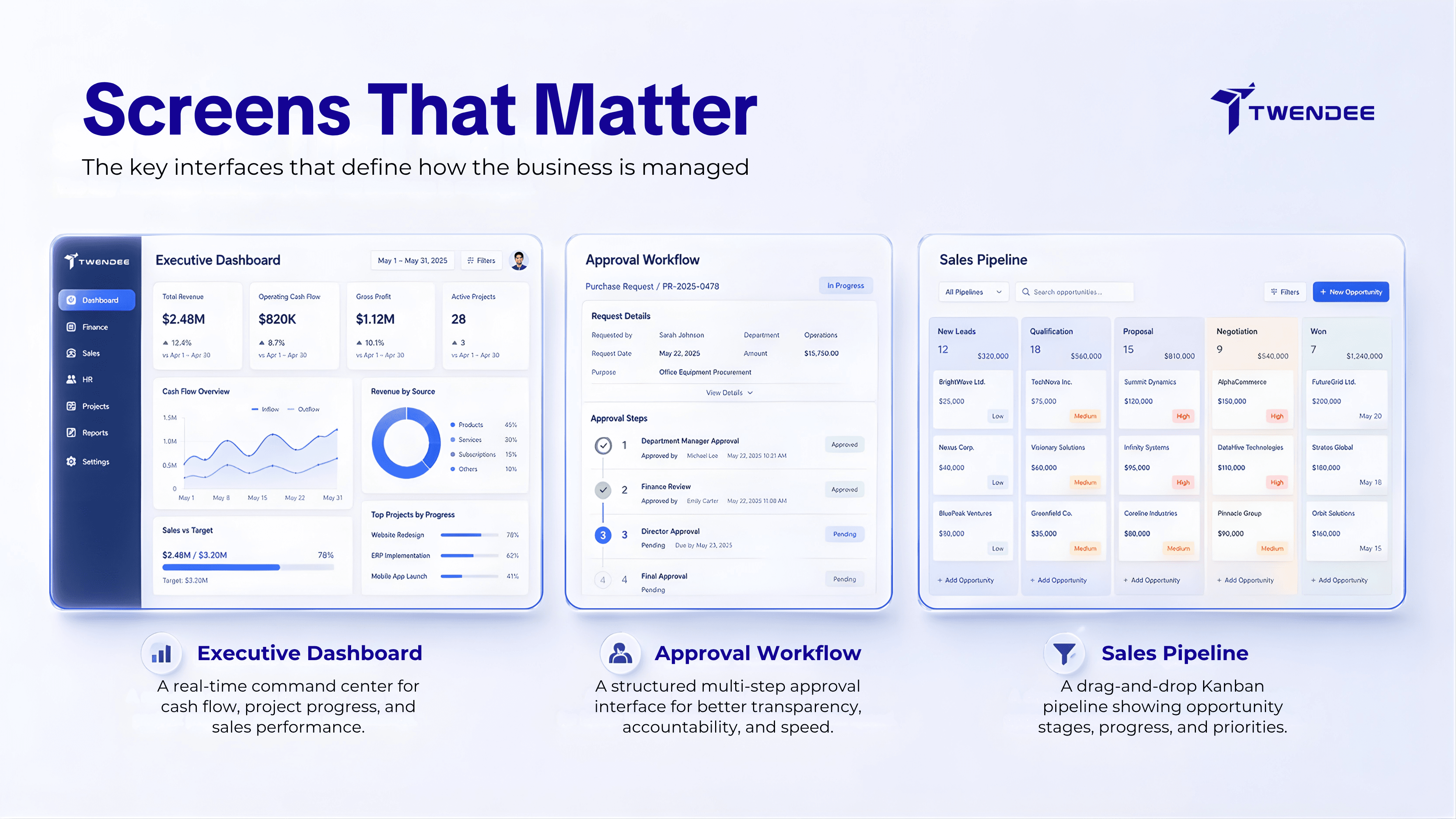
Twendee ERP connects executive visibility, approval workflows, and sales pipeline management in one operational environment, helping businesses reduce fragmented work across teams. (Source: Twendee)
Twendee ERP can also create one structured environment for areas such as CRM, finance, HR, internal requests, and management visibility. This gives teams shared workflow states while preserving the specialist systems the business still needs.
As a result, the company gains one clearer operational view without replacing its entire software stack.
The same foundation also prepares the business for automation and AI. Once data sources, permissions, workflow states, and ownership are clear, AI systems can retrieve better context and act within safer boundaries.
Conclusion
The hidden cost of software fragmentation is not the number of subscriptions on an invoice. It is the friction created between systems. Disconnected applications lead to duplicate work, slower handoffs, unclear ownership, inconsistent data, and incomplete management visibility. They can also make capable teams look poorly coordinated because employees must compensate for missing connections.
Automation and AI do not remove these weaknesses. Without shared workflow logic and trusted data, they can scale inconsistency faster. Businesses should therefore begin with one high-value workflow. They can then decide which tools to keep, which systems to connect, and which overlaps to remove.
Twendee helps businesses integrate existing systems and build shared ERP and workflow platforms around real operating processes. By connecting data, approvals, reporting, and cross-team ownership, Twendee creates one clearer operational model across the tools the business still needs.
Book a call: Calendly
Read latest blog: Why Procurement Software Is Moving Beyond Approval Chains
