Procurement used to be treated as an approval process. A team raised a request, a manager approved it, finance checked the budget, and purchasing created the order. That model worked when procurement was mostly about control.
Today, procurement has become more connected. Companies need to manage supplier data, contract terms, budget availability, purchase requests, approvals, and operational needs in one workflow. When those pieces sit in different tools, decisions become slow and fragmented.
That is why procurement management software is moving beyond simple approval chains. The real value is no longer just faster approvals. It is helping finance, operations, and purchasing teams make better decisions from the same data.
What is procurement management software?
Procurement management software is a system that helps businesses manage purchasing workflows, supplier information, purchase requests, approvals, budgets, contracts, and procurement reporting in one place.
In a basic setup, procurement software helps teams submit and approve purchase requests. In a more advanced setup, it connects supplier management, budget checks, contract data, purchase orders, finance visibility, and internal operations. This gives companies a clearer view of what is being bought, who approved it, which supplier is involved, and whether the purchase follows budget and contract rules.
This matters because procurement is no longer just a purchasing task. Deloitte’s 2025 Global Chief Procurement Officer Survey shows that procurement leaders are investing more in digital tools and AI as they respond to greater internal and external complexity. Deloitte also notes that “Digital Masters” are allocating up to 24% of their procurement budgets to technology, nearly double the level reported in 2023. (Deloitte)
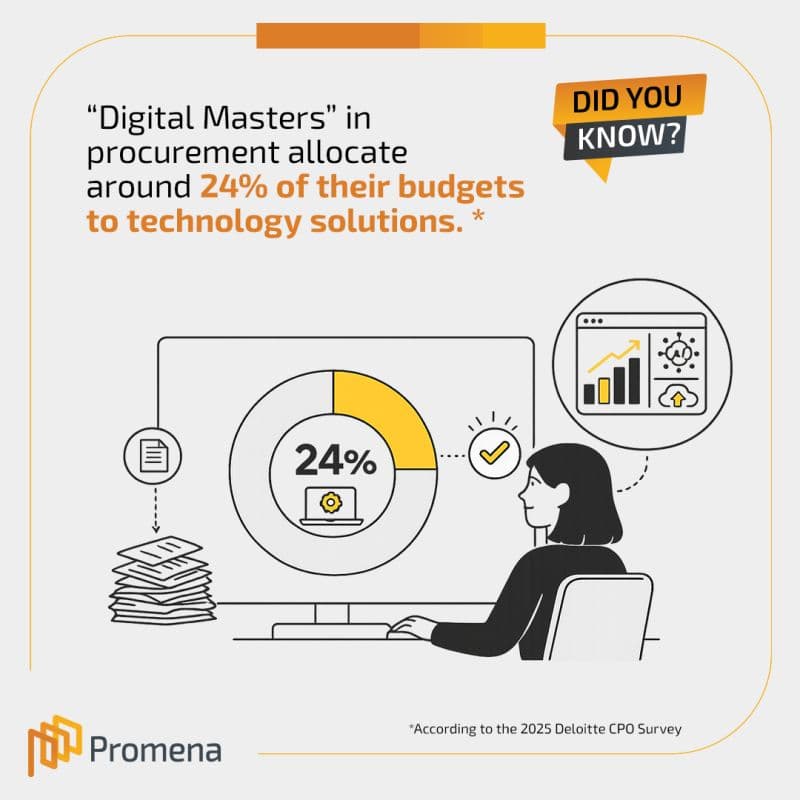
Digital procurement leaders invest 24% in technology. (Source: Deloitte, Visual by Promena)
For growing businesses, this shift is important. A company may start with email approvals, spreadsheets, and manual supplier tracking. However, as purchasing volume grows, that setup creates delays and blind spots. Teams may not know whether a supplier is approved, whether a request fits the budget, whether a contract term applies, or whether a similar purchase already happened.
A strong procurement system reduces those gaps by turning procurement into a connected workflow.
Why approval chains are no longer enough
Approval chains are still necessary. Businesses need managers to review requests, finance teams to check budgets, and procurement teams to control supplier and purchasing rules. However, approval alone does not solve the deeper procurement problem.
The deeper problem is fragmented decision-making.
A purchase request can move through approval quickly and still be a poor decision if the approver cannot see the right supplier data, contract terms, budget status, inventory needs, or operational context. In that case, the workflow is fast, but not smart.
For example, a department may request equipment from a supplier that is not on the preferred vendor list. The manager may approve it because the need looks urgent. Finance may later find that the purchase exceeds the available budget. Procurement may discover that another supplier already has a better contract rate. Operations may then face delays because the item does not match internal requirements.
This is why purchasing workflow software needs to support more than routing. It should help each team make decisions with the right context before the approval happens.
Modern procurement workflows should answer practical questions such as:
Is this supplier approved?
Does this purchase match an existing contract?
Is there enough budget for this request?
Does finance need to review it first?
Is the purchase linked to a project, department, or inventory need?
Who needs to approve the request next?
Can the decision be traced later?
When these questions are answered inside one system, procurement becomes easier to control. When they are answered across email threads, spreadsheets, chat messages, and finance reports, the business loses visibility.
This is one reason procurement software adoption continues to grow. Global Market Insights estimated the global procurement software market at USD 7.5 billion in 2024 and projected it to reach USD 17.8 billion by 2034, with growth driven by automation, spend visibility, and digital procurement needs. (GMI)
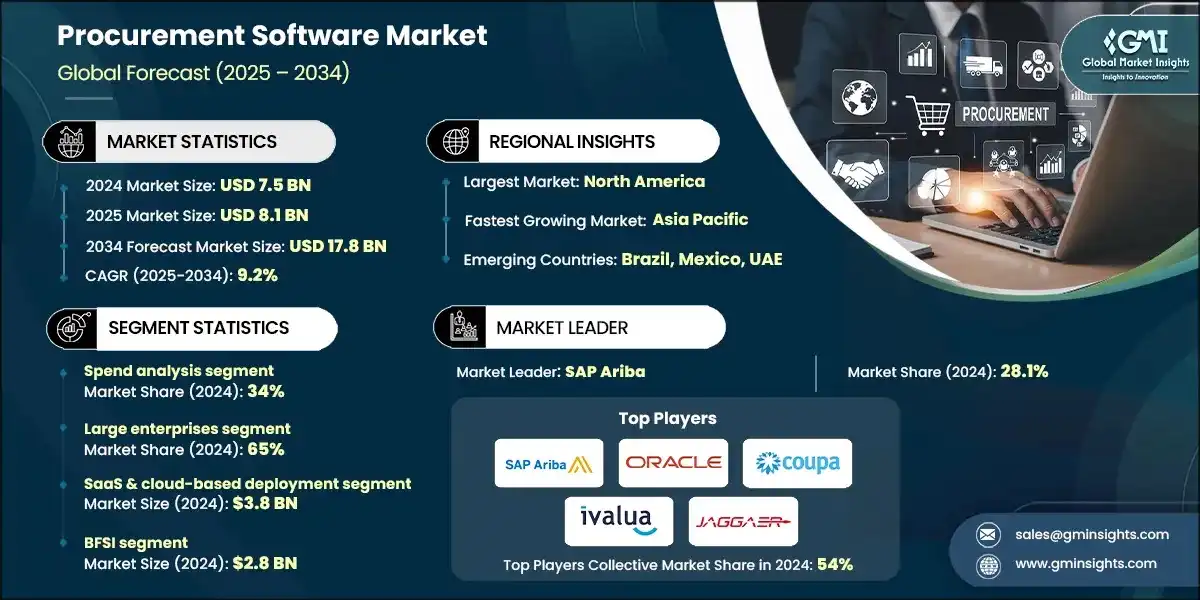
The global procurement software market is forecast to grow from USD 7.5 billion in 2024 to USD 17.8 billion by 2034. (Source: Global Market Insight)
The market growth reflects a practical reality. Businesses are not only buying procurement software to digitize approvals. They are looking for better control over spend, supplier data, contracts, and procurement decisions.
How supplier management software improves procurement decisions
Procurement decisions depend heavily on supplier data. If supplier information is incomplete, outdated, or scattered, teams may approve purchases without knowing the real risk or value of the supplier.
Supplier management software helps companies centralize supplier profiles, documents, performance data, contract details, compliance information, and purchasing history. This makes supplier decisions easier to review and compare.
Amazon Business explains that supplier management software helps procurement teams centralize supplier data, automate performance tracking, and improve supplier performance. (Amazon Business)
This is useful because supplier decisions often affect more than price. A supplier may offer a lower cost but have poor delivery reliability. Another supplier may have better payment terms but limited capacity. A third supplier may be preferred by procurement but not visible to the team making the request.
Without connected supplier data, each team may make decisions from a narrow view. Procurement looks at vendor terms. Finance looks at cost. Operations looks at delivery speed. Managers look at urgency. The result is often inconsistent purchasing behavior.
A connected procurement system brings these views together. When someone raises a request, the system can show approved suppliers, contract terms, previous purchase history, delivery performance, and related budget information. This helps the approver understand the decision before approving it.
It can also reduce maverick spending. Employees are more likely to bypass procurement when the official process is slow, unclear, or disconnected from the tools they use every day. When the approved workflow is simple, connected, and visible, teams have fewer reasons to buy outside the process.
Why procurement system integration matters
Procurement rarely works alone. It touches finance, inventory, operations, HR, legal, and management reporting. That means procurement system integration is now a core requirement, not an optional feature.
A procurement system should connect with the systems that already hold business context. Finance systems hold budgets, payment status, and accounting rules. Inventory systems show stock needs and reorder signals. ERP systems connect procurement with operations, approvals, projects, and reporting. Contract systems hold terms, renewal dates, and supplier obligations.
If procurement data does not connect with these systems, teams have to manually check information before making a decision. This slows down the process and increases the risk of mistakes.
For example, a purchase request may need to check three things before approval: whether the supplier is approved, whether the budget is available, and whether the item is already in stock. If those checks happen in separate tools, the approval chain becomes a waiting game. If they happen inside one connected workflow, the decision becomes faster and more reliable.
This is where procurement management software creates real value. It does not only automate the approval step. It connects the data needed for the approval to be useful.
Gartner Peer Insights describes source-to-pay suites as tools that streamline and automate procurement and accounts payable processes, with functions such as sourcing, supplier management, contract management, procurement, and invoice processing. (Gartner)
For businesses that need procurement connected with finance, inventory, and internal operations, this is where Twendee’s work becomes relevant. Twendee builds procurement management systems that connect approval workflows, supplier data, budget checks, and operational data into one clearer workflow. Instead of treating procurement as a separate approval tool, Twendee helps businesses design procurement as part of a broader operating system where purchasing, finance, and operations can work from the same data.
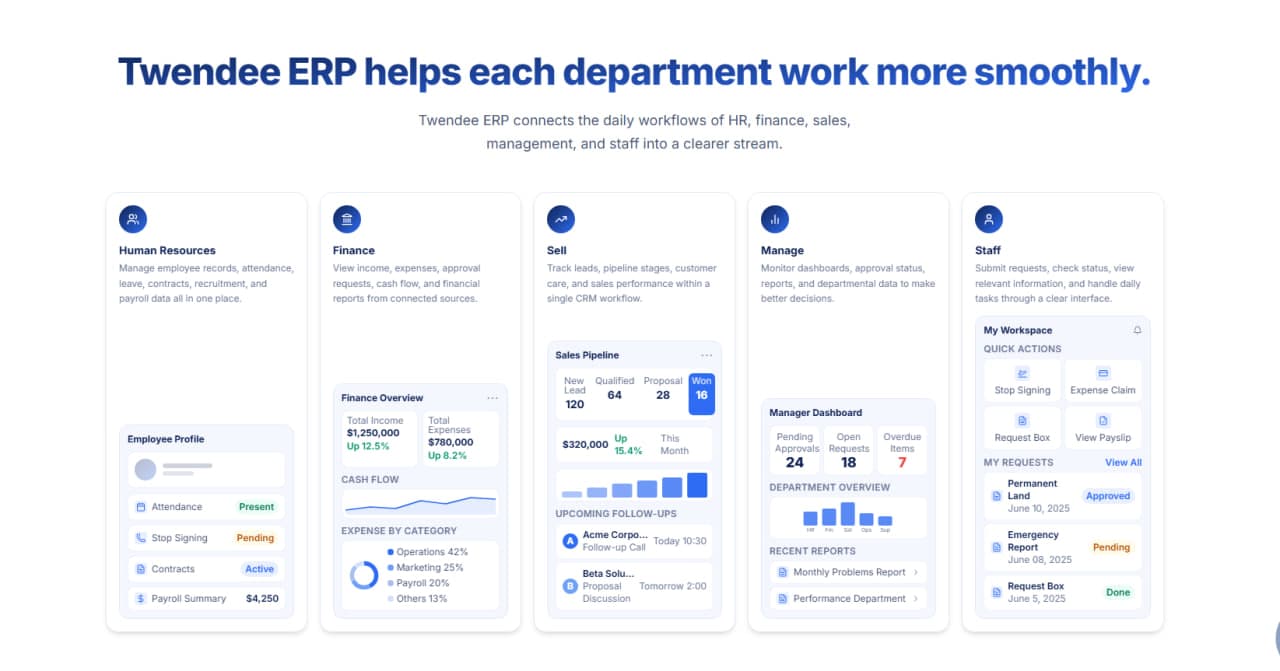
Twendee ERP connects daily work across HR, finance, sales, managers, and employees, creating a clearer operating flow for business workflows such as procurement, approvals, and reporting (Source: Twendee ERP)
That broader source-to-pay view is important. Procurement is not just the moment a request gets approved. It includes supplier selection, contract control, purchasing, budget visibility, invoice matching, and spend reporting. The more connected these steps are, the less fragmented procurement decisions become.
What procurement software should include for growing businesses
A growing business does not always need the most complex enterprise procurement suite. However, it does need a system that can reduce manual work and create reliable control as purchasing volume increases.
A practical procurement management system should include five core capabilities.
1. Request and approval workflows
Teams need a clear way to submit purchase requests, attach documents, select suppliers, and route approvals based on department, budget, purchase type, or risk level.
2. Supplier management
The system should store supplier profiles, contact details, contracts, compliance documents, performance history, and approval status. This helps teams choose suppliers with better context.
3. Budget and finance checks
Procurement should connect with budget control. Teams need to know whether a purchase fits the available budget before the request moves too far.
4. Contract and purchase order visibility
Procurement software should show whether a purchase is linked to an existing contract or purchase order. This reduces off-contract buying and improves traceability.
5. Reporting and audit trails
Managers need visibility into spend by supplier, department, category, project, and approval status. Audit trails also help the business review who approved what and why.
These capabilities help businesses move from manual purchasing to controlled procurement operations. They also prepare the company for future automation. Once supplier data, approval rules, budgets, and procurement records are structured, AI can later support tasks such as request summaries, supplier recommendations, budget checks, and exception detection.
How Twendee builds procurement systems beyond approval chains
Twendee helps businesses build procurement management systems that connect approval workflows, supplier data, budget checks, and internal operations. The goal is not only to make approvals faster. It is to help teams make procurement decisions with clearer context.
For example, Twendee can design a procurement workflow where an employee submits a purchase request, the system checks budget availability, routes the request to the right manager, links the request to supplier information, and keeps finance updated for reporting. If the purchase affects inventory or operations, the workflow can also connect with those modules.
This matters for businesses that have outgrown spreadsheets and email approvals but do not want disconnected tools across finance, purchasing, and operations.
Twendee can also integrate procurement data with ERP, inventory, finance, and internal management systems. That gives companies a cleaner operating layer where procurement decisions can be tracked, reviewed, and improved. Over time, automation and AI can be added on top of that foundation, but only where the workflow and data are clear enough to support it.
For many companies, this is the real next step. They do not need procurement software that only moves a request from one inbox to another. They need procurement software that connects the decision.
Conclusion
Procurement software is moving beyond approval chains because procurement itself has become more connected. Businesses now need to manage supplier data, budget checks, contract terms, purchase requests, approvals, and reporting in one workflow.
Strong procurement management software helps reduce fragmented decisions across finance, operations, and purchasing teams. It gives companies better visibility into suppliers, spend, approvals, and internal needs.
For growing businesses, this is where Twendee can support the next step. Twendee helps design and build procurement management systems that connect approval workflows, supplier data, budget checks, ERP, inventory, finance, and internal operations. Instead of treating procurement as a standalone approval tool, Twendee helps businesses turn procurement into a connected operating workflow that is easier to control, trace, and improve over time.
Book a call: Calendly
Read latest blog: Software Fragmentation Is Quietly Draining Enterprise Productivity