Data residency used to sound like a compliance detail. Today, it is becoming a cloud architecture decision. Where data is stored, processed, accessed, and transferred can affect cloud vendor selection, application design, AI deployment, and long-term migration plans.
For enterprises operating across markets, data residency is no longer just about choosing a cloud region. It is about knowing where business data lives, how it moves, and which workloads need stronger location control from the beginning.
Data Residency Is More Than a Cloud Region
According to IBM’s explanation of data residency, data residency refers to the physical or geographic location where data is stored or processed. IBM also explains the distinction between data sovereignty and data residency, where data sovereignty refers to the legal and regulatory authority that applies to data based on where it is generated, stored, or processed.
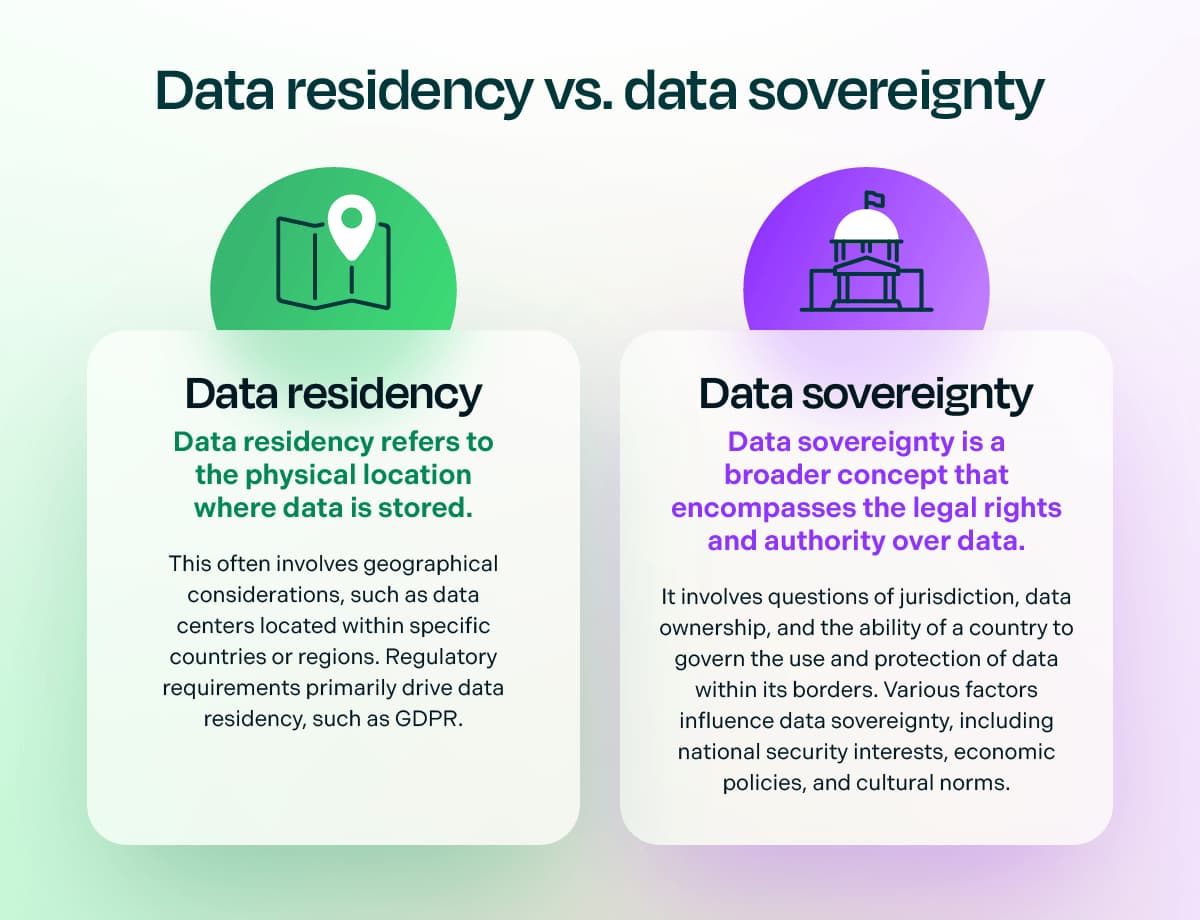
Data residency focuses on where data is physically stored, while data sovereignty covers the legal rights, jurisdiction and authority over that data. (Source: Billtrust)
This distinction matters because enterprise data rarely stays in one place.
Customer records may sit in a CRM. Transaction data may move through ERP, payment platforms, analytics tools, and reporting dashboards. AI workflows may retrieve documents from one system, process data in another, and store outputs somewhere else.
So the real question is not only: “Which cloud region are we using?”
A better question is: “Where does this data move during the full business process?”
That question affects architecture. It influences whether a workload should run in a specific region, across multiple regions, in a hybrid setup, or within a more controlled sovereign cloud environment.
Data Location Is Becoming a Cloud Strategy Issue
Not every workload needs the same data residency model.
A public marketing website may have fewer location constraints. A financial reporting system, healthcare application, customer database, or AI workflow using sensitive internal data may need tighter controls.
Enterprises should classify workloads by three practical questions:
What data does the workload use? Customer data, financial data, employee records, operational data, logs, or anonymized analytics data.
Where does the data move? Across cloud regions, between cloud and internal systems, through third-party tools, or into AI services.
What happens if the location changes? Compliance risk, customer concern, contract issue, migration cost, or operational disruption.
This is where early architecture decisions matter. If a company builds applications without mapping data flows, it may later discover that customer records, logs, backups, and AI outputs are stored in places that no longer match regulatory or business requirements.
Fixing that later can be expensive. It may require moving workloads, changing vendors, redesigning integrations, rewriting contracts, or separating data by market.
Different Workloads Need Different Residency Decisions
Not every workload needs the same data residency model.
A public marketing website may have fewer location constraints. A financial reporting system, healthcare application, customer database, or AI workflow using sensitive internal data may need tighter controls.
Enterprises should classify workloads by three practical questions:
What data does the workload use? Customer data, financial data, employee records, operational data, logs, or anonymized analytics data.
Where does the data move? Across cloud regions, between cloud and internal systems, through third-party tools, or into AI services.
What happens if the location changes? Compliance risk, customer concern, contract issue, migration cost, or operational disruption.
This is where early architecture decisions matter. If a company builds applications without mapping data flows, it may later discover that customer records, logs, backups, and AI outputs are stored in places that no longer match regulatory or business requirements.
Fixing that later can be expensive. It may require moving workloads, changing vendors, redesigning integrations, rewriting contracts, or separating data by market.
Sovereign Cloud Growth Shows the Market Is Moving
The rise of sovereign cloud shows that data location is becoming a real investment category.
According to Gartner’s forecast on sovereign cloud IaaS spending, worldwide sovereign cloud infrastructure-as-a-service spending is expected to reach $80 billion in 2026, a 35.6% increase from 2025. Gartner also notes that governments, regulated industries, and critical infrastructure organizations such as energy, utilities, and telecommunications are key buyers.
This does not mean every enterprise needs a sovereign cloud strategy immediately. But it does show that data residency and sovereignty are moving into mainstream cloud planning.
For global businesses, the implication is simple: cloud architecture needs more flexibility.
Some workloads may need local or regional hosting. Others may need hybrid architecture. Some data may remain in internal systems, while selected outputs move to cloud applications. AI workloads may need to run closer to where data already lives.
The point is not to choose the strictest model for everything. The point is to design by workload sensitivity and business requirement.
Data Residency Alone Is Not Enough
Choosing the right data location is important, but it does not solve the full problem.
If sensitive data is stored in the right region but access controls are weak, risk remains. If encryption is inconsistent, location control is incomplete. If teams cannot trace where data flows, audits become difficult. If cloud tools multiply without clear governance, the business may lose visibility even when data stays inside an approved region.
Thales’ 2025 Cloud Security Study found that 54% of cloud data is classified as sensitive, up from 47% in 2024. Yet only 8% of organizations encrypt 80% or more of their cloud data, while 42% of respondents see encryption and key management as sufficient to achieve sovereignty objectives regardless of data’s physical location.
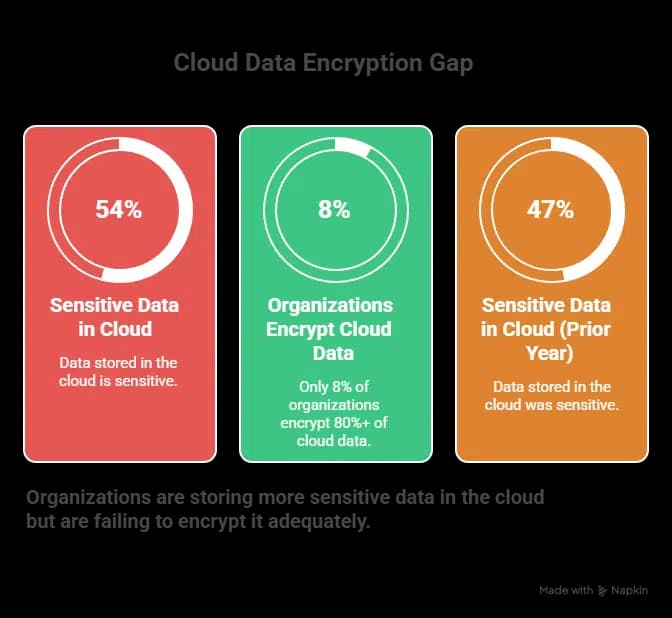
Sensitive cloud data is increasing, but encryption coverage remains limited. This shows why data residency should be combined with encryption, key management and access control. (Source: The Network Installers)
This is why data residency should be treated as one layer of control, not the whole strategy.
A stronger architecture should also include:
Data classification
Encryption and key management
Access control by role and location
Audit logs for data movement
Clear ownership of data sources
Visibility across cloud and internal systems
These controls matter even more when AI is involved. AI agents, analytics tools, and automated workflows may retrieve data from several systems at once. Without traceable data flows, the organization may struggle to prove which data was accessed, where it was processed, and who approved the action.
Early Decisions Can Reduce Migration and Compliance Complexity
Data residency decisions become harder when they are delayed.
If the business expands into a new market, adds a regulated customer segment, or changes cloud providers, the architecture must already support movement. Otherwise, every change becomes a migration project.
The European Commission’s Data Act explainer states that the EU Data Act has applied since 12 September 2025 and includes rules related to interoperability, switching between data processing services, and safeguards against unlawful third-country government access to non-personal data stored in the EU.
Under Chapter VI of the EU Data Act, providers of cloud and edge computing services must meet minimum requirements that facilitate interoperability and enable customers to switch between providers more easily. The same European Commission explainer also states that the Data Act aims to reduce barriers such as high switching costs, lengthy procedures, and lack of interoperability.
For enterprises, this reinforces a practical point: cloud architecture should avoid unnecessary lock-in.
That does not mean every company needs to move cloud providers. It means systems should be designed so that data location, data movement, and data ownership remain visible and manageable over time.
Twendee’s Role in Supporting AI Deployment and Data Architecture
In practice, most enterprises do not struggle with the concept of data residency—they struggle with visibility. Data is already spread across ERP, CRM, internal systems, cloud services, analytics tools, and AI workflows, but few organizations have a complete, up-to-date map of how it actually moves between them.
As an AI Deployment Partner, Twendee works with enterprises at this gap between architecture and reality. The starting point is a structured review of existing data flows: where critical datasets originate, which systems transform them, and where they are stored or accessed.
From there, the focus shifts to making data residency operationally clear and controllable, not just documented. This typically delivers three immediate outcomes:
Clear visibility of data movement across cloud, on-premise, and third-party systems
Identification of unnecessary cross-region transfers that increase compliance and cost risk
A workload-level view of residency requirements, instead of a one-size-fits-all cloud approach
In many cases, the issue is not the cloud model itself, but how systems were connected over time without a consistent view of residency requirements.
Rather than proposing a single deployment model, Twendee helps evaluate workloads based on their actual constraints. Some systems may require regional isolation due to regulatory or contractual requirements. Others may work better in distributed or multi-cloud setups. In some cases, hybrid approaches are needed simply because legacy systems cannot be moved without disruption.
A practical example is enterprise AI workflows. A customer service assistant may need CRM records, order history, support tickets, and policy documents in real time. A finance automation workflow may depend on ERP data, invoices, approval chains, and audit logs. These datasets often sit in different environments with different access rules, retention policies, and geographic constraints.
The challenge is not just connecting these systems, but ensuring that data movement remains explainable and auditable as it flows through AI and cloud services. Twendee helps enterprises achieve this by:
Mapping end-to-end data flows across AI and cloud pipelines
Highlighting where residency or compliance rules are being unintentionally violated
Structuring integrations so data access can be traced and governed
The result is a clearer operational foundation: decisions about deployment, compliance, and scaling are made based on how the system actually behaves in production—not how it was originally designed on paper.
Conclusion
Data residency is becoming a core part of enterprise cloud strategy. It affects where workloads run, which vendors are suitable, how applications are designed, and how AI systems access operational data.
The strongest approach is not to treat data location as a late compliance check. Enterprises should map data flows early, classify workload sensitivity, choose architecture by business requirement, and keep data movement traceable across cloud and internal environments.
As an AI Deployment Partner, Twendee helps businesses design cloud and AI architectures around real data requirements, so enterprise systems can scale without creating avoidable compliance and migration complexity.
Book a call: Calendly
Read latest blog: Multi-Cloud Strategy Is Back on the Agenda as AI Infrastructure Expands