Enterprise leaders are rethinking their enterprise software strategy because AI is changing how employees search, analyze, approve and act inside business systems. A new AI interface can make old software feel outdated very quickly.
The harder question is not whether AI can improve the user experience. It can. The harder question is what should happen to the ERP, CRM, HR, finance and operations systems that still hold the company’s records, rules and process history.
AI can change the front end of enterprise work. It does not automatically replace the operational backbone behind it.
Enterprise Software Is Hard to Replace Because It Carries Business Memory
Most enterprise applications look replaceable when they are judged by their screens. A purchase approval form, a CRM update screen or an ERP report can feel slow next to an AI assistant that accepts a natural-language request.
That comparison misses where the real value sits.
Enterprise software is not only a user interface. It carries years of operating knowledge that a company depends on every day:
Customer history and sales activity
Finance rules, approval limits and audit records
HR policies, employee data and permission structures
Procurement workflows, supplier terms and exception handling
Inventory, billing, delivery and operational dependencies
A finance system may know how invoices are matched, which exceptions need approval, which cost centers apply and how month-end adjustments are handled. A CRM may contain years of account notes, deal stages, service issues and renewal patterns.
Replacing the screen is easy. Recreating the business memory behind the screen is the expensive part.
This is why many enterprise systems remain in place long after their interface feels outdated. McKinsey notes that as much as 70% of software used by Fortune 500 companies was developed 20 or more years ago, which shows how deeply legacy systems remain embedded in large enterprises.
The AI-era question is therefore more specific: which parts of the system should stay stable, which parts should be modernized and which interactions can be redesigned with AI?
Replacement Cost Lives in Rules, Data and Integrations
Enterprise software becomes hard to replace because it absorbs rules over time. Some rules are documented. Many are not.
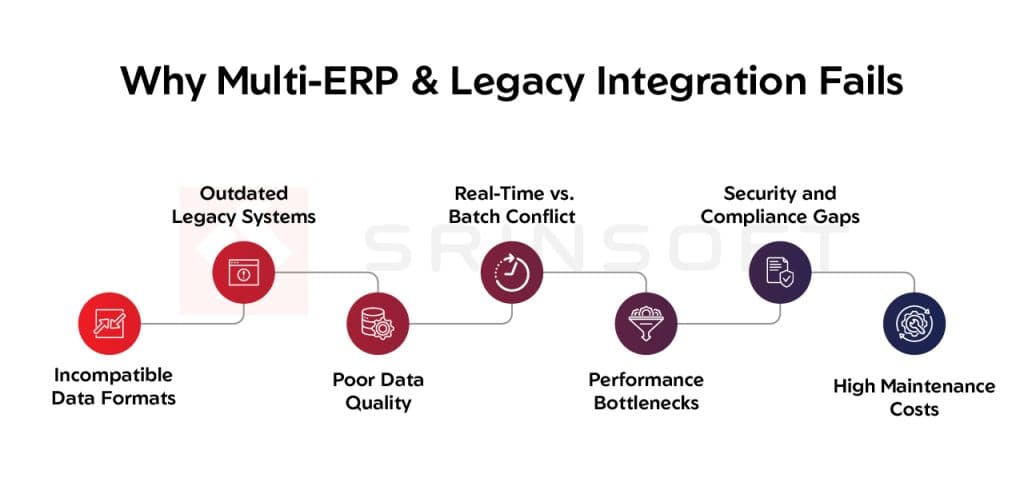
Legacy and multi-ERP integration often fails because of incompatible data formats, poor data quality, outdated systems, performance bottlenecks, security gaps and high maintenance costs. These issues explain why enterprise software replacement is rarely a simple platform migration. (Source: SrinSoft)
A company may have special payment terms for strategic customers. A warehouse may have different rules for urgent shipments. Finance may use manual adjustments during closing. HR approval chains may vary by location, seniority, contract type or policy history.
These rules look small until a replacement project has to rebuild them.
A new platform can support the standard process. The problem is that many companies do not run only on standard processes. They run on exceptions, department-level logic, historical adjustments and integrations built over many years.
The replacement cost usually comes from four layers:
Process rules: Approval flows, exceptions, escalation logic and department-specific steps.
Data history: Customer records, transactions, audit trails, documents and reporting baselines.
System integrations: Connections between ERP, CRM, HR, finance, procurement, reporting tools and external services.
User behavior: The real way teams work, including manual steps that may never appear in official documentation.
This is why replacement projects often become larger than expected. The new system may go live, but old workarounds reappear in spreadsheets, side tools and manual approvals if the underlying complexity has not been resolved.
Gartner points out that ERP integration with legacy systems may require costly middleware and can create risks such as data inaccuracy, redundancy or loss when integration is handled poorly.
For executives, this means “replace or keep” is too simple. A stronger enterprise software strategy should ask:
What business logic must be preserved?
Which integrations are business-critical?
Which data must remain traceable?
Which workflows create value, and which only preserve old habits?
Which parts of the system block AI, automation or better reporting?
At Twendee, this assessment is usually the starting point. The goal is not to rebuild every old feature. The goal is to identify which software assets still carry operational value and which parts create friction, cost or risk.
AI Changes the Interaction Layer Before It Replaces the Core System
The first major impact of AI in enterprise software is not full replacement. It is a new interaction layer.
Instead of navigating multiple screens, employees can ask questions, retrieve records, generate summaries, compare options and prepare actions through AI. A sales manager can ask for accounts at risk. A finance lead can ask why expenses changed. An HR manager can request a policy summary. An operations lead can ask which orders are blocked and what caused the delay.
This can create real productivity gains because many enterprise systems were designed for structured data entry, not fast decision support.
McKinsey’s work on enterprise architecture for the agentic era argues that the first wave of agentic AI will sit on top of legacy systems to extend existing capabilities, while the underlying systems remain intact and usability, transparency and speed improve.
That distinction matters.
AI can become the new way people access enterprise software. The ERP, CRM, HR and finance systems still remain the systems of record. They continue to store the data, enforce rules, manage permissions and create audit trails.
A practical example:
The user asks: “Which customers are at risk this quarter?”
AI retrieves CRM activity, payment history, support tickets and renewal dates.
The system highlights risk factors and suggests next actions.
A manager approves or adjusts the action.
The final update is recorded back into CRM or ERP.
In this flow, AI improves access and decision speed. It does not remove the need for reliable records underneath.
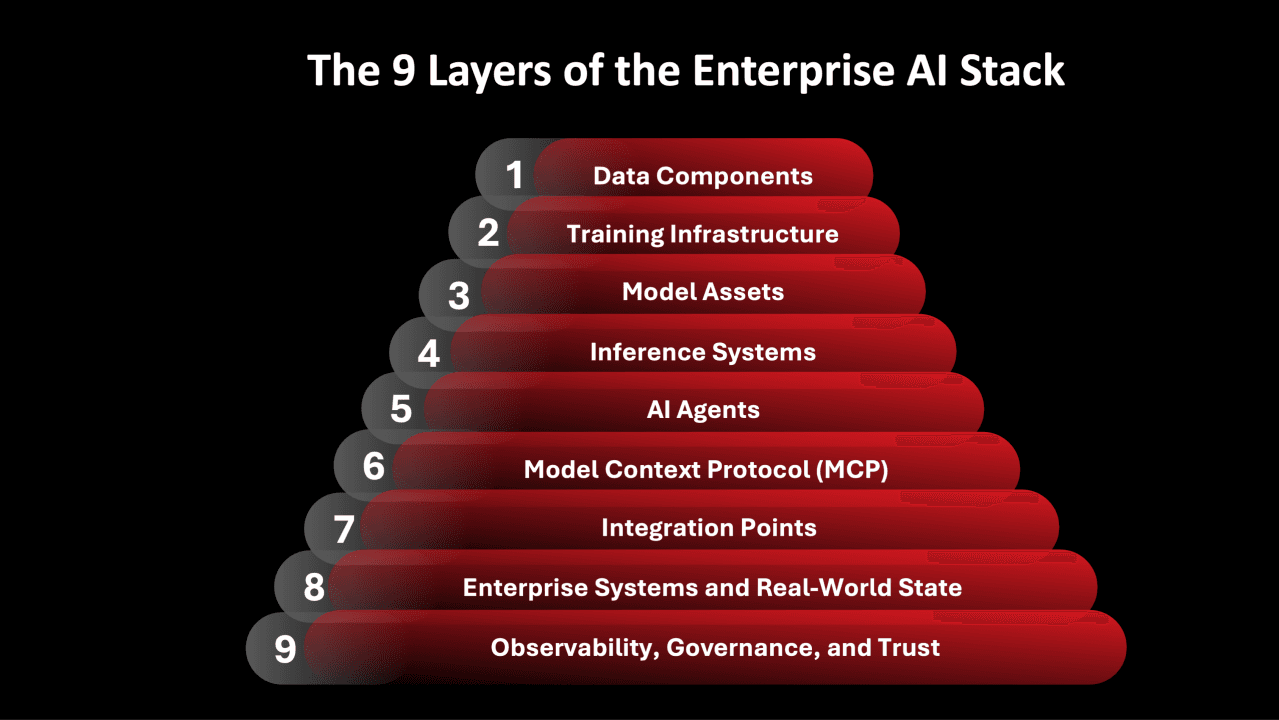
Enterprise AI depends on more than models and agents. To create business value, AI needs integration points, access to enterprise systems, real-world operational state, observability, governance and trust. (Source: ResearchGate)
This is where many AI projects fail to create durable value. They add a conversational layer, but do not connect it deeply enough to business systems. The result is a polished interface that can summarize information but cannot support real execution.
Twendee’s role as an AI Deployment Partner sits in this gap: designing AI interfaces around existing enterprise systems, connecting the right data sources and keeping permissions, approvals and audit trails intact.
The Right Strategy Is Retain, Modernize, Extend or Rebuild
Old software is not automatically a problem. New software is not automatically an improvement.
Some legacy systems look dated but run critical operations reliably. Others create real drag because they are expensive to maintain, hard to integrate, poorly documented or dependent on shrinking technical expertise.
A better enterprise software strategy is to classify systems by business value and modernization need.
Retain Keep systems that are stable, reliable and still support critical operations. Improve access through dashboards, APIs or AI interfaces instead of forcing a risky replacement.
Modernize Improve systems where the core logic remains valuable but the architecture, data model or integration layer limits performance. This may include refactoring, API enablement, data cleanup or workflow redesign.
Extend Add AI interfaces, automation or new capabilities around existing systems. This works well when the system of record is reliable but the user experience slows people down.
Rebuild or replace Replace systems that create more risk than value, especially when they block integration, reporting, compliance, automation or business change.
This portfolio view is more useful than asking whether AI will replace enterprise applications. In most companies, the answer will vary by system, function and workflow.
McKinsey reports that generative AI can reduce much of the manual work in IT modernization, with research indicating 40–50% faster modernization timelines and around 40% lower costs in some modernization work.
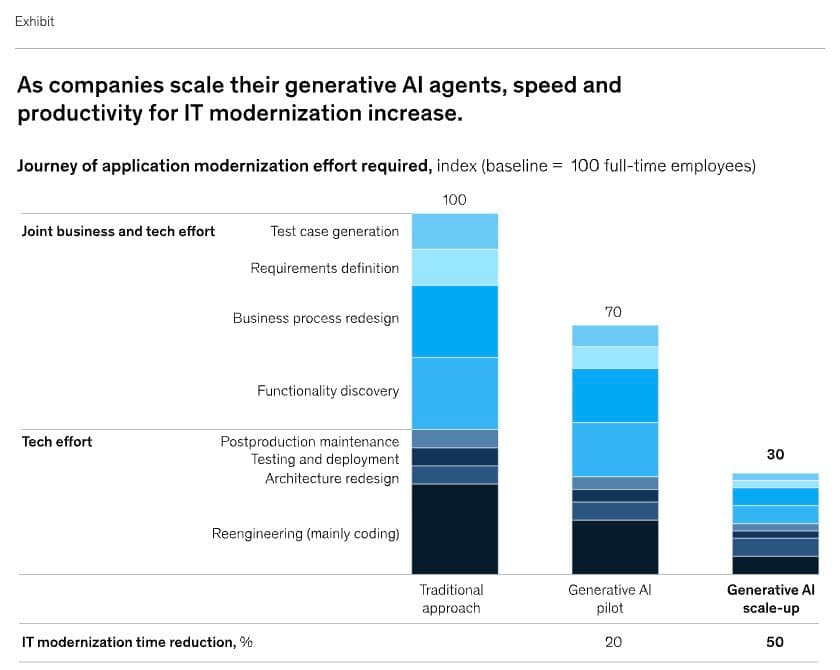
Generative AI can reduce the manual effort involved in IT modernization across key activities such as analysis, migration, refactoring, testing and documentation. This supports a more selective approach to enterprise software strategy: retain what still works, modernize what limits the business and rebuild only where replacement creates clear value. (Source: McKinsey)
That does not mean modernization becomes easy. It means AI can make the work faster and more disciplined when the company already knows what should be retained, simplified or rebuilt.
AI Makes Enterprise Systems More Valuable When They Are Well Structured
AI increases the value of enterprise software when the underlying systems expose reliable data, clear rules and traceable actions.
A well-structured ERP gives AI trusted financial and operational context. A clean CRM helps AI identify sales risks, customer history and next-best actions. A structured HR system can support employee service, workforce planning and policy guidance. A connected operations system helps AI detect bottlenecks, delays and exceptions.
The reverse is also true. Poorly structured systems limit AI.
If data is inconsistent, permissions are unclear and workflows are undocumented, AI may produce answers that sound useful but cannot be trusted for action. The problem is not the model alone. The problem is the operating environment around the model.
For AI to work with enterprise systems, companies need a few foundations in place:
Clean ownership of data and systems
Clear definitions for business metrics
Stable integrations across ERP, CRM, HR and finance
Permission controls by role and department
Audit trails for AI-assisted actions
Feedback loops to improve recommendations over time
McKinsey’s research on agentic AI foundations emphasizes that scaling agentic systems depends on data architecture that can support greater autonomy, coordination and real-time decision-making, with governance becoming a primary mechanism for control.
This is why AI and modernization should not be treated as two separate agendas. Modernization improves the systems AI depends on. AI creates new ways to extract value from systems that were previously difficult to use.
For Twendee, the practical work often includes mapping existing workflows, identifying valuable software assets, connecting data sources and adding AI-enabled interfaces around the systems that still matter to the business.
The AI Era Moves Software Strategy From Replacement to Capability Extension
In the past, enterprise modernization often meant choosing a new platform and migrating users, data and workflows. That path still makes sense when a system is unstable, unsupported or structurally unable to serve the business.
AI adds another path: extend capabilities around the existing enterprise core.
A company can keep its ERP while adding AI for variance analysis, invoice triage, procurement support or approval preparation. It can keep its CRM while adding AI for account summaries, pipeline risk, renewal signals and customer service routing. It can keep HR systems while adding AI for policy search, employee support and workforce insights.
This is not a workaround. It is a more selective modernization strategy.
The enterprise core remains responsible for records, permissions, transactions and auditability. AI improves how people access information, interpret context and prepare action. Over time, the company can decide which underlying components need deeper modernization or replacement.
That is the key shift for leaders.
AI does not remove the need for enterprise software strategy. It raises the standard for it. Companies need to know which systems are strategic assets, which systems slow the business down and where AI can create value without disrupting core operations.
Conclusion
Enterprise software is hard to replace because it carries more than code. It carries business memory, process rules, integrations, data history and operational trust.
AI will change how employees interact with enterprise applications, but it will not erase the need for reliable systems of record. The stronger move is to retain what still creates value, modernize what limits the business and add AI interfaces where they help teams act faster with proper control.
As an AI Deployment Partner, Twendee helps enterprises assess existing software assets, modernize core systems and build AI capabilities around real business operations.
Book a call: Calendly
Read our latest blog: Multi-Cloud Strategy Is Back on the Agenda as AI Infrastructure Expands