

The global offshore software development market hit $178.6 billion in 2025 and is projected to reach $198.3 billion by 2026. (Source: Softsuave, 2025) The numbers look healthy. But underneath them sits a quieter crisis: 59% of companies report dissatisfaction with offshore development outcomes, and Gartner found that 67% of offshore projects require significant rework. (Source: Deloitte Global Outsourcing Study 2024; Gartner) . The market is growing, but the traditional model is breaking. In 2026, the question isn't whether to outsource, it's how. And the answer, for product-driven companies, is clear: the agile outsourcing model is winning.
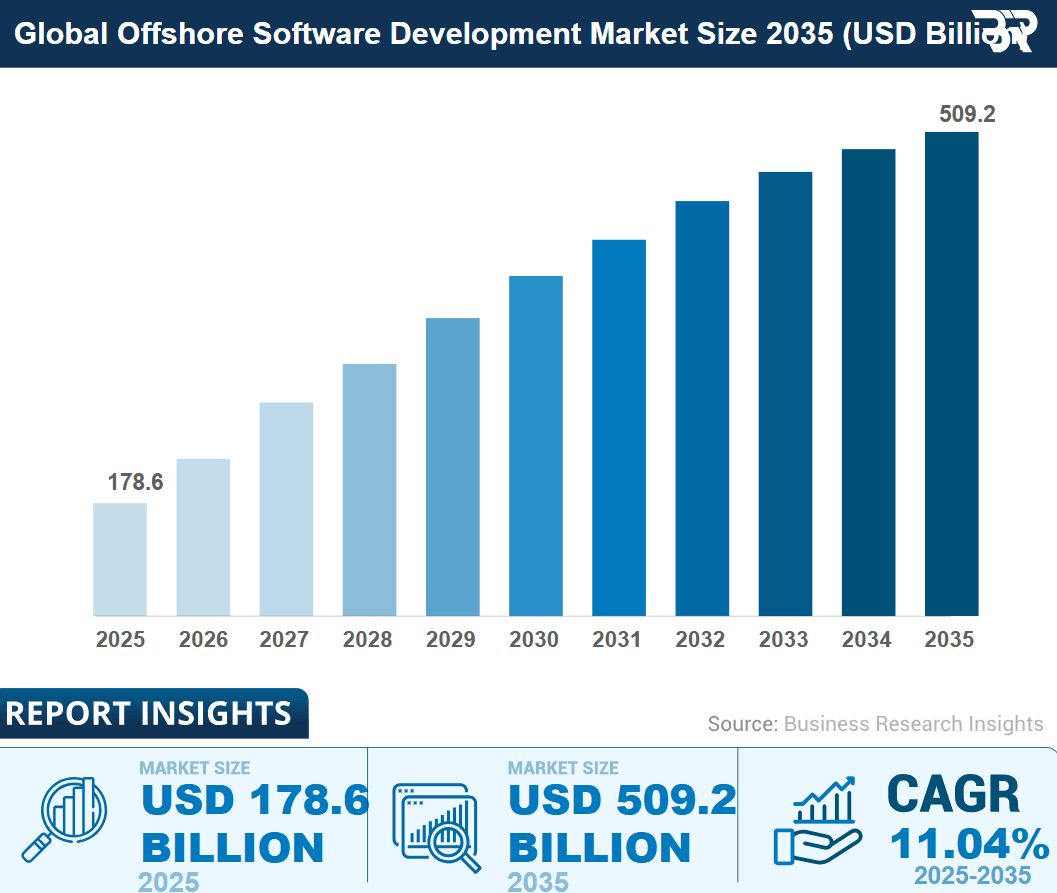
Global offshore software development market growth from 2025 to 2035 showing steady CAGR increase (source: saigontechnology)
The Core Problem With Traditional Offshore Development
Traditional offshore outsourcing was built for a different era one where software requirements were stable, timelines were measured in quarters, and "delivery" meant handing over a spec-complete codebase. That era is over.
Today, product teams ship weekly. User feedback reshapes roadmaps mid-sprint. Priorities pivot with market signals. The traditional offshore model built on fixed-scope contracts, layered account management, and asynchronous handoffs simply cannot keep pace. The structural weaknesses are well-documented:
Slow feedback loops. When developers are separated from product owners by multiple time zones, middlemen PMs, and weekly status calls, a single pivot can take weeks to cascade into actual code changes. Meanwhile, your in-house team has already moved on.
No ownership culture. In a typical offshore factory model, a "dedicated" team is simultaneously serving 3–4 other clients. (Source: fullscale.io, 2025) Developers execute tickets; they don't think about your product. The result is code that technically passes acceptance criteria but misses the point.
High turnover destroys continuity. Traditional offshore vendors run 40–60% annual developer turnover. (Source: fullscale.io, 2025) Every few months, institutional knowledge walks out the door. Onboarding cycles reset. Velocity drops. The client absorbs the cost in rework and re-explanation.
Cultural misalignment compounds miscommunication. Approximately 60% of all outsourced projects fail due to poor cultural compatibility. (Source: DECODE, 2025) And while language barriers get most of the blame, the deeper issue is that offshore teams trained in execution not problem-solving lack the context to flag bad requirements before they become bad software.
One overlooked reason traditional offshore models struggle is that many organizations don’t even have a clear understanding of how their systems function across teams, tools, and workflows. When product, engineering, and operations are already fragmented internally, adding a detached offshore layer only amplifies the misalignment. We explored this structural blind spot in detail in our article on how most organizations don’t actually understand their systems end-to-end. Without system-level visibility, outsourcing becomes execution without context. And execution without context is where rework, delays, and ownership gaps begin.
What the Agile Outsourcing Model Actually Changes
The agile outsourcing model doesn't just swap out the methodology. It changes the relationship structure between the client and the dev team. In a true agile model, the outsourced team is embedded in the product development cycle attending sprint planning, contributing to backlog grooming, and accountable to the same KPIs as the in-house product team. The dev team isn't downstream of the product. It is part of the product.
Three structural differences separate agile outsourcing from traditional offshore:
Tight feedback loops replace asynchronous handoffs. Instead of monthly milestone reviews, agile outsourcing teams operate in 1–2 week sprints with real-time retrospectives. According to a 2023 survey in the Journal of Systems and Software, 75% of organizations now require outsourcing partners to adopt Agile practices precisely because iterative development and continuous feedback reduce costly misalignments. (Source: Journal of Systems and Software, 2023)
Team ownership replaces ticket execution. Developers in an agile outsourcing setup understand the product roadmap. They know why a feature is being built, not just what it should do. This context is the difference between code that ships and code that sticks. Research from the MIT Sloan Management Review (2023) shows that businesses using integrated, collaborative models achieve 15–20% higher project outcomes compared to siloed offshore arrangements.
Outcome metrics replace activity metrics. Traditional offshore contracts measure inputs — hours logged, tickets closed, code committed. Agile outsourcing measures outputs — deployment frequency, change failure rate, lead time to production. These are the DORA metrics that actually predict whether a team is healthy.
The impact of this shift is measurable. Agile projects are on average 28% more successful than traditional waterfall or fixed-scope projects. (Source: DECODE/Atlassian, 2025) And DevOps-integrated teams the natural complement to agile outsourcing reduce deployment times by up to 50% while improving software quality by 30%. (Source: IEEE Transactions on Software Engineering, 2023)
Traditional Offshore vs Agile Outsourcing: Where It Breaks Down
Dimension | Traditional Offshore | Agile Outsourcing Model |
Feedback cycle | Weeks (monthly milestones) | Days (sprint cadence) |
Team ownership | Low (ticket execution) | High (product roadmap alignment) |
Dev turnover | 40–60% annually | Stable (outcome-aligned retention) |
Rework rate | 67% of projects (Gartner) | Significantly reduced |
Requirement adaptation | Slow (change requests, cost) | Built-in (sprint replanning) |
Success rate | 23% achieve successful partnerships (Accelerance 2024) | 28% higher than traditional (Atlassian) |
The differences in this table are structural, not cosmetic. Traditional offshore models optimize for cost and ticket throughput, which makes them slow to adapt when product priorities shift. Feedback is delayed, ownership is diluted, and rework becomes common as requirements evolve.
Agile outsourcing changes the operating logic. Short feedback cycles, roadmap-level ownership, and outcome-based metrics reduce misalignment before it compounds. Instead of managing change through formal requests and added cost, change is absorbed through sprint replanning. In markets where product velocity determines competitiveness, the model that integrates teams into the product lifecycle will consistently outperform the one built around handoffs and headcount. The question in 2026 is no longer whether to outsource, but whether the outsourcing model is designed for speed and accountability.
Distributed Agile Development: Making It Work Across Time Zones
A common objection: "Agile requires co-location. How do you run distributed agile development?" This was a real constraint in 2015. It's a solved problem in 2026. 72% of offshore development teams now leverage agile practices to boost collaboration and delivery speed. (Source: Softsuave, 2025) The tooling infrastructure async standup tools, shared sprint boards, CI/CD pipelines visible to all stakeholders has matured to the point where timezone differences are a workflow consideration, not a dealbreaker.
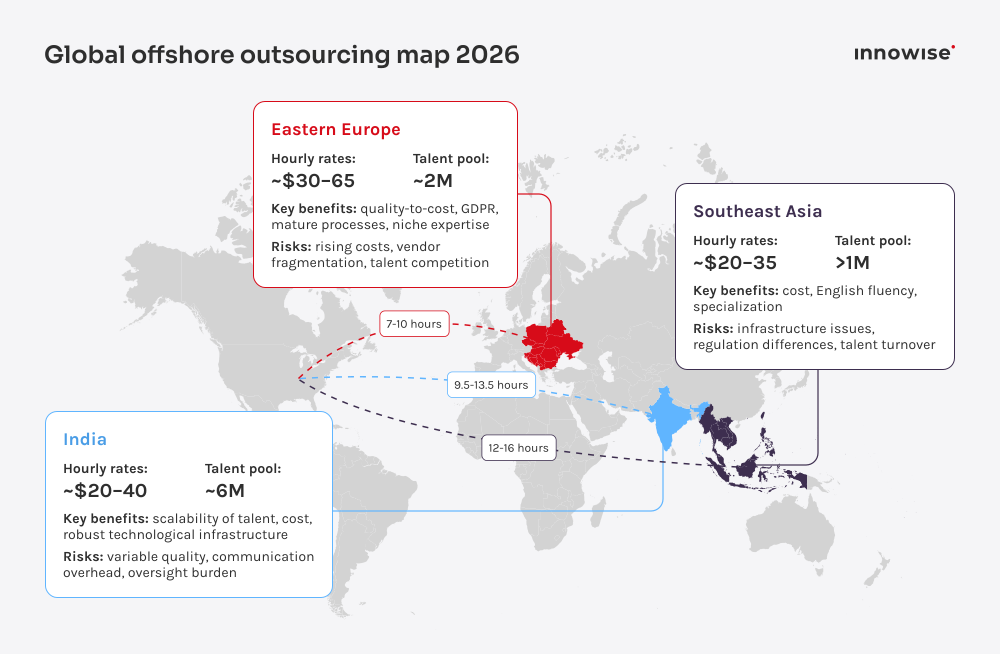
Global offshore outsourcing hubs in Eastern Europe, India, and Southeast Asia with hourly rates comparison (source: innowise)
What does matter in distributed agile development is not proximity, it's overlap hours and communication discipline. A team in Vietnam working with a product owner in Berlin can run effective sprints with 2–3 hours of daily overlap for synchronous decisions, and async tooling handling the rest. What fails is when teams lack the agile culture to use those overlap hours productively.
This is where the setup matters more than the geography. An agile outsourcing team that has internalized sprint ceremonies, owns their part of the backlog, and escalates blockers proactively will outperform a co-located offshore team running fake-agile waterfall in disguise.
Most outsourcing vendors claim "agile." Few are built for it. At Twendee, the delivery model is structured around a single principle: the dev team must be connected to the product roadmap, not just the current sprint ticket. This means onboarding goes beyond tech stack familiarization engineers understand the product vision, the user problems being solved, and the business metrics the roadmap is driving toward.
In practice, this looks like:
Dev teams attending roadmap reviews, not just sprint kickoffs so engineers understand the why behind priorities, not just the what
Embedded product thinking in code reviews flag when a feature spec may contradict UX goals or create downstream technical debt before implementation begins
Shared DORA dashboards both Twendee's delivery team and the client's product leads track the same deployment frequency, lead time, and change failure rate metrics
Sprint-level ownership accountability: team members own outcomes, not task lists; a sprint that ships features nobody uses is treated as a failure, not a win
The result is a distributed agile development model where the offshore team behaves like an embedded product team, one that happens to be in Vietnam. This is how the agile outsourcing model closes the gap that traditional offshore always struggled with: the gap between "built as specced" and "built what the product actually needed."
Conclusion
The offshore market is not going anywhere. Cost arbitrage remains real. Global talent access remains a strategic lever. But in 2026, the competitive advantage doesn't come from having an offshore team, it comes from how that team is integrated into your product development cycle.
The traditional offshore model was optimized for cost and headcount. The agile outsourcing model is optimized for velocity and outcome. For product companies operating in fast-moving markets where the roadmap shifts every quarter and user feedback is the primary compass, there's only one model that survives contact with reality. Agile outsourcing isn't a better version of offshore. It's a fundamentally different bet: on ownership, feedback, and product alignment over compliance, handoffs, and headcount. The data already shows which bet is paying off. At Twendee, we design distributed teams that operate as embedded product units aligned to your roadmap, accountable to your DORA metrics, and built for long-term velocity, not short-term ticket throughput. If you're rethinking how your offshore team should work in 2026, let’s have a conversation about building an agile delivery model that actually matches how modern product teams ship.
Stay connected with us via Facebook, X, and LinkedIn.
