

Internal documentation usually works well when the team is small. People know who to ask, where to find things, and which version of the process is still true. But as teams grow, that informal system starts to break. A strong internal documentation system becomes necessary because knowledge can no longer depend on memory, scattered files, or a few people who “just know how things work.” The problem is rarely that teams do not write enough documents. The real problem is that documentation does not scale at the same speed as the business.
Knowledge Still Lives in People’s Heads
In a small team, undocumented knowledge can feel harmless. A new employee can ask the founder how a process works. A project manager can explain the delivery flow in a quick call. A senior team member can remember why a decision was made, which client exception applies, or how to handle a special case. This works because the team is close enough for knowledge to move through conversations.
But when the company grows, that same habit becomes a bottleneck. The people who know the process become the only people who can explain it. New employees wait for answers. Junior team members repeat the same questions. Managers become the fallback source for every exception. Handover depends on whether the right person has enough time to explain what was never documented properly. That is where internal documentation begins to fail. It does not fail because there is no information at all. It fails because the most useful knowledge is still informal.
The most important knowledge inside a company is often not the clean checklist. It is the decision logic behind the checklist. Why does this approval step exist? When can a team skip it? Which customer requests need escalation? What does “ready for delivery” actually mean in practice? These details are usually learned through experience, not through a document.
When teams scale, experience becomes harder to transfer. A company knowledge base needs to capture more than final instructions. It needs to preserve context, ownership, exceptions, and decision history so people can act consistently without depending on one person’s memory.
This is why Twendee looks at internal documentation as part of operational infrastructure. A useful internal documentation system should help businesses turn individual knowledge into reusable team knowledge. It should make the process easier to understand, easier to find, and easier to apply in real work. Without that shift, documentation remains incomplete even when the company has many documents.
Information Is Scattered Across Too Many Tools
As teams grow, information starts spreading everywhere. A policy sits in Google Docs. A process update lives in Slack. A client handover note is buried in email. A technical explanation is in a project ticket. Sales materials sit in a shared drive. HR onboarding documents are in another folder. Someone created a Notion page, but nobody knows whether it is still current. At this stage, the company may believe it has documentation. But in reality, it has fragments.
This becomes a real operational problem because people no longer know which source to trust. If two documents explain the same process differently, which one is correct? If a workflow was updated in chat but not reflected in the wiki, which version should the team follow? If a new employee cannot find the right page, does the documentation actually exist from their point of view?
Recent workplace research shows how common this problem is. Atlassian’s 2025 State of Teams research found that leaders and teams waste 25% of their time searching for answers. Miro’s 2025 Momentum at Work report also found that 63% of knowledge workers say information and data are spread across too many tools, while 57% point to inconsistent tools, norms, or preferences across teams. These numbers explain why documentation fails at scale. The issue is not only missing documents. It is the absence of a trusted source of truth.
A company knowledge base should not be a dumping ground for every file the company has ever created. It needs structure. It needs clear categories, access permissions, document owners, review status, and links to the workflows where that knowledge is used.
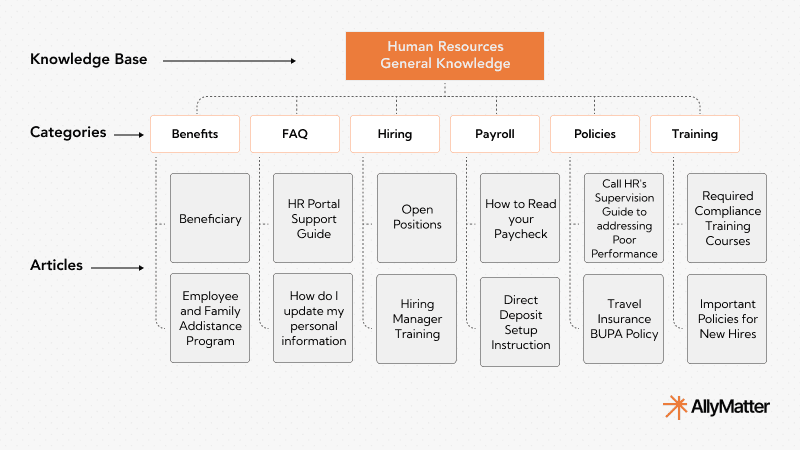
Company knowledge base structure (source: allymatter)
This is where internal documentation software can help, but software alone is not enough. If the same scattered habits are moved into a new tool, the problem simply becomes more organized on the surface. The deeper work is designing how knowledge should be structured around teams, processes, roles, and daily operations.
For example, a sales team should not have to search across five folders to understand the latest proposal process. A support team should not need to ask three people which escalation path is correct. A project manager should not have to compare old handover notes with new delivery templates. The internal documentation system should make the correct answer easier to find than asking someone manually. That is the difference between storing information and managing knowledge.
No One Owns the Update Process
Many companies start documentation projects with good intentions. They create templates, write SOPs, launch an internal wiki, and ask teams to document their workflows. For a few weeks, the system looks healthy. Then the business changes.
A team adds a new approval step. A product changes. A client workflow becomes more complex. A department switches tools. A manager updates a process in a meeting. A new exception becomes common, but nobody updates the document.
Over time, the internal wiki becomes a collection of old truths. This is one of the most common reasons internal documentation fails as teams scale. Documentation is treated as a one-time project instead of an ongoing workflow. Once a document is published, nobody clearly owns what happens next.
A strong documentation workflow should answer simple but important questions. Who owns this page? When should it be reviewed? Who can edit it? Who approves major changes? What happens when the workflow changes but the document is still outdated? How does the team know whether this page is current?
Without this ownership layer, people gradually lose trust in the documentation. They read a page, suspect it may be outdated, and ask someone anyway. Once that happens repeatedly, documentation stops being the default source of truth. The team returns to chat, meetings, and memory.
This creates more “work about work.” Asana’s Anatomy of Work research found that knowledge workers spend 60% of their time on work about work, including searching for information, switching between apps, chasing status, and managing shifting priorities. Poor internal documentation contributes to this pattern because teams spend more time trying to understand work than actually moving work forward.
This is why documentation workflow matters as much as the content itself. For a scaling company, internal wiki management should include ownership, review cycles, version control, approval flows, and permission settings. A document should not only say what the process is. It should show whether the process is still valid, who owns it, and how changes are managed.
Twendee can support this by helping businesses design documentation systems that connect knowledge management with operational governance. That means documentation is not just written and forgotten. It becomes part of how teams maintain consistency as processes change. When documentation has no owner, it decays. When it has a workflow, it can keep up with the business.
It Is Separated from Daily Workflow
The deepest reason internal documentation fails is that it often lives outside the work itself. A company may have a detailed wiki, but employees still do not use it during onboarding, customer support, project delivery, approval, sales handover, or internal requests. The document exists, but it does not appear at the moment when the team needs it. This is why static documentation often fails at scale. People do not want to stop their work, search through a folder, compare different pages, and guess which one applies to the task in front of them. They want the right knowledge in the right context.
If a new employee is onboarding, the documentation should connect to the tasks they need to complete. If a project is handed over, the delivery notes should connect to the actual project workflow. If a support issue needs escalation, the internal guide should appear inside the support process. If a finance approval requires certain conditions, the policy should connect to the approval workflow instead of sitting in a separate folder. This is the gap between documentation and operations.
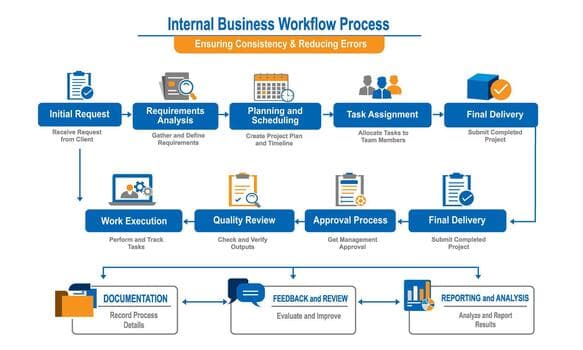
Internal documentation workflow system (source: vecteezy)
A useful internal documentation system should not only help people read knowledge. It should help them apply knowledge while work is happening. This becomes even more important as companies adopt AI tools. Glean’s 2026 Work AI Index found that workers spend 6.4 hours per week “botsitting” AI, including feeding AI context, supervising outputs, debugging errors, and switching between tools. One reason this happens is that AI tools often lack access to the company context they need to produce reliable output.
For businesses, this is a warning. If internal knowledge is scattered, outdated, and disconnected from workflow, AI will not magically fix it. It may make the problem more visible. An AI assistant connected to poor documentation will return poor context faster. An AI agent working across unclear workflows will struggle to know which source is authoritative, which process is current, and who owns the next step.
That is why Twendee’s approach focuses on connecting documentation with workflow systems. The goal is not simply to build another company's knowledge base. The goal is to help teams access the right knowledge inside the actual flow of work. If your team is scaling and internal knowledge is becoming harder to manage, book a consultation with Twendee to explore how a better documentation system can support your operations.
When documentation is connected to onboarding, handover, approvals, support, delivery, and internal operations, it becomes more useful. When it is used more often, teams are more likely to notice gaps, update content, and keep the system alive. Documentation scales when it becomes part of daily work.
Conclusion
Internal documentation fails as teams scale because knowledge becomes harder to find, harder to trust, harder to update, and harder to use in daily operations.
At a small scale, teams can rely on memory, conversations, and informal handovers. But as the business grows, those habits create bottlenecks. Process knowledge gets trapped in people’s heads. Information spreads across too many tools. Documents become outdated because no one owns the update process. Internal wikis lose value because they are separated from real workflows.
A scalable internal documentation system is not just a library of documents. It is a working structure for how knowledge is captured, organized, reviewed, accessed, and applied.
Twendee helps businesses build internal documentation and knowledge management systems that connect documentation with workflow, ownership, permissions, and daily operations. This gives teams a clearer way to preserve internal knowledge and use it in the moments that matter.
To see how Twendee helps growing teams organize internal knowledge, improve documentation workflows and reduce operational confusion, visit Twendee Software or connect with the team on LinkedIn.
Read latest blog: Enterprises Need Visibility Into What AI Systems Actually Do
