Enterprise software rarely succeeds because of features alone. Its value emerges when technology works with real data, established approval structures and the daily decisions of business teams. As these environments become more complex, the traditional distance between product development and implementation is becoming harder to maintain.
This is driving the rise of the forward-deployed engineer: an engineer who works closer to the customer’s operational environment and remains involved from discovery through production deployment. More than a new job title, forward-deployed engineering reflects a broader shift in how enterprise software is built, implemented and improved.
Enterprise Software Is No Longer Built Away From the Business
Enterprise systems have moved deeper into the operating core of organizations. An ERP platform influences how purchasing, finance, inventory and human resources coordinate. A CRM system shapes how customer information moves between sales, marketing and service teams. An enterprise AI agent may need to retrieve internal data, follow permission rules and execute actions across several existing systems.
Building the technology is therefore only one part of the work. The solution must also fit the organization’s data structures, process dependencies, authority levels and operational exceptions.
This helps explain why technically completed projects can still underperform. Gartner predicts that by 2027, more than 70% of recently implemented ERP initiatives will fail to fully meet their original business-case goals, with as many as 25% failing severely. Gartner attributes much of this risk to technology-centric approaches that do not sufficiently engage stakeholders or align implementation with business expectations.
The same challenge appears in broader transformation programs. McKinsey’s research has repeatedly found that fewer than 30% of digital transformations succeed in both improving performance and sustaining those improvements over time.
These figures do not suggest that enterprise technologies are inherently ineffective. They reveal a more structural issue: the quality of a product before implementation does not guarantee its value after implementation.
An engineering decision that appears reasonable in isolation may create friction when applied to an established workflow. A standardized data model may not reflect how information is owned across different departments. An automated approval flow may overlook exceptions that experienced employees handle informally. An integration that works in testing may behave differently when exposed to incomplete records, inconsistent identifiers or legacy infrastructure.
The distance between engineering decisions and business operations has therefore become one of the most important enterprise implementation challenges.
Why Traditional Delivery Models Lose Context During Implementation
Traditional software delivery often separates business discovery, implementation and engineering into distinct layers. Business users communicate requirements to analysts or consultants, who translate them into specifications for project managers and technical teams.
This structure can provide governance and clear accountability. However, it becomes less effective when requirements cannot be fully understood before deployment begins.
Enterprise implementation is full of discoveries. Business teams frequently refine their requirements after interacting with a working system. Data that appeared consistent in documentation may contain years of exceptions. Workflows may differ by region, department or customer type. Integration dependencies may become visible only when information starts moving between production systems.
As these discoveries travel through multiple delivery layers, operational context can be compressed into feature requests.
A finance team may report that an automated payment workflow “does not work,” while the underlying issue is a conflict between approval thresholds, entity-specific policies and incomplete vendor data. By the time the problem reaches engineering, it may have become a request for an additional screen or validation rule rather than a discussion about the process itself.
The result is often requirement churn. Teams repeatedly revise specifications, rebuild components and delay go-live dates because the original assumptions were technically clear but operationally incomplete.
McKinsey has found that 25% to 40% of large technology programs exceed their budgets or schedules by more than 50%. Its research also indicates that an average of 42% of the potential financial value from large transformations is lost during execution and post-implementation sustainment, rather than during initial strategy development.
This is why many enterprise delays begin as operational ambiguities before they become technical problems. When engineering remains far from the environment in which the software will be used, assumptions survive longer, feedback arrives later and corrections become more expensive.
Forward-Deployed Engineering Brings Technical Decisions Closer to Operational Reality
Enterprises are increasingly placing engineers closer to operational teams so implementation feedback can influence technical decisions before problems become costly to correct.
A forward-deployed engineer does not simply receive a finalized specification and build against it. The role typically spans discovery, technical scoping, system design, development and production rollout. OpenAI, for example, describes its forward-deployed engineers as owning complex deployments end to end while working directly with customer engineering and domain teams.
This creates a shorter feedback loop between identifying an operational problem and changing the system.
Instead of asking business stakeholders to translate every issue into a technical requirement, forward-deployed engineers can examine the surrounding context. They can determine whether the problem comes from application logic, data quality, an integration dependency or a process that has not been standardized.
The distinction matters. Not every business request requires custom development. Some problems can be resolved through configuration. Others require cleaning or restructuring data. In certain cases, automating the existing workflow would only reinforce an inefficient process.
Working close to operational teams allows engineers to validate these differences early. They can observe how users make decisions, identify where exceptions occur and test whether a proposed solution can survive production conditions.
Palantir was an early adopter of this model. Its forward-deployed software engineers have worked directly on customer problems such as integrating data in complex government environments. Palantir distinguishes these roles from conventional product engineering by emphasizing their position between technical development and customer deployment.
The model has since moved beyond a single company. In 2026, OpenAI launched a deployment-focused business that included approximately 150 forward-deployed engineers and deployment specialists, specifically to help enterprises turn advanced AI capabilities into operational systems. OpenAI also expanded forward-deployed engineering across multiple global locations and introduced partnerships designed to combine its product expertise with enterprise transformation and delivery capabilities.
These developments point to a wider evolution in enterprise software implementation. Implementation is no longer treated purely as a downstream activity after product development. It is becoming a continuous source of engineering intelligence.
The emerging delivery loop is more iterative:
Observe the operation → validate assumptions → build and integrate → deploy → measure the outcome → refine the system.
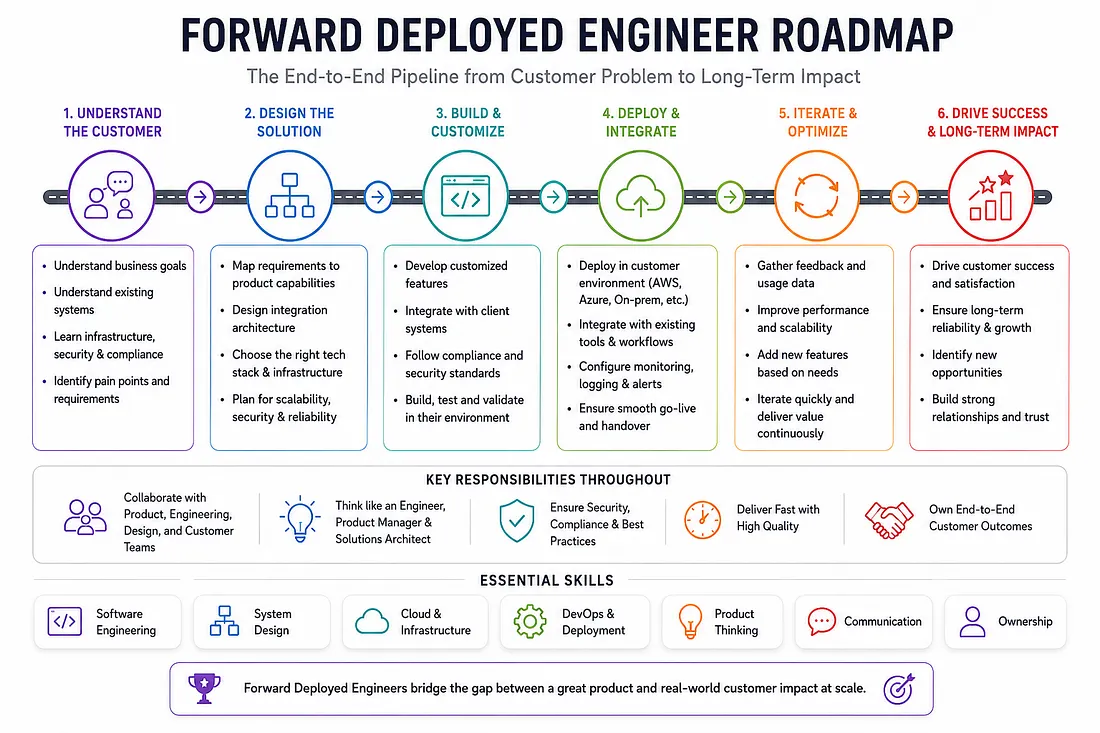
Forward-deployed engineer roadmap showing six stages from understanding customer needs and designing the solution to deployment, continuous optimization and long-term business impact. (Source: Gaddam.Naveen)
The role of the forward-deployed engineer is to keep technical authority present throughout that loop.
Business Context Is Becoming Part of Engineering Quality
Enterprise engineering has traditionally been assessed through technical measures such as reliability, security, performance and scalability. These remain essential, but they no longer provide a complete picture of software quality.
A system may be stable and technically correct while still creating little operational value. It may follow the approved specification but conflict with how teams actually coordinate. It may automate the standard path successfully while failing whenever a common exception occurs. It may generate accurate outputs but lack the permissions and approval controls required for employees to trust or use them.
In enterprise environments, quality increasingly includes operational fit.
This does not mean engineers must become management consultants. It means technical decisions require a stronger understanding of the conditions surrounding the system. Engineers need enough business context to recognise process dependencies, clarify data ownership, understand decision rights and distinguish between a genuine software gap and an unresolved operational issue.
Data quality illustrates this shift. Gartner reports that 59% of organizations do not measure data quality, even though poor-quality information can affect large user groups and connected business processes. An engineer implementing an AI or analytics system cannot treat this only as a technical input problem. The solution may depend on which team owns the data, how records are created and who is responsible for correcting exceptions.
The same applies to AI deployment. Model capability alone cannot determine whether an enterprise agent is ready for production. The implementation must define what information the agent can access, which actions it may perform, when human approval is required and how every decision will be audited.
Software quality is therefore no longer measured only by whether a system works as designed. It is also measured by whether people can adopt, govern and operate it as intended.
Forward Deployment Changes the Business Outcomes of Software Delivery
The immediate benefit of forward deployment may appear to be speed. Engineers can resolve technical issues directly, reducing the time spent moving information between teams. However, its more important effect is improving the quality and timing of decisions throughout delivery.
Assumptions are tested earlier, reducing requirement churn. Integration constraints surface before go-live. Engineering teams build with greater awareness of real workflows, lowering the risk of expensive rework. Business users are involved in shaping the solution, which can strengthen adoption and shorten the path from deployment to measurable value.
This also changes how enterprise projects should be evaluated. Feature completion and launch dates remain useful delivery metrics, but they do not show whether the system has improved operations. Leaders should also examine processing time, manual intervention, exception rates, user adoption and the speed at which the platform can adapt to new business requirements.
At Twendee, this principle is reflected in delivery teams that combine software engineering, system integration and business-process analysis. Engineers work directly with stakeholders to understand operational requirements, adapt enterprise solutions during implementation and support continued improvement beyond the initial software handover.
The objective is not to customize every request. It is to determine which needs require engineering, which can be addressed through configuration and which reveal a deeper process or data issue. This allows the solution to fit the business without sacrificing maintainability or future scalability.
Enterprise software delivery is consequently moving away from a linear sequence of building, configuring and handing over a system. It is becoming cross-functional by design, combining engineering, integration, process understanding and continuous implementation.
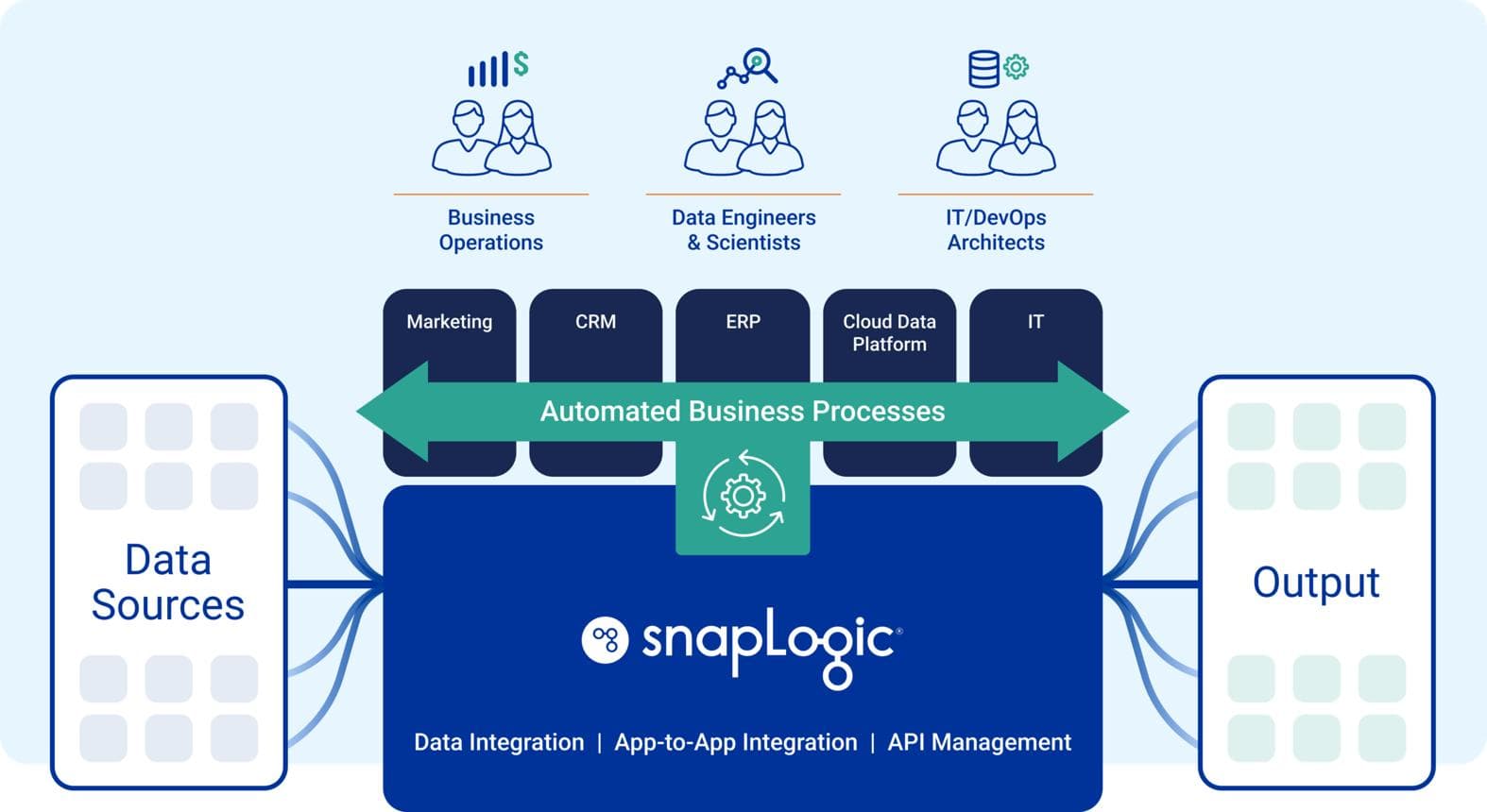
Enterprise automation infographic showing business operations, data engineers and IT architects connecting CRM, ERP, marketing, cloud data and IT systems through automated business processes. (Source: SnapLogic)
Conclusion
Forward-deployed engineering is more than a response to complex implementation work. It reflects a fundamental change in enterprise software delivery: technical teams are becoming more accountable for what happens after the product enters the business.
The companies that deliver enterprise software effectively will not necessarily be those that write code fastest. They will be those that reduce the distance between engineering decisions and operational reality.
Twendee helps enterprises bridge that distance by bringing engineering, integration and process expertise into one delivery model. Visit the Twendee website, follow Twendee on LinkedIn, or book a conversation through Twendee’s Calendly to explore how your next enterprise software or AI initiative can move from technical deployment to measurable operational value.