
Software teams rarely hit a scaling limit because they run out of developers. More often, they accumulate so much delivery complexity that engineers spend increasing amounts of time navigating environments, infrastructure, deployment paths and internal tooling. As application portfolios grow, platform engineering is becoming a way to turn that repeated work into shared capabilities. The strategic question is whether standardization genuinely makes software easier to build, ship and operate.
Software Teams Are Reaching a New Scalability Limit
Growth changes the economics of software delivery. A single product team can absorb a surprising amount of operational complexity because the people who created the system also know how to work around it. That becomes harder to sustain when one application becomes dozens, infrastructure spans multiple environments, and teams inherit different deployment conventions, observability stacks and access patterns.
The cost often appears as developer friction rather than a visible infrastructure problem. Atlassian’s 2025 State of Developer Experience research found that 50% of developers reported losing more than 10 hours a week to non-coding tasks, while 90% said they lost at least six hours. The most common sources included finding information, adapting to new technology and switching between tools.
This is why scaling engineering headcount does not automatically create proportional delivery capacity. Each new team can also create another CI/CD pipeline, another service template, another path to production and another set of operational decisions. The organization gains people while multiplying the number of things those people must understand.
The more useful question for engineering leaders is therefore not, “How do we make every developer faster?” It is, “Which engineering problems should developers stop solving repeatedly?”
Platform Engineering Turns Repeated Work Into Shared Capabilities
That question explains the rise of the internal developer platform more clearly than a tool-centric definition ever could. Platform engineering takes recurring delivery needs — provisioning environments, deploying services, applying security controls, accessing observability or creating new components — and turns them into reusable capabilities that teams can consume.
The leverage comes from solving a recurring problem once and making the solution available many times. A well-designed developer platform gives teams a supported path to production without requiring every product squad to become expert in the infrastructure beneath it.
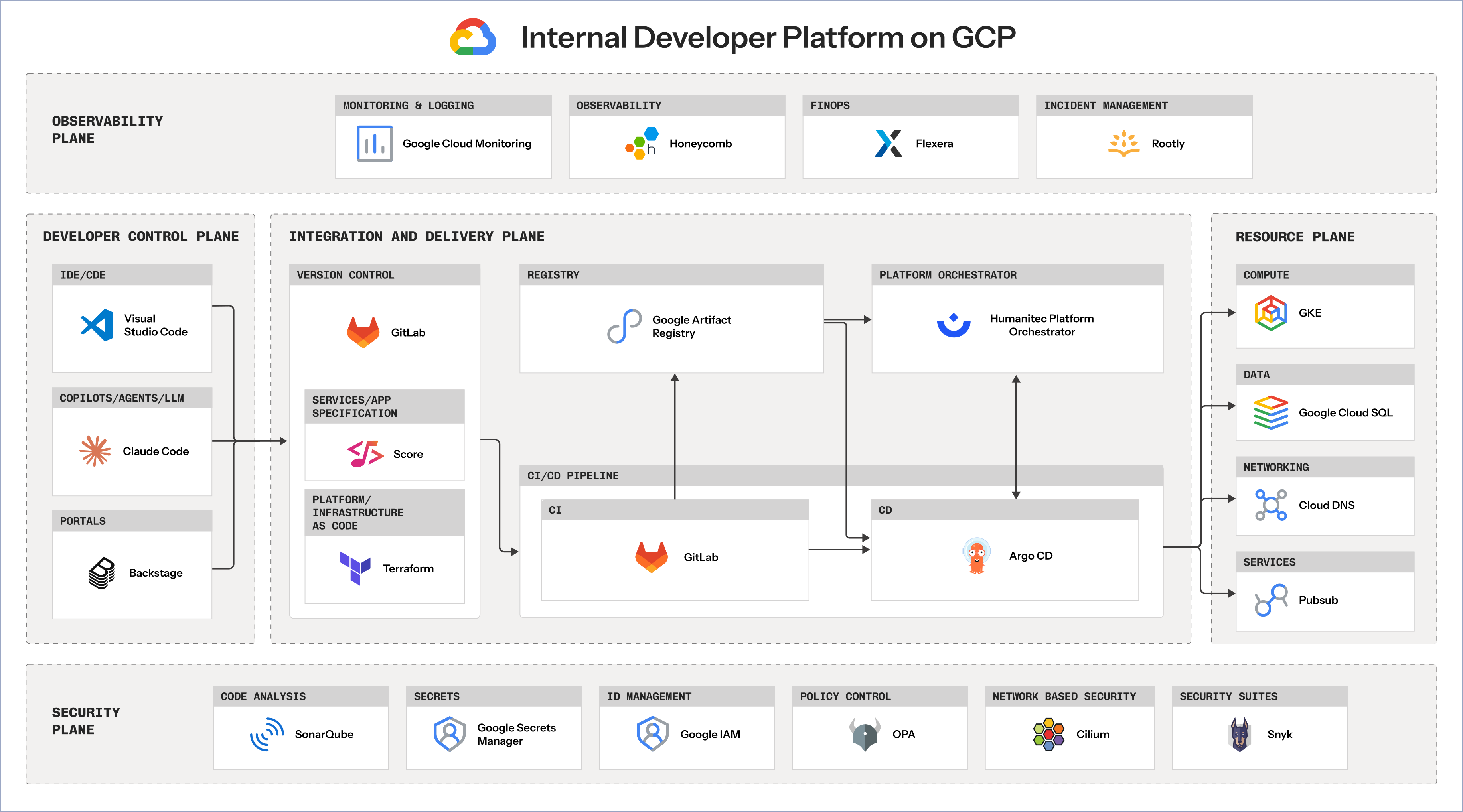
Internal developer platform architecture on Google Cloud showing developer control, integration and delivery, observability, security, and resource planes. (Source: Platform Engineering)
Google Cloud’s 2025 DORA Report shows how mainstream this model has become: 90% of organizations in its research had adopted at least one platform, and DORA found a direct relationship between the quality of an internal platform and an organization’s ability to capture value from newer development technologies, including AI.
That connection matters. Faster code generation can increase the amount of software flowing through an organization, but deployment, testing, controls and feedback loops still determine how efficiently that software reaches production. DORA’s findings suggest that acceleration upstream can expose weaknesses downstream when the surrounding delivery system cannot absorb the additional change.
Platform engineering therefore becomes more valuable as software creation accelerates. Yet the existence of a shared layer is not evidence that it works. A platform that standardizes the wrong things can simply give developers another system to navigate.
A Platform Creates Leverage Only When Developers Choose to Use It
This is where many platform initiatives become an organizational design problem rather than a purely technical one.
A platform team can automate dozens of workflows and still fail to improve delivery if developers experience the platform as an extra gate. When engineers need to learn opaque abstractions, wait for platform specialists to make routine changes or bypass the approved path to get work done, complexity has simply moved from infrastructure into a new layer.
The 2024 DORA research on platform engineering reached a similar conclusion. Its findings emphasized user-centered design, developer independence and a product-oriented approach. DORA also observed that platform initiatives may experience an initial performance dip before benefits emerge as the platform matures.
The implication for engineering leaders is significant: an internal developer platform should be managed as a product whose users happen to be developers.
That changes what success looks like. Counting platform features or automated workflows says little about whether engineering capacity has actually improved. Adoption, time to first deployment, deployment lead time, self-service usage and the frequency with which teams work around the platform reveal much more about whether a platform engineering strategy is creating useful leverage.
Spotify provides a useful example. During a period of rapid hiring, the company discovered that developer productivity was not increasing alongside headcount. One onboarding measure — the time required for a new engineer to reach their tenth pull request — had risen above 60 days. Spotify linked the problem partly to a fragmented engineering environment that created significant context switching and cognitive load. After Backstage became a common layer for navigating the development ecosystem and accessing standardized paths, the same onboarding measure dropped to around 20 days.
The platform has since expanded considerably. Spotify says its internal version of Backstage is used by 2,700+ engineers to manage more than 14,000 software components.
The important part of that case is the operating principle rather than the portal itself. Spotify preserved team autonomy while making supported “golden paths” easier to follow. Standardization became useful because the standardized path reduced effort.
Developer experience is not a secondary benefit of platform engineering. It is the mechanism through which platform engineering creates scale.
The strongest internal platforms make the preferred path the easiest path. When developers consistently work around the platform, that behavior should be treated as product feedback rather than resistance to standardization.
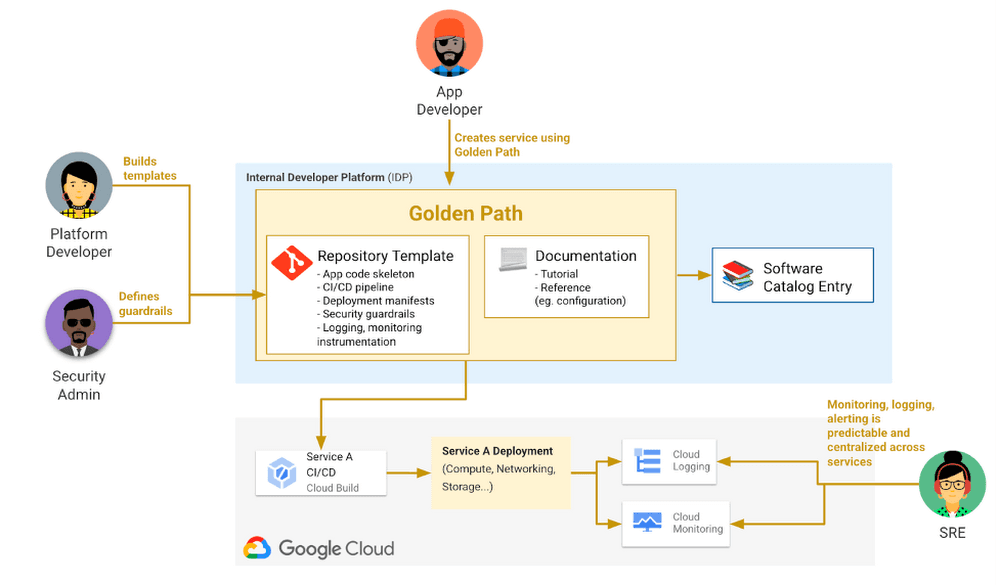
Golden Path workflow in an internal developer platform showing how platform teams provide standardized templates, guardrails, CI/CD, deployment, logging and monitoring for application developers. (Source: Google Cloud)
The Future Is Not Platform Teams vs. Product Teams
As platform engineering matures, the more consequential change is a new division of engineering responsibility.
Product teams still need ownership over architecture decisions that influence customer and business outcomes. Platform teams increasingly own capabilities that have little strategic value when recreated independently across many teams: deployment foundations, reusable infrastructure components, common service patterns, observability access and policy enforcement.
The boundary will differ between organizations. CNCF’s Q1 2026 Technology Radar found that 28% of organizations had a dedicated platform engineering team, while the most common arrangement, reported by 41%, involved multiple teams collaborating to manage platform capabilities.
The direction matters more than the org chart. Recurring engineering capabilities are increasingly being managed as shared organizational assets.
This creates room for both autonomy and standardization. Product teams can continue making decisions close to the customer while relying on a common delivery foundation for problems that do not need to be solved from scratch. Platform teams, meanwhile, have to treat product teams as customers whose workflows, friction and feedback shape the platform roadmap.
Platform engineering is therefore better understood as an operating model for software delivery than as another infrastructure category. It defines which complexity should remain visible to application teams and which complexity the organization should absorb on their behalf.
Scaling Platform Engineering Requires a Reusable Engineering Foundation
A developer portal can improve discoverability, but the experience behind it still depends on what the organization has actually standardized. If deployment pipelines, environment models, access patterns and internal services remain inconsistent, a polished interface only exposes fragmentation more neatly.
A scalable platform engineering strategy starts lower in the stack. It identifies capabilities that appear repeatedly across applications, turns them into reusable building blocks and establishes clear interfaces between the platform and the teams consuming it.
The more important design question becomes:
What should be standardized, what should remain flexible, and what should developers no longer need to think about during routine delivery?
This is also where Twendee’s role becomes practical. For organizations managing multiple applications, Twendee can help build reusable engineering foundations, standardize development and deployment workflows where repetition creates unnecessary cost, and develop internal tools around recurring engineering needs. The objective is to reduce the amount of engineering complexity that each team has to carry independently rather than impose one generic platform across every workload.
That distinction becomes increasingly important as organizations add more applications, cloud services and AI-assisted development into the same delivery environment. Software creation can accelerate rapidly; the operating environment around it has to keep pace.
The platform, in other words, needs to absorb complexity faster than the application portfolio creates it.
Conclusion
Platform engineering is gaining importance because software organizations can no longer afford to scale operational complexity at the same rate as their application portfolios. The lasting advantage will come from turning repeated engineering work into shared capabilities while keeping the developer path to production simpler.
For technology leaders, the question is no longer whether an internal developer platform exists. It is whether developers can ship with less friction because of it.
If your organization is scaling multiple applications and needs a more reusable foundation for development and deployment, visit the Twendee website, follow Twendee on LinkedIn, or book a conversation through Twendee’s Calendly.