
AI agents are gaining the ability to access enterprise systems, execute transactions, and make operational decisions with limited human intervention. Every new capability also introduces another point where an automated decision can create real consequences.
For enterprises, AI agent runtime security is becoming as important as model accuracy. Pre-deployment testing helps establish confidence in an agent's behavior, but controlling its actions requires a different approach. As autonomy expands, AI agent access control, permissions, and execution security must become part of the underlying architecture.
AI Agent Security Changes Once Agents Start Executing Actions
Traditional generative AI applications primarily produce information for users to review. Autonomous agents can take the next step, turning their decisions into actions across connected business systems. This fundamentally changes the security exposure of enterprise AI.
An agent processing customer requests, for example, may retrieve account information, check payment records, update orders, and initiate follow-up workflows. Each interaction introduces dependencies on external data, available tools, and the permissions granted to the agent.
The consequences of an incorrect decision now depend on what the agent is authorized to execute. An inaccurate recommendation might mislead an employee. An agent with excessive permissions could modify financial records or expose confidential information before anyone reviews the outcome.
The OWASP Top 10 for Agentic Applications, developed with contributions from more than 100 security researchers and industry practitioners, identifies agent goal hijacking, tool misuse, and identity abuse among the major risks facing autonomous systems.
These risks become particularly difficult to anticipate when agents operate across several applications. A decision that appears reasonable at one stage can produce an unintended consequence after subsequent tool interactions.
Pre-deployment evaluations remain necessary. However, even extensive testing cannot reproduce every combination of production data, external inputs, system responses, and operational conditions.
The security challenge therefore extends beyond predicting agent behavior to controlling the authority agents exercise during execution.
Runtime Security Must Follow What Agents Actually Execute
An enterprise can monitor an agent's generated responses and still lack visibility into the operations taking place behind them.
A successful-looking response may conceal unauthorized data retrieval, excessive tool usage, or an action performed with credentials broader than the task requires. Understanding the final output alone provides insufficient evidence that the underlying execution was appropriate.
This distinction becomes clearer when examining real security research.
In May 2026, Microsoft disclosed vulnerabilities in its Semantic Kernel agent framework that could allow prompt injection to escalate into remote code execution. In a demonstrated scenario involving CVE-2026-26030, a single malicious prompt was sufficient to launch a program on the agent's host through a vulnerable tool-execution path.
The significance lies in the transition from language processing to system execution. The agent's ability to select tools and supply parameters created a path through which manipulated instructions could produce an actual system-level action.
The incident illustrates why agent execution security must account for the complete relationship between an instruction, the tool selected, the credentials involved, and the resulting operation.
Runtime visibility should make it possible to determine whether an agent is accessing information relevant to its assigned task, invoking an appropriate function, and operating within its authorized scope.
It also needs to recognize the relationship between successive actions. Several individually permitted operations may create an unacceptable outcome when executed together.
For enterprise security teams, the relevant unit of control is increasingly the action being requested within its operational context, rather than the model response considered in isolation.
The Security Control Layer Must Operate Independently of the Agent
The central architectural question is straightforward: who determines whether an autonomous agent is allowed to execute its chosen action?
When security restrictions depend primarily on instructions given to the agent, enforcement remains vulnerable to the same reasoning errors, manipulated inputs, and contextual misunderstandings that affect the agent itself.
A more resilient architecture separates decision-making from authorization.
The agent determines what it wants to do. An independent control layer determines whether that action is permitted.
This layer operates at the boundary between the agent and enterprise resources, evaluating requests before they reach sensitive tools, APIs, databases, or transaction systems.
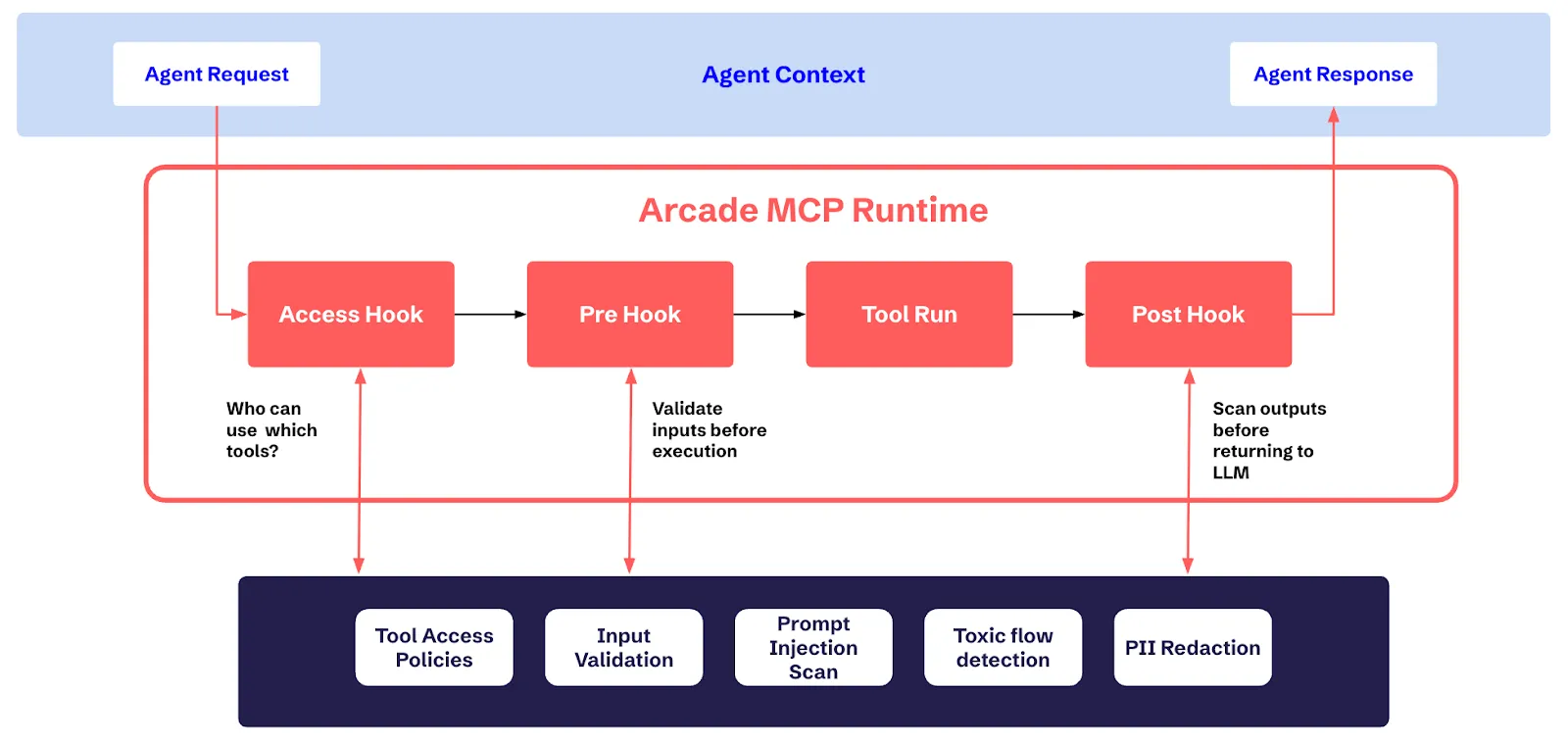
AI agent runtime security architecture showing access control, pre-execution validation, tool execution, and post-execution security checks within the Arcade MCP Runtime. (Source: Arcade)
A request to retrieve an invoice, for instance, should be evaluated against the agent's identity, the initiating user's authority, the business context, and the specific data being requested. Permission to read an invoice does not automatically authorize changing its payment details.
The NIST National Cybersecurity Center of Excellence's 2026 work on agent identity and authorization reflects this emerging requirement. Its concept paper addresses identification, authorization, auditing, and the application of established identity standards to autonomous software agents.
These considerations have practical architectural implications. Permissions should be scoped to the task, credentials should have limited authority, and enforcement should occur through trusted systems that the agent cannot independently override.
An effective control layer can therefore evaluate whether a requested action complies with enterprise policy before allowing execution. If the request exceeds established permissions, the system can deny it or require additional authorization.
Crucially, the enforcement point must be difficult for the agent to bypass through alternative tools or execution paths. A policy that governs one API while leaving another route unrestricted offers limited protection.
Independent enforcement also provides a consistent security boundary across different agents and models. Organizations can update agent capabilities without rebuilding their fundamental authorization rules each time.
This is where runtime security becomes an architectural responsibility. The reliability of enterprise AI increasingly depends on infrastructure that can govern autonomous decisions independently of the systems producing them.
High-Risk Actions Require Risk-Based Execution Controls
Independent enforcement does not mean every agent action requires human approval.
Requiring manual intervention throughout an automated workflow would undermine the operational efficiency that enterprises expect from autonomous AI. The more useful approach is to establish controls proportional to the consequences of each action.
Consider an AI procurement agent supporting purchasing operations.
Checking inventory availability may require relatively limited permissions. Preparing a purchase order introduces additional considerations, including supplier information and approved spending limits. Committing a high-value order creates a financial obligation and may require explicit authorization.
The same agent can perform all three activities, while the control layer applies different requirements according to the business impact.
Effective AI agent permissions should therefore reflect the sensitivity, financial exposure, and reversibility of each operation. Actions that are easy to reverse may be suitable for greater autonomy, while irreversible or high-impact decisions require stronger controls.
This approach also needs to consider cumulative risk. An agent might divide a large transaction into smaller operations, each falling below an individual approval threshold. Evaluating the overall transaction context helps prevent such sequences from circumventing spending policies.
Research published in Microsoft's June 2026 analysis of agentic AI failure modes reinforces this concern. Drawing on 12 months of red-teaming engagements, Microsoft identified human-approval bypasses involving incremental escalation and manipulation of approval processes.
For enterprises, this means approval mechanisms must consider the full workflow and underlying business intent.
When an agent crosses a defined risk boundary, the system should be able to pause execution, request additional verification, restrict access, or isolate the affected process.
The goal is to preserve autonomous execution where risk is manageable while maintaining stronger oversight where consequences become material.
Traceable Execution Makes Autonomous Agents Accountable
Preventing unauthorized actions addresses only part of the enterprise security challenge. Organizations also need reliable evidence of what their agents have done.
As autonomous workflows become more complex, execution histories provide the foundation for investigating unexpected outcomes and establishing operational accountability.
A useful audit record should connect an agent's identity and assigned task with the tools invoked, authorization decisions, relevant data access, approvals, and resulting system changes. Records should also capture rejected actions and points where execution was interrupted.
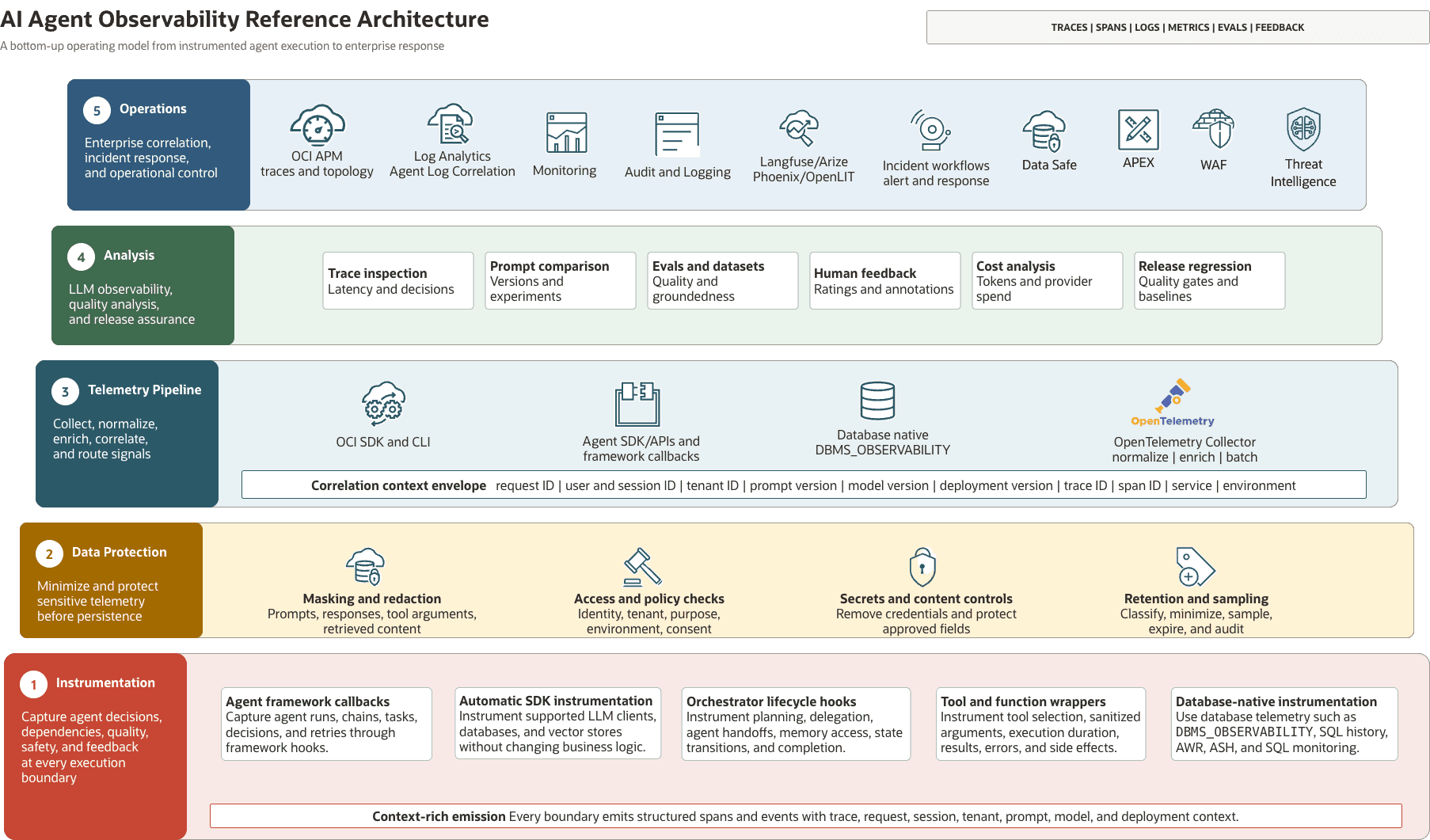
AI agent observability reference architecture illustrating five layers of execution monitoring, including instrumentation, data protection, telemetry collection, trace analysis, and audit logging. (Source: Oracle)
This allows security teams to distinguish between an agent making an incorrect decision, a permission being configured too broadly, and an enforcement mechanism failing to apply the expected policy.
Traceability becomes especially important when several agents collaborate on a single business process. Without a connected execution history, reconstructing responsibility across different services can become difficult.
The OWASP AI Agent Security Cheat Sheet emphasizes security logging, monitoring, and controls around agent tool usage as important safeguards for autonomous architectures.
These records support incident investigation and compliance while providing evidence that organizations can use to refine permissions, approval thresholds, and execution policies.
At Twendee, this architectural perspective aligns with how enterprise AI agents should be deployed and governed. Policy enforcement around tools and data, approval and containment mechanisms for sensitive operations, and traceable execution histories form interconnected capabilities for maintaining control over automated workflows.
Their value comes from working together. Authorization limits what an agent can execute, containment restricts the impact of unexpected behavior, and traceability establishes evidence of how decisions were enforced.
As enterprises expand agent autonomy, these capabilities become essential to maintaining both operational trust and organizational accountability.
Conclusion
AI agent runtime security requires enterprises to rethink where security decisions are made and enforced. Testing can establish confidence before deployment, but independent runtime controls determine how safely agents operate in production.
Organizations that build authorization, risk-based intervention, and traceability into their AI architecture can expand automation without surrendering control over critical business operations.
As an AI Deployment Partner, Twendee helps enterprises design and integrate AI solutions with the governance and execution controls required for real-world operations.
Explore Twendee's enterprise AI capabilities orvisit the Twendee website, follow Twendee on LinkedIn, or book a conversation through Twendee’s Calendly to discuss your AI agent deployment strategy.