Enterprise AI agents are moving toward continuous work, handling tasks that may take hours or days to complete across multiple business systems. These always-on AI agents need to remember previous actions, respond to changing conditions, and continue working after interruptions.
This creates new demands for enterprise architecture. Systems must preserve context, manage permissions, track execution, and support recovery throughout the workflow. As businesses move from isolated AI interactions to persistent automation, the infrastructure supporting agents becomes just as important as their ability to reason and make decisions.
Why Enterprise AI Agents Need More Than Traditional Automation Architecture
Traditional enterprise automation typically follows predefined triggers and rules. An invoice arrives, a system extracts the required information, validates it, and routes it for approval. The process moves through established steps, with exceptions handled according to configured conditions.
Autonomous AI agents introduce more flexible decision-making. They can interpret information, select tools, coordinate activities, and adjust their next actions according to intermediate results. This flexibility creates opportunities to automate work that previously required employees to move between several applications.
The architectural challenge becomes clearer when an agent must operate beyond a single interaction.
Consider an enterprise agent responsible for resolving overdue customer payments. It may need to retrieve outstanding invoices from an ERP system, review communication history in CRM, identify disputed amounts, contact the account owner, wait for approval, and update financial records.
The workflow could take several days. During that period, the agent must preserve information about completed activities, pending decisions, and changes to the customer's account.
A typical API request cannot independently maintain this entire process. Enterprise systems need a durable workflow that stores execution state outside the model, coordinates subsequent actions, and resumes when the required information becomes available.
According to Microsoft's Durable Task documentation, production AI workflows may remain active for hours, days, or weeks because of human approvals, multi-step reasoning, and tool interactions. These processes require persistent state, reliable execution, and mechanisms to recover from failures without unnecessarily repeating completed work.
The wider business risk is also significant. Gartner reported in October 2026 that more than 90% of IT leaders expect AI agents to deliver substantial productivity benefits, while predicting that over 40% of agentic AI projects will be canceled by the end of 2027 because of costs, unclear business value, or inadequate risk controls.
These findings highlight the difference between demonstrating an agent's capabilities and operating one reliably inside an enterprise.
An agent may perform an individual task successfully while the broader workflow still fails because of expired credentials, unavailable APIs, outdated information, or missing approvals. As agents take responsibility for longer processes, these operational dependencies become central architectural concerns.
For technology leaders, the decision is increasingly about how to support continuous execution across existing enterprise applications while maintaining reliability and accountability.
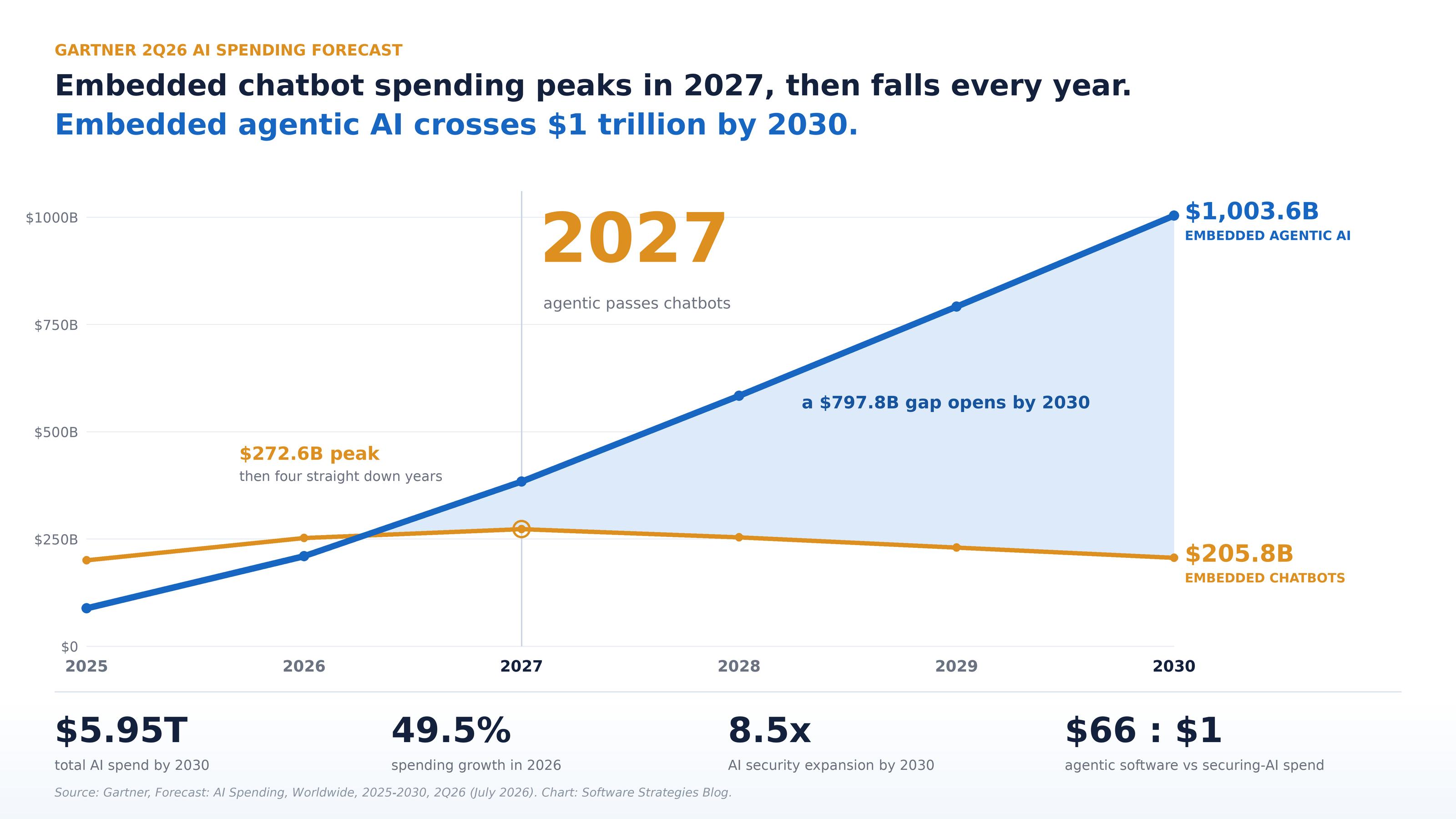
Gartner AI spending forecast comparing embedded chatbots and agentic AI from 2025 to 2030, with agentic AI spending projected to exceed $1 trillion by 2030. (Source: Gartner)
The Architecture Required to Run Persistent AI Agents
An enterprise AI agent platform needs several capabilities working together: persistent context, execution state, secure system access, and recovery mechanisms. Each addresses a different challenge introduced by agents operating across applications and over extended periods.
Persistent Context and State Management
An AI agent working on a long-running task must distinguish between information it should remember and the current status of the work it is performing.
Context provides the information needed to make decisions, including customer records, business rules, previous interactions, and relevant documents. Execution state records what has happened during the workflow: which actions succeeded, which are pending, and what should happen next.
These functions require different approaches to storage and management.
For example, an agent processing a customer dispute may need access to previous communications and contractual terms. It must also know whether a credit adjustment has been approved, whether a payment has already been posted, and whether the case remains open.
Losing the conversation history can weaken decision-making. Losing execution state can cause more serious problems, including duplicate actions or incorrect financial updates.
This distinction is reflected in LangGraph's persistence architecture, which separates checkpointed workflow state from longer-term information storage. Checkpoints allow agents to resume interrupted processes, support human review, and recover from failures. Persistent stores maintain information that may be useful across different sessions or tasks.
For enterprise deployments, the underlying principle is broader than a particular framework. Important workflow information must survive model calls, application restarts, and changes in execution environments.
A persistent agent should therefore maintain a reliable record of its progress rather than depending entirely on the information available within its current model context.
This becomes especially important when multiple agents collaborate. If one agent validates customer information while another prepares a financial adjustment, both need access to consistent records of the transaction and its current status.
Identity, Permissions, and Controlled Execution
Long-running agents also change how businesses need to manage access to enterprise systems.
An agent handling a customer account may need to read invoices, retrieve payment histories, update case records, and initiate approval requests. These activities involve different permissions, even when they belong to the same business process.
Access to customer data does not automatically justify permission to modify financial records. Similarly, an agent authorized to prepare a payment adjustment should not necessarily have authority to approve or execute it.
A reliable architecture distinguishes between three levels of capability:
Read: Retrieve information from approved enterprise systems.
Decide: Analyze information and recommend or select actions within defined policies.
Execute: Perform authorized operations, with approval required where appropriate.
These boundaries become more important as agents work across applications with different security models.
In May 2026, Gartner predicted that 40% of enterprises would demote or decommission autonomous AI agents by 2027 because of governance failures. Its analysis emphasized the danger of treating agent governance as a choice between complete restriction and unrestricted trust.
The practical implication is that permissions should reflect the agent's assigned responsibilities, the sensitivity of the operation, and the conditions under which execution is permitted.
For example, an accounts receivable agent might be authorized to send routine payment reminders and update follow-up statuses. Writing off a customer balance or changing an approved credit limit would require additional authorization.
Enterprise systems also need to establish whose authority an agent is using. An agent working on behalf of a finance employee should operate within that employee's approved scope, while service-level permissions must remain constrained by the specific workflow.
This requires coordination between identity management, application permissions, business rules, and audit logging.
Over time, access policies may also need to respond to changes in an agent's task, operating environment, or assigned role. Continuous execution cannot be treated as permanent permission to perform every available action.
Recovery, Human Escalation, and Reliable Workflow Execution
Persistent agents will encounter interrupted connections, unavailable services, conflicting records, and decisions requiring human judgment. Enterprise architecture must account for these conditions during workflow design.
A reliable system needs to know which actions can be retried safely, which require verification, and when a process should stop for human intervention.
Consider an agent preparing a payment adjustment. It submits the transaction to an ERP system, but the connection fails before the system returns confirmation.
If the agent simply repeats the operation, it may create a duplicate adjustment. Instead, the workflow should verify whether the original transaction succeeded before attempting another action.
This is where durable execution and transaction controls become essential.
Microsoft's Durable Task architecture addresses long-running execution through state preservation and orchestration, while OpenAI's Agents SDK documentation describes integrations with workflow engines such as Temporal, Dapr, and Restate for recovery and human approval processes.
These capabilities allow organizations to design workflows that continue despite temporary infrastructure problems.
However, recovery requires more than technical retries. Financial adjustments, account changes, and external communications may create consequences that cannot be reversed by repeating a software operation.
Organizations need explicit rules for when to retry, pause, escalate, compensate for a completed action, or terminate a process.
Human intervention becomes part of normal execution rather than an exceptional workaround.
For instance, an agent may independently retrieve invoices, identify overdue balances, and prepare collection recommendations. If it encounters a disputed amount exceeding an approved threshold, the workflow can pause, preserve its current state, request human review, and resume after the decision is recorded.
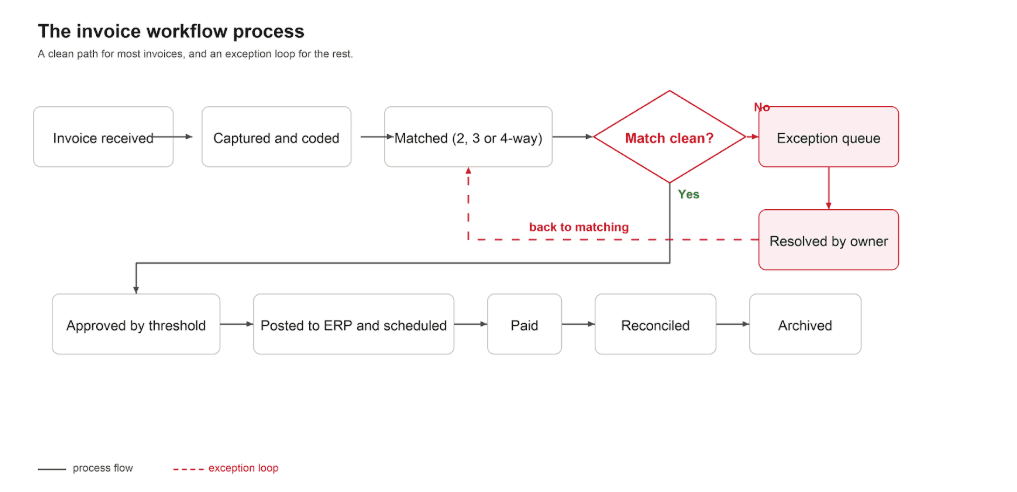
Invoice processing workflow showing automated matching, exception handling, human review, approval, ERP posting, and reconciliation. (Source: Mindsprint)
This design combines operational continuity with accountable decision-making. It also prevents employees from having to reconstruct the entire transaction when a case reaches them.
How Always-On Agents Change Enterprise Automation Strategy
As persistent agents become part of enterprise operations, the architecture increasingly resembles an operating layer for continuous work. This layer coordinates agents, business applications, stored context, execution policies, and human decisions across workflows.
Existing CRM, ERP, and finance systems remain essential because they maintain authoritative business records. The agent layer connects these applications, interprets information, determines the next permitted action, and tracks the work through completion.
A useful example is the evolution of agent execution frameworks. LangGraph supports checkpointing and workflow recovery, while OpenAI's Agents SDK supports durable orchestration integrations and human approval patterns. These capabilities reflect a broader architectural shift toward applications that can preserve and resume complex work across multiple interactions.
For enterprise leaders, this introduces several practical priorities.
Organizations need to identify workflows where continuity creates measurable business value. Customer dispute resolution, accounts receivable management, procurement approvals, and cross-system exception handling are potential candidates because they involve multiple activities, waiting periods, and decisions.
Agent performance needs to be measured across the complete workflow. A successful API call or accurate model response provides limited insight into whether the underlying business process was completed. More meaningful indicators include end-to-end task completion, exception rates, recovery time, approval delays, and the cost of each completed workflow.
Enterprise integration must support both information access and controlled action execution. Connecting an agent to an ERP system is useful only when the architecture defines which records it can access, which changes it can make, and how those changes are verified.
This is also where AI deployment partners can contribute practical value. At Twendee, the focus is on designing agent workflows around existing business systems, connecting execution to reliable enterprise data, and establishing permissions, human escalation, and recovery mechanisms.
The goal is to make persistent automation manageable as workflows grow more complex. Businesses need to know what their agents are doing, where decisions are pending, and how operations can continue when conditions change.
Ultimately, always-on AI agents will create the most value when organizations treat them as part of their operational architecture, with the same expectations for reliability, security, and accountability applied to other business-critical systems.
Conclusion
Persistent AI agents are changing enterprise automation by making continuous, context-aware execution possible across business applications. Their effectiveness depends on architecture that supports state management, secure access, workflow recovery, and human oversight.
Twendee helps enterprises design, integrate, and deploy AI agents within real operational environments, turning agent capabilities into reliable business workflows.
Explore your enterprise AI strategy with Twendee: Schedule a consultation to discuss how persistent AI agents can support your business operations.