

Enterprise infrastructure used to be discussed largely in terms of uptime, disaster recovery and IT operations. That frame is becoming too narrow. ERP, payments, logistics, customer platforms and AI workloads now depend on chains of applications, APIs, cloud services and external vendors. When one link fails, the effect can move quickly from a technical incident to delayed orders, failed transactions, customer disruption and financial loss.
Digital infrastructure resilience is therefore becoming less about keeping individual systems online and more about understanding how the enterprise continues operating when one part of its technology environment fails.
Technology Disruptions Are Now Business Continuity Risks
The cost profile of outages already makes resilience a management issue. Uptime Institute’s Annual Outage Analysis 2026 found that 57% of respondents said their most recent major outage cost more than $100,000, while one in five reported costs above $1 million. Uptime also noted that third-party IT and data center service providers have accounted for about two-thirds of publicly reported outages in its database over the past nine years.
The more important point is what sits behind those numbers. A technology failure does not create business impact in proportion to the size of the component that failed. It creates impact according to what the business depends on that component to do. That changes the scope of IT resilience from technical availability to business continuity.
The 2024 CrowdStrike outage is a useful example. According to Microsoft’s account of the incident, a faulty CrowdStrike update affected an estimated 8.5 million Windows devices, less than 1% of all Windows machines. Yet its consequences spread across organizations running critical services because the affected software sat inside operationally important environments. Parametrix later estimated $5.4 billion in direct financial losses for U.S. Fortune 500 companies, excluding Microsoft.
The incident illustrates why technology resilience has moved beyond the CIO’s operational agenda. Boards do not need to review every server, network route or API. They do need to understand which technology failures can interrupt revenue, customer service, regulatory obligations or core operations.
The question is no longer simply, “Which system went down?” It is, “What business capability depended on it?”
Enterprise Resilience Depends on Visibility Across Technology Dependencies
Most enterprises have asset inventories, application lists and monitoring dashboards. Fewer can trace a critical business process through every dependency that keeps it running.
An order-processing workflow, for example, may depend on a commerce application, an identity service, an integration layer, inventory data, a payment provider, ERP and cloud infrastructure. Each system can appear healthy in isolation while the end-to-end process remains vulnerable to a failure somewhere in the chain.
Understanding digital infrastructure risk therefore requires a different view of architecture:
Business process → application → integration/API → infrastructure → external vendor
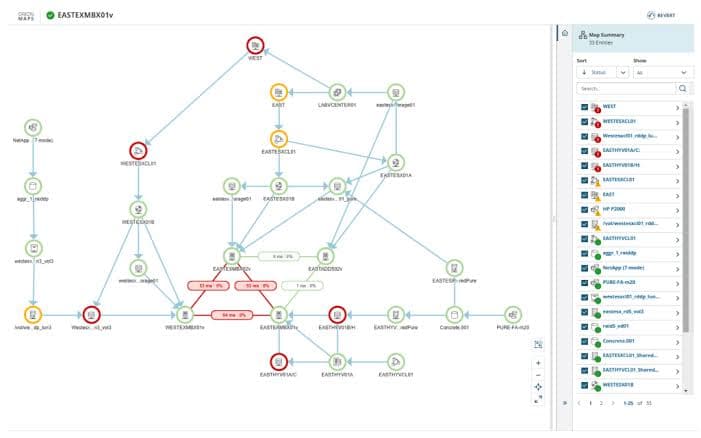
Application infrastructure dependency map showing interconnected enterprise systems, servers and infrastructure components. (Source: Fortinet)
This sequence changes the questions leadership and architecture teams ask. Instead of stopping at whether an application has backup capacity, they can examine which workflows rely on the same API, whether multiple applications share one infrastructure dependency, which external vendors support critical functions and where a failure could propagate across several processes.
The June 2025 Google Cloud outage demonstrates how quickly a shared dependency can create wider impact. In its official incident report, Google explained that a policy change containing unintended blank fields was replicated globally within seconds. The resulting failures affected multiple Google Cloud, Workspace and security products. Engineers identified the root cause quickly, yet recovery still varied across products and regions for hours.
The lesson is not that globally distributed infrastructure is inherently fragile. The lesson is that dependency visibility matters more as enterprise architectures become more interconnected.
For Twendee, this is an important part of architecture and modernization work. Mapping critical workflows to the applications, integrations and infrastructure beneath them gives enterprises a more useful resilience view than a static system inventory. It connects technical dependencies to the operational consequences of failure.
The Most Dangerous Single Points of Failure Often Sit Between Systems
Enterprise resilience programs naturally pay attention to obvious failure points such as servers, databases, network devices and application instances. Modern architectures create another category of exposure that is easier to overlook: the weak point may sit between systems rather than inside them.
A business may run two redundant applications but route both through the same identity provider. It may operate resilient infrastructure but depend on one API for payment authorization. It may use multiple SaaS platforms that ultimately rely on the same cloud region or connectivity provider.
At the application level, this environment can look diversified. At the workflow level, it may still contain one dependency capable of stopping the entire process.
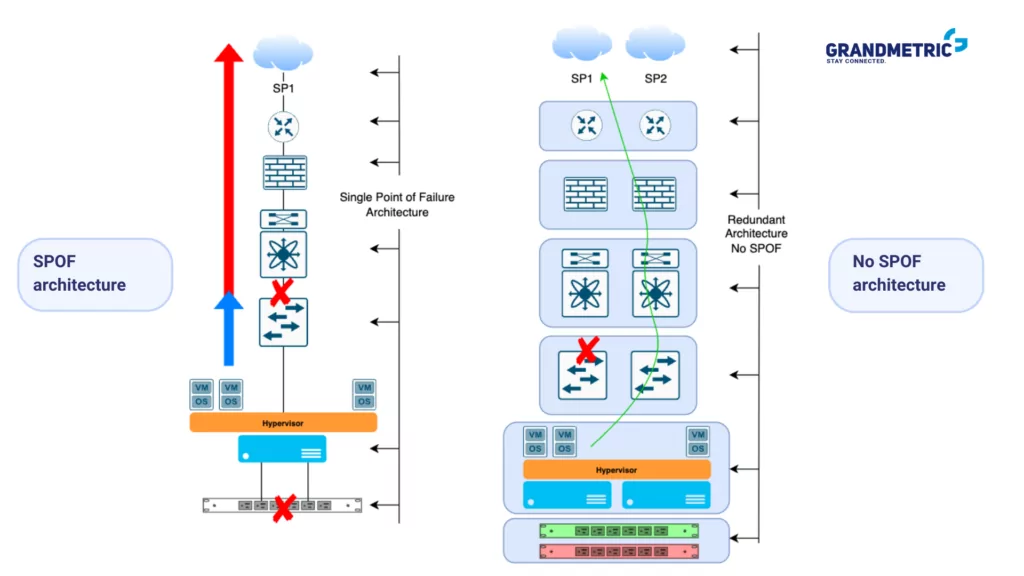
Comparison of single point of failure architecture and redundant infrastructure architecture designed to maintain service continuity. (Source: Grandmetric)
This distinction becomes more important as enterprises rely on external technology providers. The EU’s Digital Operational Resilience Act (DORA) explicitly addresses ICT third-party concentration risk and requires financial entities to consider whether critical services rely on providers that are difficult to substitute. DORA applies specifically to financial entities in the EU, but the architecture issue it addresses is broader: multiple contracts and applications do not automatically create resilience when their dependencies converge on the same provider or infrastructure layer.
A resilient application does not automatically create a resilient business process. Resilience has to be evaluated across the full dependency chain.
Recovery Is Only One Dimension of Infrastructure Resilience
Recovery time remains essential, but it answers only one question: how quickly can normal service return?
A stronger infrastructure resilience strategy also asks what happens before recovery is complete and what happens if the planned recovery path does not work as expected.
Four capabilities need to be considered together:
Recovery: How quickly can the capability return?
Redundancy: Can another component or path take over?
Substitutability: Can the enterprise move to another vendor, system or operating path?
Continuity: What can the business continue doing while recovery is underway?
These represent different forms of protection. Faster recovery shortens disruption. Redundancy reduces the chance that one component can stop a workload. Substitutability reduces dependence on a particular provider or technology. Continuity determines which operations remain possible under degraded conditions.
This distinction matters because nominal redundancy can still share the same failure domain. Two services may run on separate instances while depending on the same region, control plane, network route or external provider. In that case, technical duplication has increased, but the underlying business exposure remains.
Resilience planning should therefore test whether redundancy is genuinely independent and whether an alternative path can be activated under realistic operating conditions. An alternative that exists only on an architecture diagram provides little protection when disruption actually occurs.
Board-Level Resilience Planning Should Follow Business-Critical Workloads
Not every workload requires the same level of resilience. Treating them equally would either overspend on low-impact systems or underprotect the processes where disruption is materially expensive.
A better starting point is business criticality.
A reporting dashboard may tolerate several hours of downtime. A customer payment flow, warehouse operation or order-fulfillment process may have a much narrower disruption window. The architecture and resilience investment around each workload should reflect that difference.
For every critical workload, leadership and technology teams need a shared view of its operational tolerance, the dependencies supporting it, the most consequential failure points and the recovery or alternative paths available. Only then can the organization decide where additional redundancy, vendor diversification or architectural redesign is worth the investment.
This is what makes digital infrastructure resilience a board-level architecture issue. The board does not need to decide how failover should be configured. It needs visibility into where technology concentration creates material business exposure and whether resilience investment matches that exposure.
Twendee approaches this by starting from business-critical workflows rather than infrastructure components alone. Mapping integration dependencies, identifying single points of failure and designing recovery or redundancy around operational criticality helps connect architecture decisions to the business consequences they are intended to reduce. It also prevents resilience spending from becoming a broad infrastructure exercise with no clear link to business risk.
Conclusion
Digital infrastructure resilience is increasingly defined by how well an enterprise understands its critical dependencies, where failure can propagate and how much of the business can continue operating when disruption occurs.
For leadership teams, the priority is visibility: what the business depends on, where those dependencies concentrate risk and which workloads justify stronger recovery, redundancy or alternative paths.
Twendee helps enterprises assess critical technology dependencies and design resilient architectures around real operational priorities. Visit the Twendee website, follow Twendee on LinkedIn, or book a conversation through Twendee’s Calendly to discuss your infrastructure and architecture priorities with us.
