

For many finance teams, month-end reporting becomes difficult before the actual reporting begins. Account balances must be reconciled, supporting documents collected, journal entries reviewed, exceptions resolved and approvals completed before the numbers are ready for management.
When these activities depend on spreadsheets, emails and data pulled from separate systems, each additional handoff creates another place where the close can slow down.
Financial close automation addresses this operational work first. By standardizing recurring tasks, collecting data automatically and directing unresolved items to the right reviewers, companies can shorten the path from period end to reliable financial information.
Why does the month-end close still require so much manual work?
A financial close is a sequence of dependent activities.
Before finance can finalize the income statement, balance sheet or management report, teams may need to complete bank reconciliations, confirm accounts payable and receivable balances, record accruals, reconcile intercompany transactions, review journal entries and obtain supporting evidence.
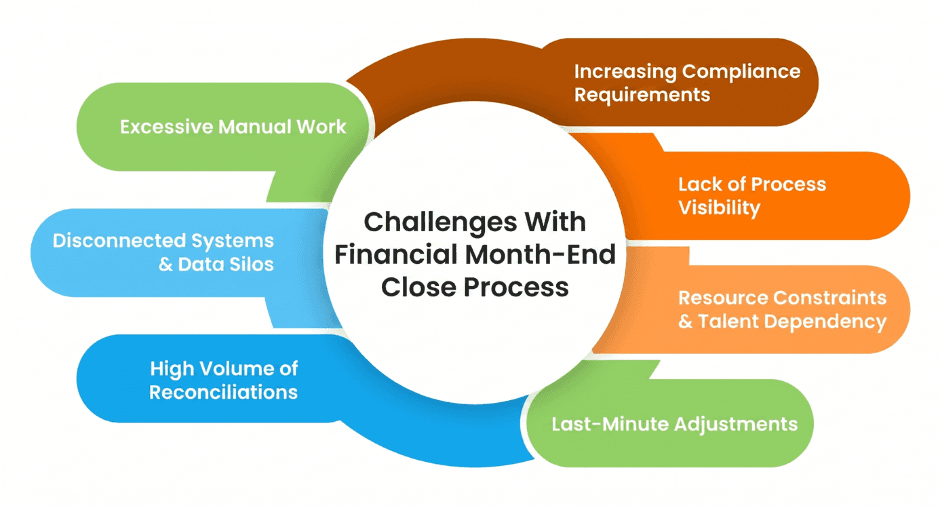
Common challenges in the month-end close include excessive manual work, disconnected systems, heavy reconciliation workloads, limited process visibility and last-minute adjustments. (Source: HighRadius)
One unfinished task can delay several others.
Consider a company operating several business units. Finance may receive transaction data from an ERP, bank statements from banking portals, expense information from another application and supporting documents through email or shared folders. If a balance does not reconcile, an accountant first has to identify the difference, trace it back to the source and contact the relevant employee before the account can be signed off.
Multiply that process across dozens or hundreds of accounts and the workload quickly accumulates around the same few days each month.
The scale of this problem is visible in current benchmarks. APQC’s financial management benchmarking covers 3,389 companies and reports a median of eight days to complete the monthly financial close.
The bottleneck is also not limited to companies with outdated accounting systems. In the EY Smart Closing & Reporting Survey 2026, 40% of companies identified manual processes and insufficient automation as the largest obstacle in financial closing and consolidation.
That distinction matters.
A company can already have an ERP and still rely heavily on manual work during the close. The ERP may contain the accounting records, while employees still export data into spreadsheets, compare balances, request evidence, track completion through email and manually update close checklists.
The problem is therefore not simply that finance teams “need better software.” The close often contains too many recurring handoffs between systems, data and people.
Those handoffs are where month-end close automation can have the greatest impact.
Financial close automation reduces recurring work while keeping exceptions visible
A useful automation project starts by separating two types of work.
The first is predictable work. The same bank accounts need to be reconciled every month. The same entities submit close packages. The same journal entries recur. The same evidence needs to be collected and the same approval sequence applies.
The second is exception work. A balance does not match. An invoice is missing. A journal entry falls outside an approved threshold. An intercompany difference remains unresolved.
Finance teams need to investigate the second group. They should not have to spend the same amount of effort processing the first.
This is where an accounting close process can be redesigned around automation.
For example, instead of an employee downloading transaction data from two systems and matching individual records, an automated reconciliation can import both data sets and apply predefined matching rules. Transactions that meet the rule are cleared automatically. Only unmatched items are sent to the accountant for review.
The same principle applies across other close activities.
Recurring tasks can be generated automatically at the beginning of each period and assigned to predefined owners. Supporting documents can be attached to the relevant account instead of collected through separate email threads. Journal entries can move through established validation and approval rules. Managers can see which activities are complete, overdue or blocked without asking every team for a status update.
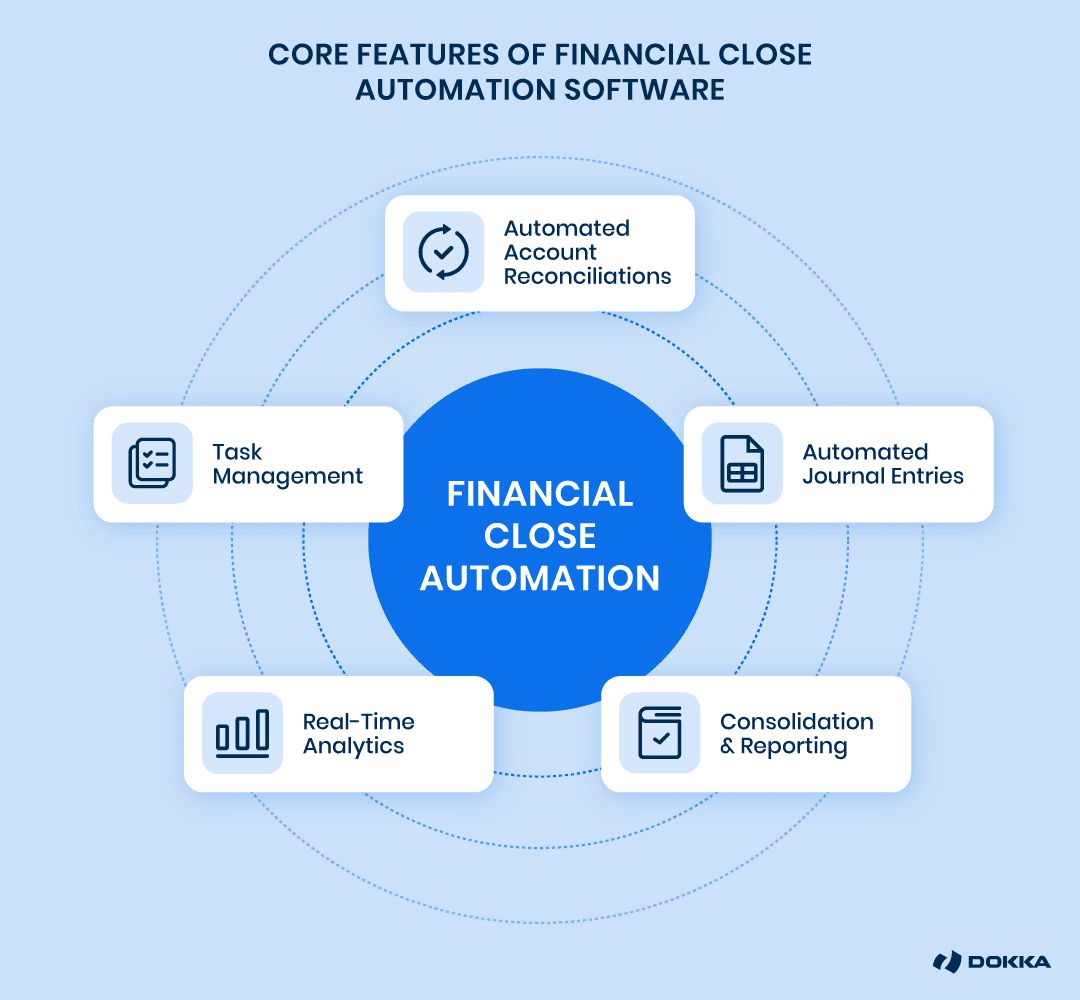
Financial close automation can bring recurring close activities such as reconciliations, journal entries, task management and reporting into a more standardized and visible workflow. (Source: Dokka)
This approach reduces work because automation handles the part of the process where the expected outcome is already known.
The potential effect can be measured beyond close-cycle length. An IDC business-value study published by SAP and BlackLine found that organizations using the financial close solutions studied spent 47% less time creating reports, required 41% fewer days for substantiation completion and 45% fewer days for journal-entry completion. The study also reported that 35% of journal entries were automated.
Automation does not mean allowing every transaction to pass without review.
Controls become more important as more work moves automatically. A company needs to determine which transactions can be matched automatically, what tolerance is acceptable, which journal entries require approval and what should happen when a rule is violated.
That is why exception routing is as important as automation itself.
Suppose two records should contain the same amount. If they match within the approved criteria, the system can complete that step. If they differ materially, the item should remain open and be assigned to the appropriate reviewer with the supporting data attached.
Finance still exercises judgment. The difference is that employees spend more of their close window investigating the transactions that actually require judgment.
This is also why financial close software cannot be evaluated independently from system integration.
If the reconciliation tool cannot receive reliable data from the ERP, banking systems or other accounting applications, employees will continue moving information manually between systems. The automation simply relocates the manual work instead of removing it.
At Twendee, this type of project therefore starts by mapping the existing close workflow: where each data set originates, where employees currently export or re-enter information, which reconciliations repeat every month, who owns each approval and where exceptions typically become stuck.
The automation layer can then connect ERP, accounting and reporting systems around that actual workflow. Routine data collection and matching can run automatically, while exceptions, evidence and approvals remain visible and traceable.
The objective is not to automate every close activity. It is to remove repetitive work without weakening the controls that make the final numbers reliable.
A shorter close creates a larger review window before reporting
Why should a company care whether its close takes eight days instead of six?
The answer becomes clearer when the reporting deadline is fixed.
Assume management reporting is due on day eight. If accountants are still reconciling accounts and chasing supporting documents until day seven, there is very little time left to investigate an unusual balance discovered near the end of the process.
If recurring reconciliation and data collection are completed earlier, that same issue can surface on day four or five. Finance has more time to trace the transactions, speak with the responsible business team and determine whether an adjustment is required before reporting.
The value of a faster close is therefore partly the position of the remaining work on the calendar.
This is why automation should be judged by more than the number of days removed from the close. Companies should also ask whether material exceptions are being identified earlier and whether finance has enough time to resolve them before results are distributed.
Deloitte’s guidance on financial close similarly emphasizes automated reconciliations, integrated journal-entry processes, clearer audit trails and real-time visibility across close activities as elements of a more autonomous close environment.
The improvement can be substantial when companies redesign the process rather than automating isolated tasks.
In one Deloitte finance-close automation implementation, the firm reported a potential one-to-two-day reduction in accounting close cycle time, approximately 300 hours less journal-posting time and a 3–5% improvement in cross-functional labor efficiency.
The lesson is not that every company will save the same number of days. Close complexity varies by entity structure, transaction volume, reporting requirements and existing systems.
A more useful starting point is to identify where time is currently being consumed.
How many hours are spent collecting data that already exists elsewhere? Which reconciliations follow the same rules every month? How many close delays come from missing approvals or evidence? Which exceptions repeatedly appear late because teams cannot see them earlier?
Once those questions are answered, financial close automation becomes a process-design decision rather than simply another software purchase.
Conclusion
A month-end close becomes difficult when finance teams spend the reporting window collecting data, repeating reconciliations, tracking approvals and searching for exceptions across disconnected systems.
Automation can reduce that workload by standardizing recurring activities and moving routine data between systems automatically, while keeping unusual transactions visible for human review.
The result should be measured in more than a shorter close calendar. When reliable numbers and material exceptions become visible earlier, finance teams gain more time to investigate issues before management reporting begins.
Twendee helps businesses map financial close workflows, connect finance systems and design automation around reconciliation, exception handling, approvals and auditability.
Book a call: Calendly
Read our latest blog: Platform Engineering Is Changing How Software Teams Scale
