As AI agents gain the ability to execute code, access enterprise data, and interact with business systems, security becomes a question of operational control. An agent following instructions correctly today may still execute an unintended action tomorrow.
This is why AI agent sandboxing is becoming a production requirement. Organizations need enforceable boundaries around what agents can access, modify, and execute, especially as autonomous workflows move closer to critical business operations.
AI Agents Need Execution Boundaries, Not Just Better Prompts
The security assumptions surrounding enterprise AI are changing. Traditional conversational systems primarily generate responses for users to evaluate. Autonomous agents can go further, executing commands, modifying files, interacting with APIs, and initiating actions across connected applications.
This creates a fundamentally different risk profile. An inaccurate response may misinform a decision, while an incorrectly executed command can directly affect business data, infrastructure, or operational continuity.
Prompt engineering remains important for guiding agent behavior, but instructions alone cannot establish reliable security boundaries. An agent may misunderstand its task, encounter malicious instructions embedded in retrieved content, or select an inappropriate tool while pursuing an otherwise legitimate objective.
The consequences become more serious when those tools carry extensive permissions.
Research from NVIDIA's AI Red Team illustrates this exposure. Researchers documented CVE-2024-12366, a remote code execution vulnerability in an AI-driven analytics pipeline that executed model-generated Python code without sufficient isolation. Attack techniques bypassed sanitization measures through manipulated inputs and exposed execution capabilities.
The case highlights an architectural weakness: filtering generated content cannot reliably substitute for controlling the environment in which that content executes.
For enterprise leaders, the distinction matters because agent reliability and system security address different problems. Better models may reduce erroneous behavior, but organizations still need independent mechanisms to constrain the consequences of unexpected actions.
An effective AI agent runtime security strategy therefore begins with a practical question: What can the agent actually execute if its instructions fail?
Answering that question requires controls beyond the model itself.
How AI Agent Sandboxing Limits Execution Risks
An AI agent sandbox establishes a controlled environment where an agent can perform authorized tasks without automatically inheriting unrestricted access to surrounding systems.
The principle is straightforward: execution privileges should reflect the requirements of the task, rather than the full capabilities of the infrastructure hosting the agent.
In practice, AI sandboxing combines several technical boundaries. Execution isolation separates agent-generated code from sensitive workloads. Filesystem restrictions determine which directories can be accessed or modified. Network policies limit external connections, while credential management prevents unnecessary exposure to privileged services.
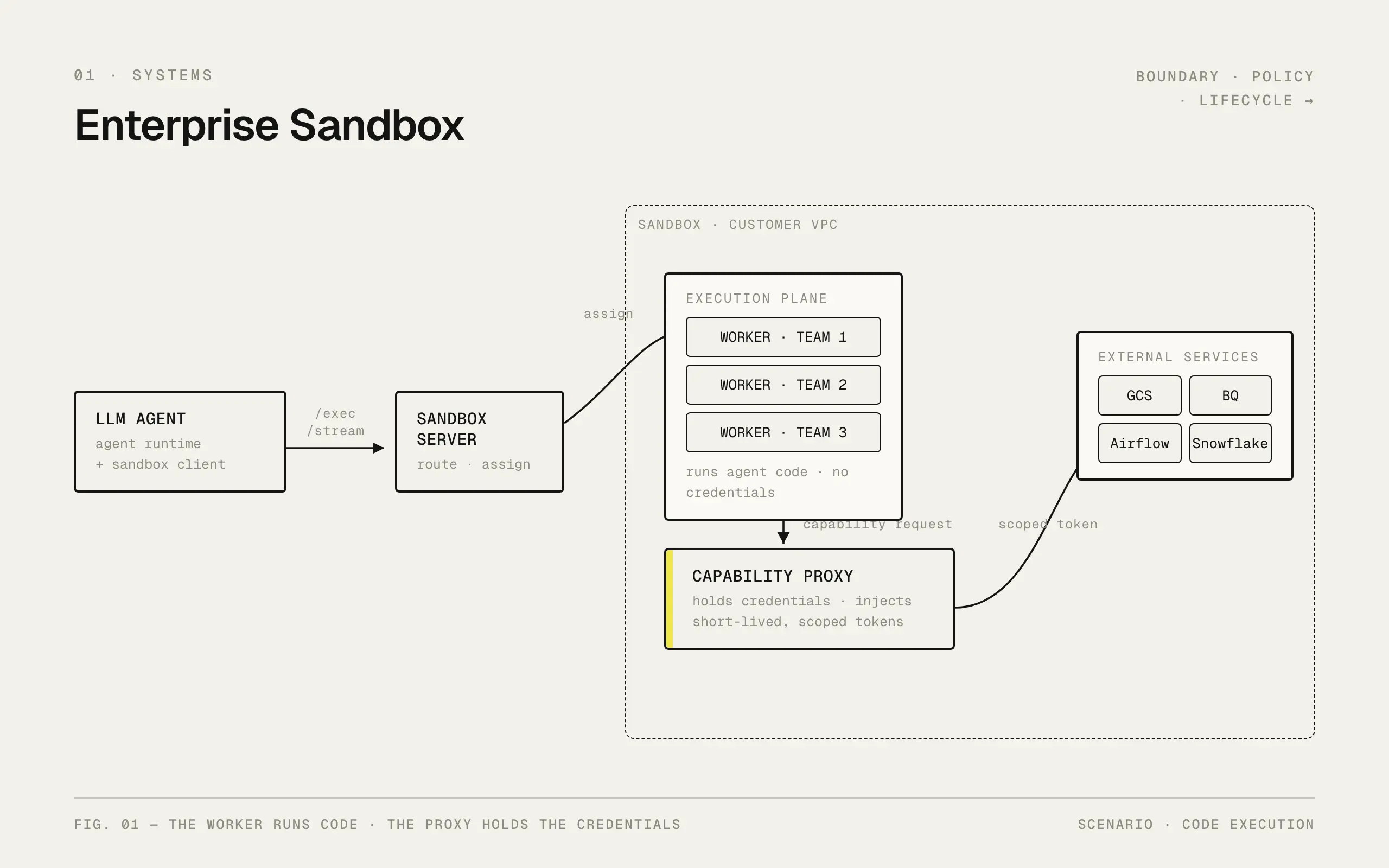
Enterprise AI agent sandbox architecture showing isolated execution workers, capability proxy, credential separation, and controlled access to external services. (Source: Pavo)
These controls work together to reduce the potential impact of mistakes or malicious instructions.
Consider an AI coding agent responsible for updating application dependencies. It may legitimately need repository access, permission to modify selected files, and the ability to run tests. Those activities do not necessarily justify access to production databases, deployment credentials, or unrelated internal services.
A properly configured sandbox allows the authorized work to proceed while restricting capabilities outside that scope.
Importantly, stronger boundaries do not inevitably reduce productivity.
In October 2025, Anthropic reported that sandboxing reduced permission prompts by 84% in its internal Claude Code usage. Its implementation uses filesystem and network isolation to let agents perform permitted activities with fewer interruptions.
The figure represents Anthropic's internal experience rather than a universal productivity benchmark. Nevertheless, it demonstrates an important design opportunity: organizations can reduce unnecessary human intervention by defining safe execution boundaries in advance.
This becomes particularly relevant as AI agents handle longer tasks involving multiple tools and intermediate decisions.
Rather than requiring approval for every routine operation, a secure execution environment can permit low-risk actions within predefined limits and escalate requests that exceed them.
The objective is controlled autonomy, where agents retain sufficient freedom to complete useful work while their potential impact remains constrained.
However, isolation becomes only one part of the security equation when these agents enter production environments.
Why Production AI Agents Require More Than Isolation
Moving an agent into production changes the consequences of its decisions.
In development environments, errors often affect temporary files, test datasets, or disposable infrastructure. Production agents may interact with customer records, financial systems, internal applications, and workflows where incorrect actions create measurable operational costs.
The risks also vary according to how agents operate.
Coding agents can introduce unintended changes into software repositories. Browser agents may encounter malicious instructions embedded in websites or documents. Long-running agents can execute sequences of dependent actions, allowing an early mistake to influence subsequent decisions.
Sandboxing limits the technical environment available to these agents, but isolation alone cannot determine whether every permitted action is appropriate.
An agent authorized to update customer records, for instance, could still modify the wrong record without crossing its sandbox boundary. The operation may be technically permitted while remaining operationally incorrect.
This distinction is central to enterprise security architecture.
In its May 2026 engineering report, OpenAI described how it operates Codex safely through a combination of constrained execution, managed configuration, network policies, approvals, and agent-native telemetry.
The approach separates two responsibilities: technical boundaries determine what an agent can execute, while approval policies govern when additional authorization is required.
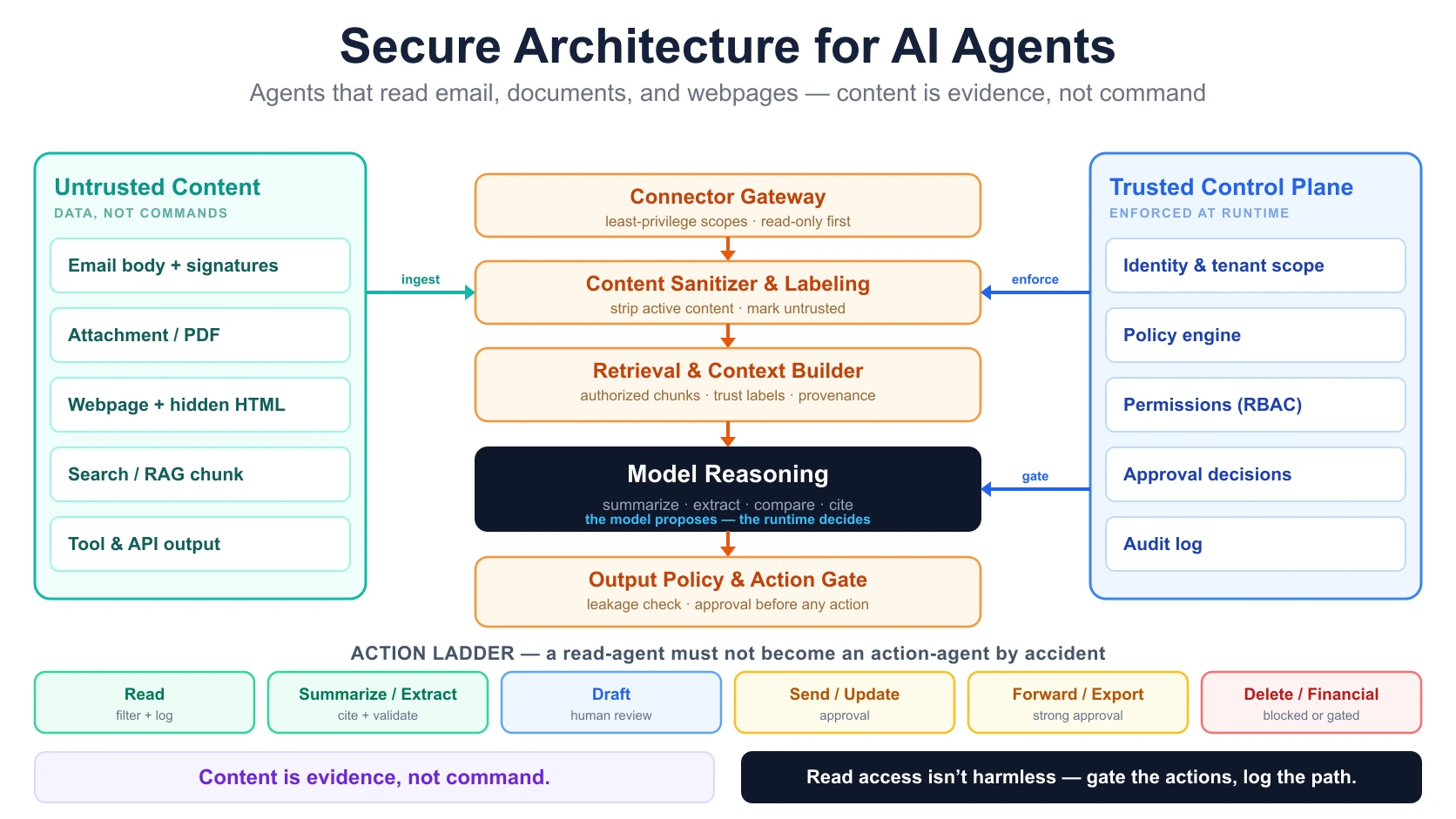
Secure AI agent runtime architecture showing policy enforcement, role-based access control, human approval gates, audit logging, and protection against untrusted content. (Source: Aakash)
This separation is particularly important for sensitive enterprise workflows, where permissions must remain enforceable independently of the agent's own decisions.
Three capabilities deserve particular attention:
Policy enforcement: Infrastructure and tool-level controls must enforce access restrictions even when the agent requests actions outside its authorized scope.
Risk-based approvals: Sensitive operations, including financial transactions, privileged system changes, or irreversible data modifications, should trigger additional authorization.
Operational visibility: Execution logs and monitoring must provide sufficient evidence to investigate actions, identify abnormal behavior, and support incident response.
These controls also need to account for the limitations of sandboxing itself.
An isolated environment may prevent access to unauthorized resources, but it cannot automatically validate business intent, eliminate compromised authorized tools, or guarantee that every permitted operation is safe.
The broader security architecture must therefore address both unauthorized execution and inappropriate actions performed through legitimate permissions.
This introduces a different measure of production readiness. Organizations should evaluate AI agents through their ability to maintain operational control under unexpected conditions, alongside task accuracy and completion rates.
As autonomy increases, the ability to enforce boundaries, reconstruct decisions, and interrupt unsafe workflows becomes essential to sustainable deployment.
Building Secure AI Agent Workflows for Enterprise Operations
For enterprises adopting autonomous agents, sandboxing should be treated as an architectural decision made during workflow design.
The starting point is understanding the operational context. Before selecting execution infrastructure, organizations need to identify which systems an agent will interact with, what information it requires, which actions it may initiate, and where human authorization remains necessary.
These decisions determine the appropriate isolation model.
A document-processing agent that extracts information from invoices may require access to designated storage and validation services. An agent supporting payment operations faces different requirements because its actions may affect financial records or trigger transactions.
Applying identical permissions and approval policies to both workflows would overlook their different risk profiles.
A more sustainable approach is to align AI agent isolation with business responsibilities. Each workflow receives the execution capabilities necessary for its tasks, while sensitive operations remain subject to additional controls.
OpenAI's sandbox security guidance reinforces this approach through isolated workloads, restricted network destinations, and separation of credentials from agent-generated code.
These practices also influence how enterprises should evaluate implementation partners. The challenge extends beyond provisioning isolated containers. Sandbox boundaries must operate consistently with existing identity management, application permissions, monitoring infrastructure, and incident-response procedures.
At Twendee, this is closely aligned with our approach to enterprise AI deployment. We focus on connecting AI capabilities with operational workflows while establishing the execution boundaries and governance mechanisms required for controlled adoption.
That includes designing isolated execution environments, defining tool and data-access permissions around specific workflows, and integrating agent activities with approval processes, audit logging, and incident-response mechanisms.
Before expanding deployment, organizations should validate these controls against realistic failure conditions. Testing should establish whether agents can access unauthorized resources, whether sensitive actions trigger appropriate approvals, and whether operators can investigate and interrupt problematic execution.
These evaluations provide a stronger basis for scaling autonomy than successful task demonstrations alone.
Ultimately, a secure AI execution environment should enable enterprises to expand what agents can accomplish without surrendering control over how those outcomes are achieved.
Conclusion
AI agent sandboxing is becoming essential as enterprise agents gain greater execution capabilities and access to business-critical systems. Its value lies in establishing enforceable boundaries that allow useful autonomy while limiting operational exposure.
Production readiness requires more than isolation. It depends on combining execution controls with appropriate permissions, human oversight, and continuous monitoring.
Twendee helps enterprises design and integrate AI agents into existing workflows with security and governance built into deployment.Visit the Twendee website, follow Twendee on LinkedIn, or book a conversation through Twendee’s Calendly to explore a controlled approach to enterprise AI adoption.