Tokenized deposits could let banks move familiar deposit money through programmable digital systems. Unlike stablecoins, they remain claims on commercial banks, which may make them useful for transactions that need to connect digital assets with existing banking relationships. Early examples show the model moving into real financial workflows, but broad adoption will depend on clear legal treatment, interoperability and reliable settlement.
In September 2026, Hong Kong included tokenized deposits in the settlement process for the HKD tranche of its fourth digital green bond issuance. The Hong Kong Monetary Authority described it as the first digital bond to integrate HKD tokenized deposits. This is a meaningful institutional example, though it does not mean tokenized deposits are already widely available for everyday business payments. www.hkma.gov.hk
What is a tokenized deposit?
A tokenized deposit is a digital representation of money held in a commercial bank account. The token records or transfers a claim on the issuing bank through a programmable digital ledger. The customer still holds a bank deposit; tokenization changes how that claim can be represented and moved.
That distinction matters because the token’s value depends on the issuing bank and the legal terms of the deposit. Tokenization alone does not create a new guarantee, eliminate bank credit risk or establish that every token qualifies for deposit protection. Those questions depend on the product’s structure and the rules in the relevant jurisdiction. The Bank for International Settlements describes tokenized deposits as commercial bank money and emphasizes the importance of clear claims and reliable settlement. www.bis.org
How tokenized deposits differ from stablecoins
Both can represent money on a digital ledger, but they represent different claims.
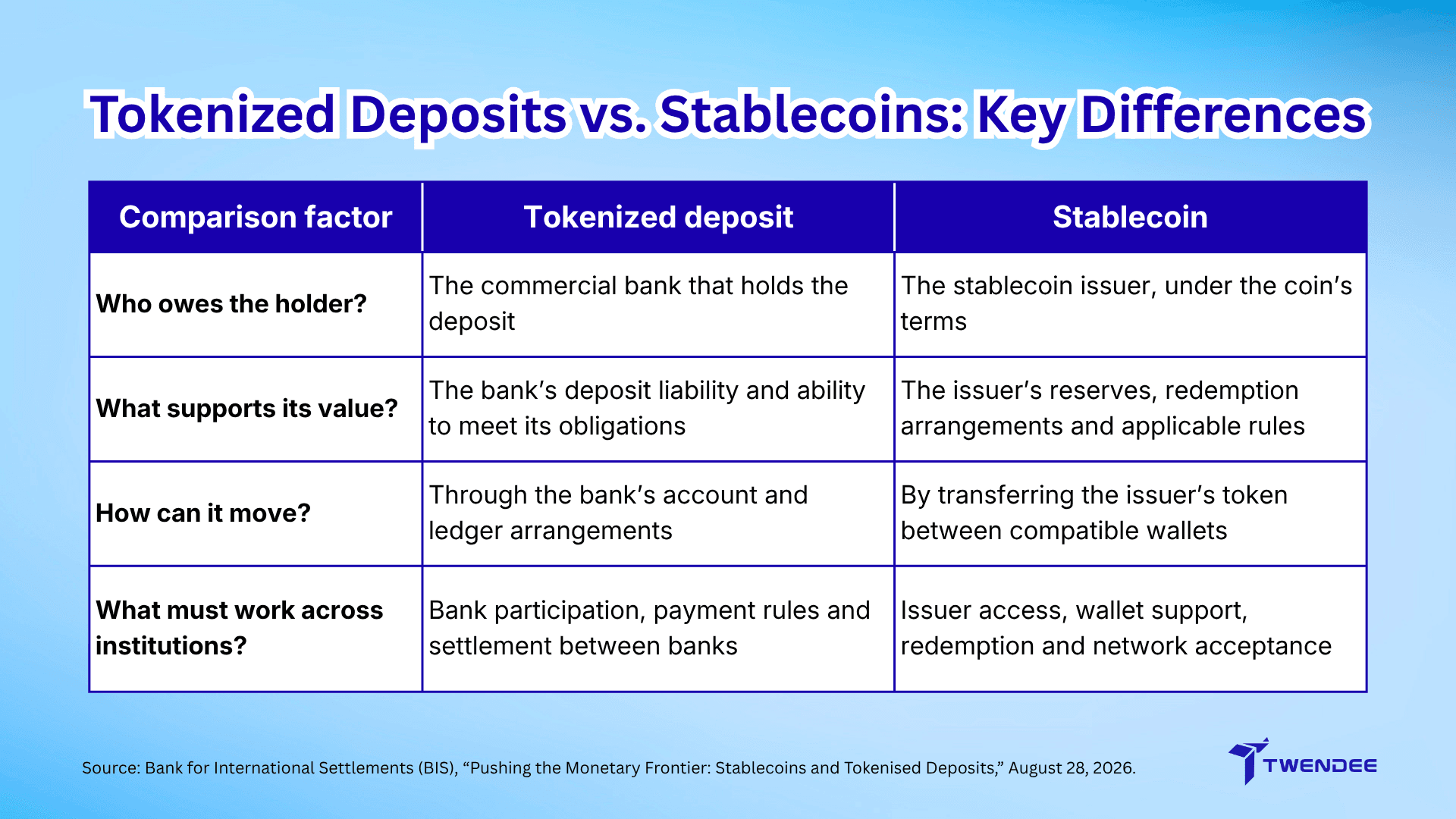
Comparison table of tokenized deposits and stablecoins, covering who owes the holder, what supports value, how each transfers, and what cross-institution use requires. (Source: Twendee)
A 2026 speech by the BIS general manager makes the distinction concrete: tokenized deposits are account-based bank liabilities. When a payment is made, the payer’s balance is debited and the recipient’s balance is credited, while interbank settlement takes place through central bank accounts in the background. A stablecoin payment, by contrast, transfers the issuer’s liability from one holder to another. (BIS)
This does not make one model universally better. Tokenized deposits may fit transactions that rely on banking relationships and regulated settlement. Stablecoins may suit other settings, including parts of the digital asset market. The right choice depends on the participants, the rules and the payment being made.
Where tokenized deposits could help
1. Settling payments alongside digital assets
A buyer and seller may need to exchange a digital asset and money at the same time. If the asset and payment use compatible systems, a transaction can be structured so both sides complete together. This can reduce the risk of one party delivering an asset while waiting for payment.
In 2025, J.P. Morgan reported that institutional clients had begun using JPM Coin, its USD deposit token, on the Base network. The bank said test transactions enabled near-instant, round-the-clock settlement. This is evidence of an institutional offering, not proof that all banks or customers can use it or that every transaction settles instantly. Access remains subject to J.P. Morgan’s client and network arrangements. (JPMorgan)
Hong Kong’s September 2026 digital green bond provides another example. Tokenized deposits were incorporated into settlement for the HKD tranche alongside traditional settlement and a tokenized central bank money option. This shows how tokenized bank money can be used within an existing financial transaction rather than operating as a standalone replacement for banking infrastructure. (Hong Kong Monetary Authority)
2. Automating payments tied to specific conditions
A programmable payment can be released when agreed conditions are met. For example, a buyer’s payment could be triggered when a shipment record is confirmed, or a bond transaction could settle when both the securities and funds are ready.
This could reduce manual handoffs and reconciliation, particularly when several organizations need to coordinate. It does not remove the need to verify the underlying information. If a shipment record is late or incorrect, automation can execute the wrong outcome more quickly. Businesses still need clear approval rules, reliable source data and a process for handling exceptions.
3. Improving treasury visibility across participating banks
Companies with accounts at multiple banks often manage balances, transfers and payment timing through separate systems. A shared digital ledger could make certain movements easier to coordinate and support transfers outside conventional operating hours, if the participating banks and settlement arrangements allow it.
The potential benefit is operational: treasury teams may be able to move funds when obligations arise instead of waiting for a later processing window. But a tokenized deposit at one bank does not automatically become usable at another. Banks need compatible systems, clear rules for transferring claims and dependable arrangements for settling obligations between them.
What could slow adoption?
Tokenized deposits do not solve every problem associated with digital payments. Four questions will shape whether they become useful beyond controlled institutional settings:
Can different systems work together? A token that moves only within one bank’s platform has limited reach. Banks and market infrastructure providers need agreed technical and operating standards.
What exactly does the holder own? Contracts must identify the issuing bank, the nature of the claim, redemption terms and the legal treatment of the deposit.
How will risks be controlled? Banks need safeguards for cybersecurity, operational continuity, identity checks, transaction monitoring and recovery if a network or service fails.
Can users access and settle the money when needed? Round-the-clock transfers require more than a ledger that runs all day. Participating institutions, liquidity and the settlement asset must also be available.
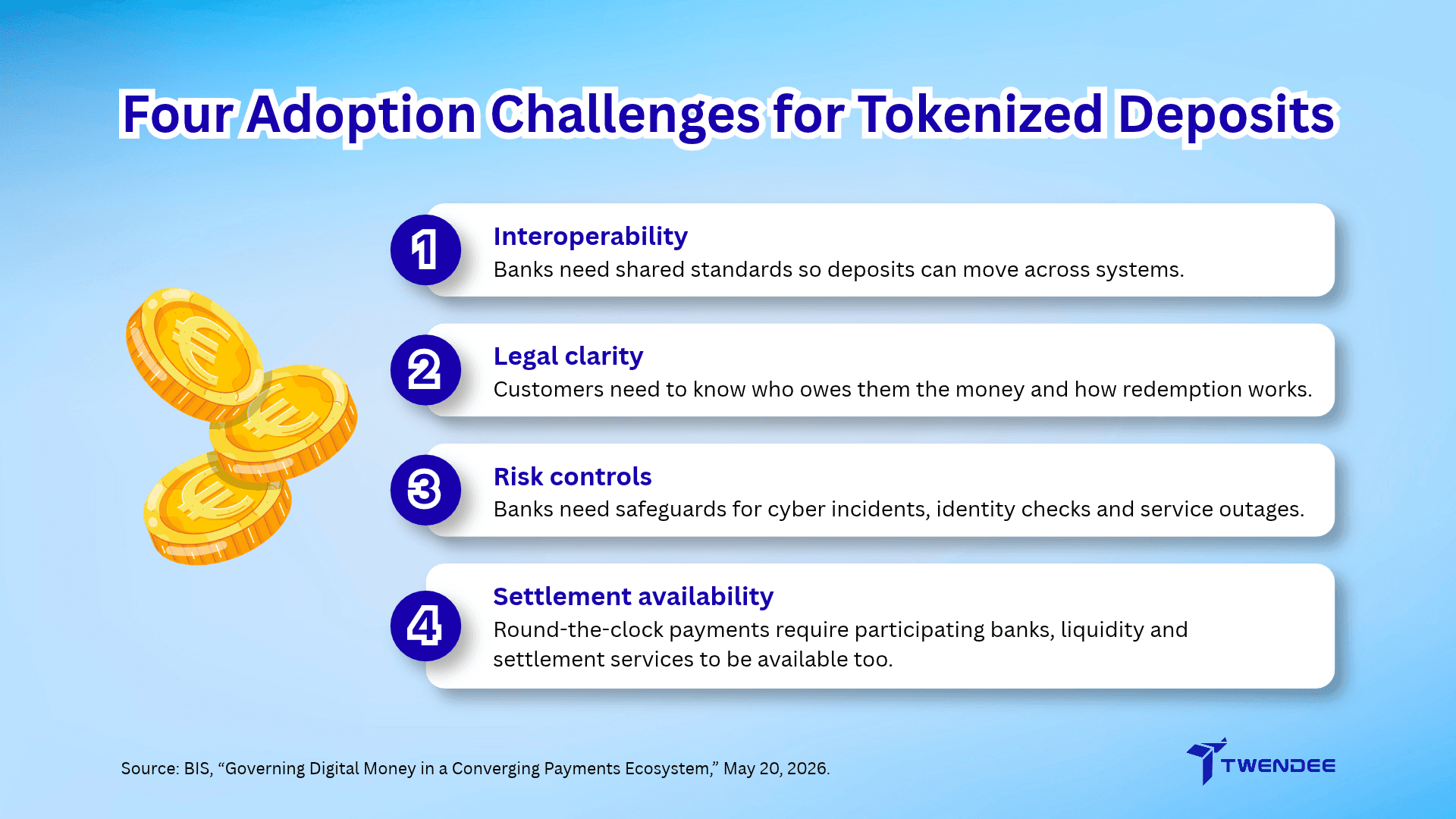
Interoperability, legal clarity, risk controls and settlement availability will shape whether tokenized deposits can scale beyond controlled pilots. (Source: Twendee)
The BIS’s 2026 annual report says tokenized platforms could combine messaging, reconciliation and asset transfer, potentially shortening settlement cycles and reducing operational errors. It also stresses that these benefits depend on safeguards, interoperability and settlement in trusted money. The technology may streamline a process; it cannot replace the legal and institutional arrangements that make a payment final. (BIS)
What should banks evaluate before building?
A bank considering tokenized deposits should start with a specific payment or settlement problem, not with the technology itself. A practical assessment should answer:
Which transaction is inefficient today? Identify delays, manual reconciliation, operating-hour constraints or failed handoffs.
Who needs to participate? Map the banks, customers, asset platforms and service providers involved.
What does the token represent legally? Define the claim, redemption process, customer protections and applicable rules.
How will settlement work across systems? Specify how balances move between banks and what happens if a transaction fails.
How will the bank measure results? Track settlement time, reconciliation effort, exception rates, operating cost and failed transactions.
Starting with a defined transaction helps banks distinguish a useful payment improvement from a technology demonstration with no clear path into day-to-day operations.
Conclusion
Tokenized deposits could bring commercial bank money into programmable payment workflows, but their adoption depends on clear legal treatment, interoperability and reliable settlement. Twendee helps bridge blockchain-based payment rails with existing banking systems, addressing the integration work needed to explore these use cases in practice.
FAQs
Are tokenized deposits a type of stablecoin?
No. A tokenized deposit represents a claim on a commercial bank. A stablecoin represents a claim on its issuer, with value supported by the issuer’s backing and redemption arrangements. The details vary by product and jurisdiction.
Can tokenized deposits settle payments 24/7?
They can support round-the-clock settlement when the banks, network, counterparties and settlement arrangements are available. A ledger that operates continuously does not, by itself, guarantee that a payment can be completed at any time.
Are tokenized deposits already widely used?
No. Some institutions offer them to eligible clients, while authorities are testing them in controlled pilots. Hong Kong’s 2026 digital bond settlement and J.P. Morgan’s institutional offering are examples, but they do not indicate broad access across the banking sector.
Book a consultation: Calendly
Read latest blogs: Twendee Blog