

Cloud decisions are usually made around deployment speed, scalability and cost. Enterprise leaders also need to know what happens when a critical workload must move. A provider may change its pricing, discontinue a service, fail to meet regulatory requirements or become unsuitable for the business. A cloud exit strategy gives the organization a realistic view of its dependencies, migration effort and recovery time before that pressure appears. It preserves the ability to change direction without turning every cloud decision into a future operational constraint.
Why a Cloud Exit Strategy Now Belongs in Risk Planning
Cloud adoption becomes harder to reverse as systems mature. Early workloads may use standard compute, storage and databases. Teams later add provider-specific identity, serverless functions, data pipelines, monitoring and managed AI services. Each addition increases future migration work.
This is the practical form of cloud vendor lock-in. The deeper constraint sits inside application code, data formats, infrastructure configuration, operating knowledge and business integrations. A company may own its data and still need months to extract, transform and validate it elsewhere. Backups offer limited protection without an environment capable of restoring them.
Regulators are also treating switching capability as an operational concern. The European Commission states that the EU Data Act has applied since 12 September 2025 and establishes a framework for customers to switch between data-processing providers. In financial services, the Digital Operational Resilience Act requires exit strategies for technology services supporting critical or important functions. These rules reflect a broader expectation: an enterprise should understand whether a third-party dependency can be replaced without unacceptable disruption.
The business case can also be financial. After 15 years of extensive use of Amazon and Google cloud services, 37signals moved Basecamp, HEY and five other applications from AWS to its own hardware in 2023. The company reports that the move required no additional staff and expects it to save about $10 million over five years, reducing infrastructure costs by between one-half and two-thirds.

37signals expects to save approximately $10 million over five years after moving Basecamp, HEY and five other applications from AWS to owned hardware. (Source: Basecamp)
37signals has stable workloads and strong infrastructure expertise, so its experience is context-specific. It still shows why cloud vendor risk should be measured early. The strategic value lies in knowing the available options, economics and time needed to act.
What an Executable Cloud Exit Strategy Must Cover
An executable plan connects business priorities with technical dependencies, contracts, people and a tested recovery sequence. Five areas determine whether a cloud exit strategy can work under real conditions.
1. Start with the business service and its recovery limits. The first unit of analysis should be the service the business needs to keep running, such as payment processing, order management, customer support or financial reporting. A list of cloud resources rarely reveals which revenue streams, customers and teams depend on them.
For each critical service, define the maximum acceptable downtime, tolerable data loss and minimum capacity during transition. Identify peak periods when migration would create excessive exposure. These limits establish the recovery timeline and keep infrastructure targets aligned with business continuity.
2. Map every dependency that makes the workload difficult to move. The map should follow the workload across applications, databases, storage, queues, identity, encryption keys, networks, monitoring, deployment pipelines and external integrations. It should show connections with ERP, CRM, payment platforms and internal data services.
Managed services deserve closer attention. Replacing a proprietary database, event service or machine-learning platform may require code changes, data conversion and new skills. Record the target equivalent, required conversion and teams that understand the current setup.
Infrastructure definitions, security rules, secrets, certificates, access roles, retention settings and monitoring thresholds all influence application behavior. A usable cloud migration strategy must capture this operating context alongside data and code.
3. Separate data portability from workload portability. The ability to download data proves that it can leave. The enterprise must also preserve schemas, metadata, access controls, audit history and relationships between records. Large datasets may need continuous replication to stay within the permitted outage window.
Workload portability asks whether the application can run safely elsewhere. Containers and infrastructure-as-code reduce some effort, while provider-specific services still need replacements. The cloud exit strategy should name a realistic destination, such as another public cloud, a private environment, colocation infrastructure or a temporary recovery platform. An unnamed alternative cannot be tested or costed.
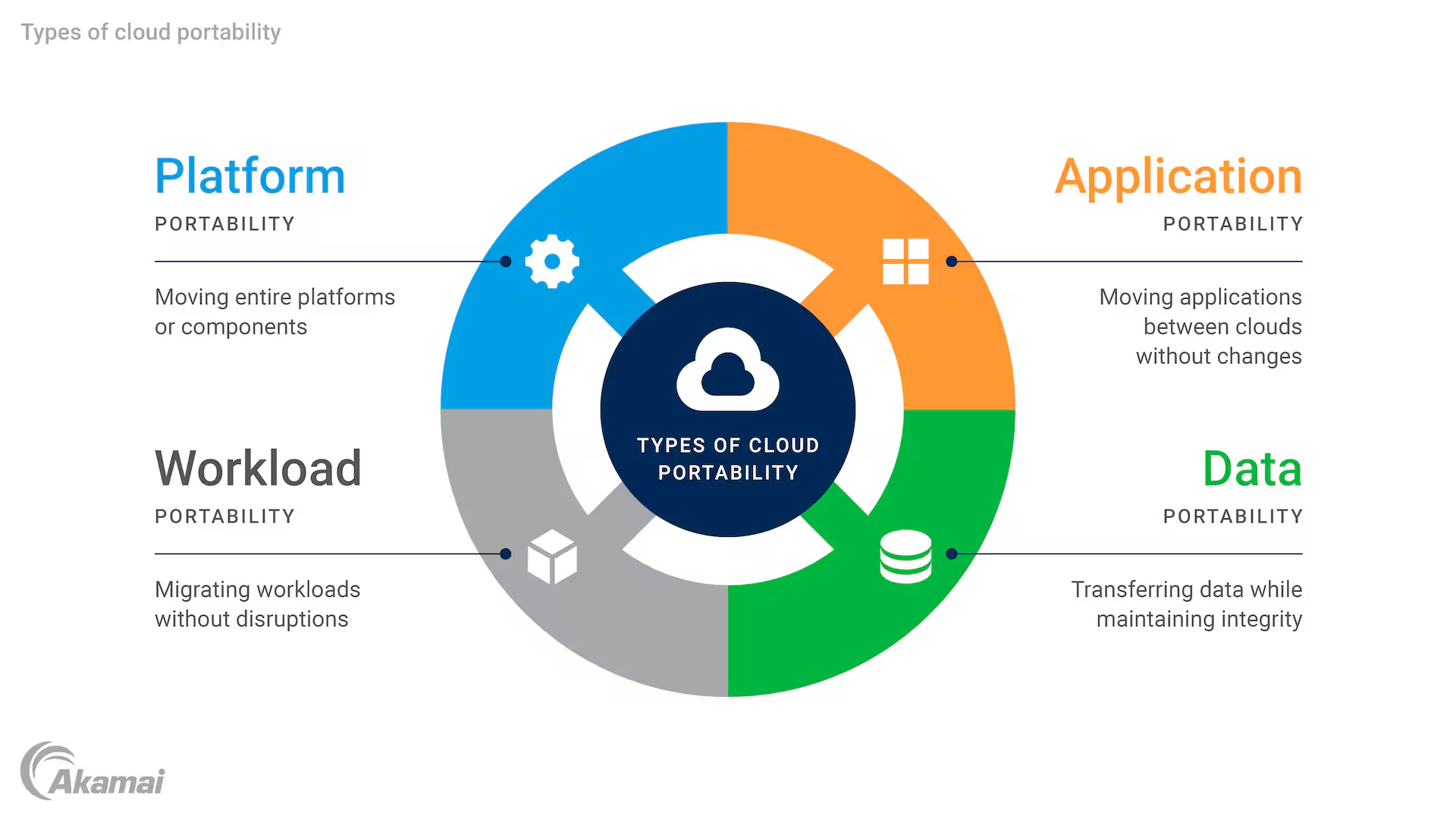
Cloud portability extends across platforms, applications, workloads and data, with each layer requiring a different migration approach. (Source: Akamai)
4. Turn contract review into operational requirements. Procurement and legal teams should confirm notice periods, termination rights, data-export formats, switching support, service continuity during transition and the provider’s obligations after termination. The review should cover subcontractors, software licenses, reserved-capacity commitments and the process for verifying data deletion.
Technical and contractual timelines must agree. A 30-day termination period creates risk when transfer, validation and cutover require three months. Contracted exit assistance may also provide too few engineering hours. Resolve these gaps while the customer still has negotiating leverage.
Enterprises should estimate parallel infrastructure, conversion work, testing, specialist support, license changes and temporary productivity loss. This produces a credible exit budget beyond data-transfer fees.
5. Build the cutover, rollback and recovery sequence. The runbook should define who authorizes the exit, who owns each application and data set, and how teams communicate with customers, regulators and vendors. It should set the order for provisioning the target environment, replicating data, validating controls, switching traffic and reconciling transactions.
A rollback point is essential. If validation fails or the target cannot handle production traffic, teams need a controlled route to the last stable state. Specify how long the original environment remains available and how transition changes will be reconciled.
Testing turns documentation into evidence. Enterprises can begin with a tabletop exercise, then test data exports, infrastructure reconstruction and restoration of a limited workload. Useful measures include time to export and restore data, percentage of dependencies with identified alternatives, expected migration cost, achievable recovery time and the number of unresolved vendor-specific components. The cloud exit strategy should be reviewed after major architecture changes, acquisitions and contract renewals.
Cloud Portability Should Follow Business Criticality
Full portability carries its own cost. Teams may give up valuable managed services, maintain duplicate environments or add abstraction layers that slow development. Cloud portability should therefore reflect the consequence of losing access to a provider and the time the business can tolerate before recovery.
Business-critical workloads need the strongest preparation. They may require replicated data, replaceable service components, tested infrastructure definitions and a rehearsed migration path. Important workloads may rely on a documented conversion plan and periodic restoration tests. Lower-impact systems may need only a verified export, complete documentation and clear contractual rights.
This tiered cloud exit strategy keeps resilience spending aligned with business exposure. Running services across several providers can improve resilience, yet shared identity, networking or data dependencies may still create one point of failure. Architecture choices need testing against a specific exit scenario.
Twendee supports this work by mapping dependencies across cloud services, applications and data layers. The assessment shows where portability already exists, where vendor-specific design creates material risk and which workloads justify additional controls. Twendee can then design migration and contingency roadmaps with clear owners, sequencing, recovery targets and decision points. Portability becomes a deliberate property of critical systems rather than an assumption discovered during a crisis.
Conclusion
A cloud exit strategy gives leaders evidence that critical services can survive a change in provider, contract or operating conditions. It must cover business priorities, dependencies, data and configuration, contractual rights, migration cost, recovery time and rollback. Regular testing shows whether those elements still work as the architecture evolves. Enterprises that build this capability early preserve negotiating power, reduce cloud vendor risk and retain more control over long-term technology choices.
Book a call: Calendly
Read our latest blog: Platform Engineering Is Changing How Software Teams Scale
