

Enterprise AI stops being only a model problem the moment it needs to touch a real business system. As agents move from answering questions to retrieving operational data, calling internal tools and preparing business actions, integration becomes part of the AI architecture itself. This is why Model Context Protocol (MCP) is attracting enterprise attention: it offers a more consistent way for AI applications to interact with the systems, data and tools that already run the business.
Enterprise AI is turning integration into the real scaling challenge
Most enterprise integration was designed around relatively stable application-to-application connections. A CRM calls an ERP API. A finance platform sends data to a warehouse. A workflow engine invokes a service with a known schema, endpoint and authentication path.
AI agents change that pattern. One agent may need to retrieve a customer record, check inventory, query an order, inspect payment status and prepare a follow-up action within the same workflow. Each underlying system can have its own API design, authentication method, data structure and permission model.
Connecting one agent to one system is manageable. The architecture becomes harder to maintain when multiple AI applications need access to dozens of business capabilities. Without a shared interaction layer, teams can end up implementing similar connectors, authentication logic and tool definitions repeatedly.
That is why the real scaling question is no longer simply, “Can this AI connect to our ERP?” It is “How will multiple AI applications interact consistently with our enterprise stack as adoption expands?”
The MCP project itself reflects this shift. Its 2026 MCP Roadmap says the protocol has moved beyond its origins in connecting local tools and is already being used in production and agent workflows. At the platform level, OpenAI added remote MCP server support to its Responses API in 2025, while Microsoft Foundry now allows agents to connect to remote MCP endpoints and work with tools exposed by external systems.
For enterprise leaders, this creates a longer-term architectural concern. Models and agent frameworks may change quickly. The interfaces between AI and core business systems are likely to need much greater stability.
Why Model Context Protocol is becoming more relevant now
MCP provides a standard interface through which AI applications can discover and interact with tools, resources and contextual data. An MCP server can sit in front of an API, database or internal service and expose selected capabilities in a form that compatible AI clients can understand.
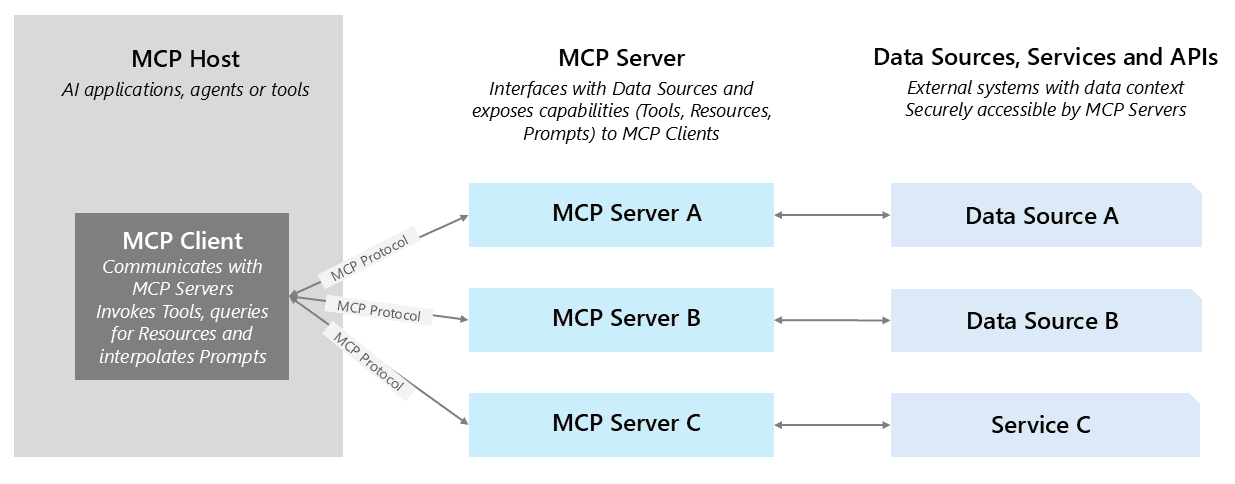
Model Context Protocol architecture connecting AI hosts and clients with MCP servers, external APIs, databases, and enterprise tools. (Source: Microsoft Learn)
It is important not to interpret this as a replacement for APIs. APIs still define how applications access and execute business capabilities. MCP operates at a different layer: it gives AI clients a consistent way to discover those capabilities and understand how to use them.
Put simply, APIs helped standardize how software exposes services. MCP is attempting to standardize how AI applications discover and use those services.
The timing matters. Early MCP adoption was closely associated with developer tooling and local experimentation. During 2026, the project has increasingly focused on the requirements that appear when MCP moves into shared enterprise infrastructure. Its roadmap explicitly identifies transport scalability, governance maturation and enterprise readiness as priorities.
The July 2026 release candidate illustrates that direction. The proposed protocol core is stateless, removing protocol-level sessions so remote servers can be scaled through ordinary HTTP infrastructure rather than requiring sticky sessions and shared session storage. The release work also strengthens authorization patterns and introduces a clearer lifecycle for future protocol changes. 2026-07-28 MCP Specification Release Candidate
Authorization is evolving as well. In June 2026, the MCP project declared its Enterprise-Managed Authorization extension stable. It allows organizations to centrally provision MCP server access through an identity provider rather than requiring users to authorize every connected server separately. Anthropic, Microsoft and Okta are among the organizations adopting the extension.
The surrounding ecosystem is becoming more concrete too. In April 2026, Google Cloud announced that more than 50 Google-managed MCP servers were generally available or in preview across Google Cloud services. That is a useful signal of how MCP is moving from individual integrations toward a managed connectivity layer for AI systems. Google Cloud’s managed MCP server announcement
The enterprise conversation around MCP is therefore changing. The question is becoming less about what the protocol is and more about where it should sit within an existing integration architecture.
Standardization changes how enterprise AI can scale
The most important potential impact of MCP is not that it makes a single integration easier. It changes how much integration work needs to be repeated.
Consider an organization building separate agents for customer service, procurement and finance. Each may need information from the same ERP or CRM. In a point-to-point approach, every application can accumulate its own connectors, tool definitions and authentication logic. Add another agent or switch to another AI platform, and parts of that work may need to be implemented again.
An MCP-compatible layer creates a different structure. Selected capabilities from ERP, CRM, databases and internal APIs can be exposed once through reusable MCP services, while multiple compatible AI applications consume them through a common interface.
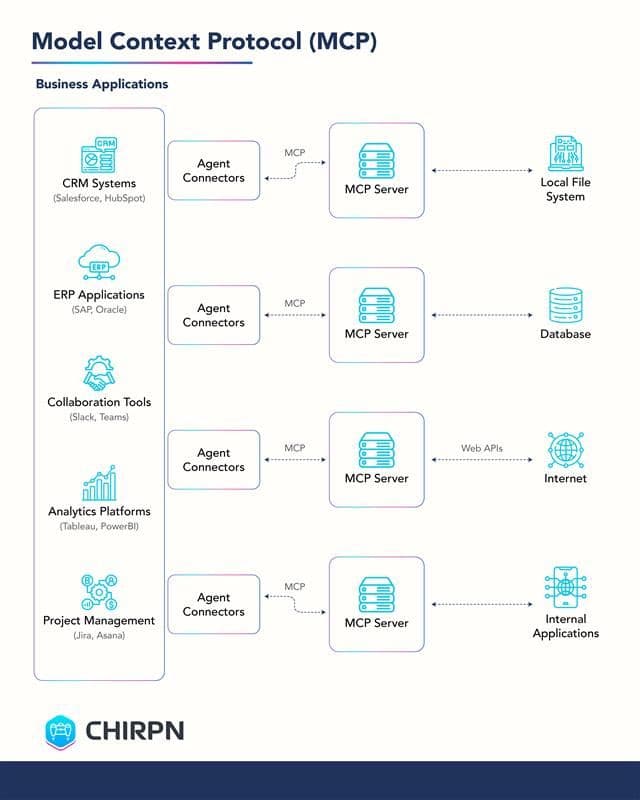
Model Context Protocol architecture connecting enterprise applications including CRM, ERP, collaboration and analytics platforms with MCP servers, databases, APIs and internal applications. (Source: Chirpn IT Solutions)
Microsoft's current enterprise tooling shows what this can look like in practice. Its guidance for building and registering MCP servers allows a company to place an MCP server in front of an internal API, register it in a private organizational tool catalog and make that server available to multiple clients. The existing API remains underneath; MCP provides the AI-facing interface above it.
This does not remove integration work. It makes more of that work reusable.
That distinction becomes important as the AI layer changes faster than the underlying enterprise stack. A company may use the same ERP for years while changing models, agent platforms or AI applications several times. If every AI application contains its own ERP-specific integration logic, changes in the AI layer continue to create downstream integration work.
A common interaction layer can reduce that coupling. The AI application needs to understand the MCP interface; the integration layer handles how that capability maps to the underlying enterprise service.
Standardization can also create a clearer boundary for governance. Instead of permissions and credentials being implemented separately inside every agent, organizations have a more consistent place to manage which systems are accessible, which tools are visible and how activity is observed.
AWS's recent work around Bedrock AgentCore Gateway shows this enterprise pattern emerging. In June 2026, AWS expanded its MCP support with centralized credential management, observability, delegated OAuth authentication, dynamic MCP server discovery, streaming and session management. AWS explicitly frames these capabilities around operating MCP deployments securely at enterprise scale. AWS Bedrock AgentCore Gateway MCP update
The strategic value of MCP integration, then, may be less about connecting today's agent faster and more about avoiding an architecture in which every future AI application must rebuild its relationship with the enterprise stack.
Enterprise value comes from the architecture around MCP
Standardization does not make enterprise architecture disappear.
An MCP server can expose a tool correctly and still expose it to the wrong identity. An agent can successfully call an API while holding more permission than the task requires. A technically valid action can still violate an internal approval process.
For that reason, an enterprise MCP architecture still has to answer several questions:
How do user and agent identities map to permissions in backend systems?
Where are approval rules and business logic enforced?
How are tool calls, failures and sensitive actions monitored and audited?
Which existing enterprise capabilities should be exposed to AI at all?
These are architectural decisions rather than protocol features.
This is also why companies do not necessarily need to redesign their infrastructure around MCP. Existing ERP APIs, CRM services, databases and internal applications often contain years of business logic and access controls. A practical AI system integration strategy can preserve those investments while introducing an MCP-compatible layer where AI access actually benefits from standardization.
This is where Twendee's role fits naturally. Twendee helps enterprises connect AI agents with existing ERP, CRM, databases, APIs and custom internal systems through integration layers designed around the infrastructure already in place. For organizations evaluating MCP enterprise adoption, that can mean identifying which capabilities should be exposed through MCP servers, connecting those servers to current services, and keeping permissions, workflow controls and operational visibility aligned with the wider system architecture.
The goal is not to MCP-enable every application. It is to create an integration layer that remains manageable when the organization has more agents, more AI use cases and potentially more model providers than it does today.
Conclusion
Model Context Protocol matters because enterprise AI is creating a different integration challenge. As AI moves from generating answers to interacting with operational systems, businesses need a more consistent way to expose and govern the capabilities those systems already provide.
MCP can become part of that foundation. Its larger value, however, will depend on the architecture built around it: APIs, identities, permissions, workflows and operational controls still determine whether an AI system can move safely from prototype to production.
If your organization is evaluating MCP, AI agents or a new integration layer for existing enterprise systems, visit the Twendee website, follow Twendee on LinkedIn, or book a conversation through Twendee’s Calendly.
