

A serverless database is often described as a simpler way to scale modern applications. That is only partly true. Serverless can reduce capacity-planning work and help applications absorb uneven demand, but it can also create new risks around latency, cost predictability and workload control.
The better question is not whether a serverless database is “modern.” The better question is: does this workload benefit more from elasticity than from fixed control?
That answer depends on traffic volatility, idle time, latency tolerance, read/write patterns, cost visibility and migration risk.
Serverless Databases Fit Workloads With Unpredictable Demand
Modern applications rarely grow in a straight line. Traffic can spike after a campaign, a product launch, a seasonal event, a partner integration or a sudden increase in user activity. Fixed database capacity often struggles with this pattern because teams must choose between two imperfect options:
Provision for normal demand and risk slow performance during traffic spikes.
Provision for peak demand and pay for unused capacity during quiet periods.
This is one reason serverless architecture has moved into mainstream cloud adoption. Datadog’s State of Serverless report found that over 70% of AWS customers, 60% of Google Cloud customers and 49% of Azure customers in its customer base use at least one serverless solution. The report is broader than databases, but it shows how strongly cloud teams are moving toward elastic infrastructure models.
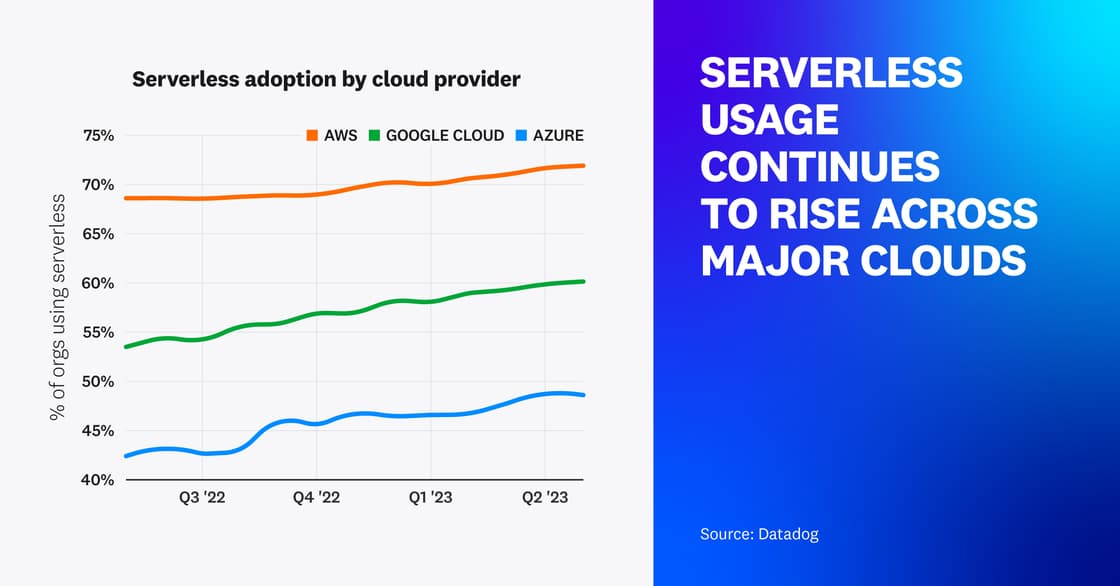
Serverless adoption continues to rise across major cloud providers, with Datadog data showing usage among AWS, Google Cloud and Azure customers increasing steadily through Q2 2023. (Source: Datadog)
For databases, the same logic applies. A serverless database architecture makes sense when application demand changes faster than manual capacity planning can keep up.
Strong fit cases often include:
Customer-facing applications with sharp usage spikes
Booking, event or campaign-driven applications
New digital products with uncertain adoption
Internal tools used heavily during specific business cycles
Development, testing or low-traffic production workloads
Applications with long idle periods and occasional bursts
The strongest case appears when idle capacity becomes a measurable cost problem. If a database sits underused for long periods, fixed capacity turns infrastructure into a standing cost rather than a workload-driven cost.
Auto-Scaling Has Boundaries, So Traffic Patterns Still Matter
“Serverless” does not mean unlimited scaling. Every platform has scaling models, limits and behavior that teams need to understand before choosing the architecture.
AWS DynamoDB on-demand mode is a useful example. For new on-demand tables, AWS states that a table can immediately support up to 4,000 writes per second and 12,000 reads per second. It can also instantly accommodate up to 2x the previous peak traffic on a table.
That is strong elasticity, but it is still rule-based. A workload that doubles during a campaign is very different from one that jumps 10x in a few minutes. Both are “variable,” but they do not create the same database requirement.
Before choosing a serverless database, teams should know:
What is the normal baseline traffic?
What was the previous peak?
How fast can traffic rise?
Is the spike usually 2x, 5x or 10x?
How long does peak traffic last?
What happens if scaling lags behind demand?
A serverless database makes sense when its scaling behavior matches the real workload pattern. It becomes risky when the decision is based on the word “serverless” rather than measured demand.
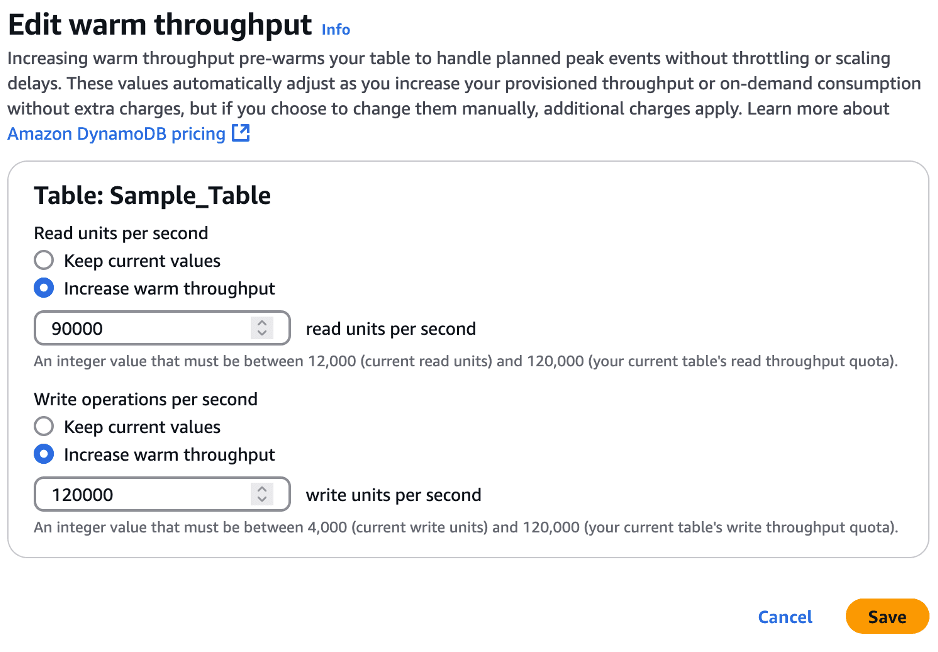
Amazon DynamoDB warm throughput settings showing read and write units per second for planned peak traffic events. (Source: AWS)
Cost Benefits Depend on Idle Time and Usage Behavior
Serverless is often linked with cost savings, but the cost case is conditional. It is strongest when an application has meaningful idle time or uneven traffic. In that case, scaling down during quiet periods can reduce waste.
Aurora Serverless v2 shows this clearly. AWS documentation says eligible Aurora Serverless v2 versions can set minimum capacity to 0 ACUs, allowing the database to pause automatically when there are no user-initiated connections for a defined period. AWS Aurora Serverless v2 Auto-Pause
That can be valuable for low-traffic internal tools, development environments, seasonal workloads or applications that do not need a database running continuously.
The cost story changes when traffic is consistently high. If the database is almost always active, serverless may offer less idle-capacity benefit. Cost can also become harder to forecast when pricing depends on operations, storage, bandwidth or scaling behavior.
Firestore is a good example. Google Cloud states that Firestore pricing is based on read and write operations, storage and network usage. Google Cloud Firestore Pricing This means a poorly designed query pattern can turn a serverless database into a billing problem.
A cost assessment should ask:
How much idle time does the workload have?
How many reads and writes does each user action create?
Which queries or features drive the most usage?
How quickly does storage grow?
Can cost be tracked by workflow, customer or product feature?
Serverless is not automatically cheaper. It is cheaper when workload behavior allows elasticity to remove real waste.
Latency Can Decide Whether Serverless Is Practical
A serverless database can scale down or pause to reduce idle cost. That same behavior can affect response time.
AWS notes that when a paused Aurora Serverless v2 cluster resumes, the first database session takes a brief time to connect. AWS also describes scale-to-zero as suitable for workloads that can tolerate resume time of about 15 second.
That detail matters. A 15-second delay may be acceptable for an internal admin tool, a development environment or a low-frequency reporting application. It is much harder to accept in checkout, booking, payment, live customer support or real-time operational dashboards.
Teams should classify workloads by latency needs:
High sensitivity: checkout, payment, booking, live support, real-time dashboards
Moderate sensitivity: customer portals, approval workflows, internal tools
Lower sensitivity: reports, admin tasks, development environments, periodic jobs
A workload can have variable traffic and still be a poor serverless fit if the user experience cannot tolerate resume delay, scaling lag or connection overhead.
Serverless Reduces Operations, But It Does Not Remove Database Engineering
A serverless database can reduce infrastructure management, but it does not remove database design. Teams still need to manage schema, indexing, query patterns, connection handling, monitoring, backup, data governance and migration safety.
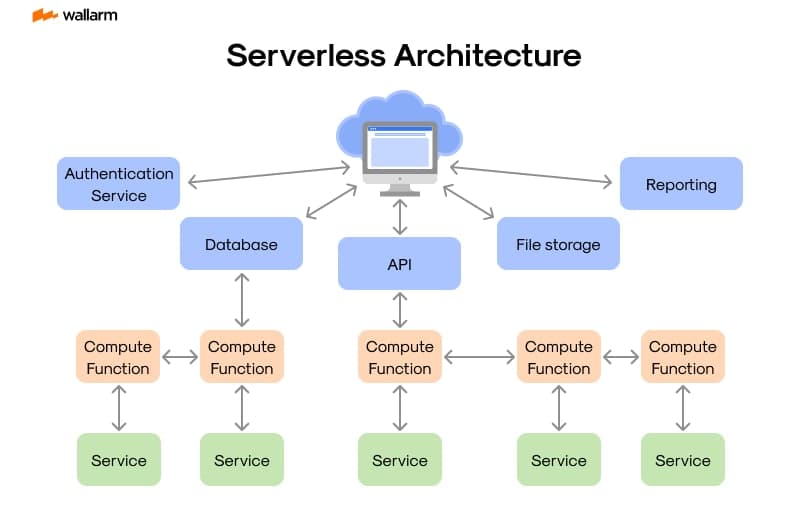
Serverless architecture reduces server management, but production applications still depend on well-designed connections between APIs, databases, authentication, storage, reporting, compute functions and business services. (Source: Wallarm)
This is where many serverless projects become weaker than expected. The team removes server provisioning work, then assumes the database will take care of everything else.
Production systems still need:
Workload modeling for reads, writes, peaks and idle periods
Query design with predictable access patterns and efficient indexes
Connection strategy, especially with serverless compute
Monitoring for latency, errors, throttling, usage and cost
Capacity guardrails through limits, quotas and alerts
Data integrity checks before and after migration
A 2025 empirical evaluation of serverless infrastructure for large-scale data processing found that serverless platforms can support scalable workloads, while still showing limitations around performance variability and cost overhead, especially in networking and storage.
This is the right way to frame the trade-off. Serverless can simplify operations, but the workload still needs engineering discipline.
The Decision Should Start From Workload Fit
A serverless database is a strong candidate when two conditions appear together: variable demand and bounded workload behavior.
Variable demand creates the need for elasticity. Bounded workload behavior makes that elasticity manageable.
A good candidate usually has:
Uneven traffic with clear peaks and troughs
Meaningful idle or low-usage periods
Understandable read/write patterns
Latency requirements compatible with serverless behavior
Cost monitoring by operation, feature or customer segment
Limited need for deep database customization
A weak candidate often has:
Stable, consistently high traffic
Strict low-latency requirements
Heavy or unpredictable query behavior
A need for deep performance tuning
Limited cost visibility
High migration risk due to many downstream dependencies
This is the core logic: serverless database architecture is not a maturity signal by itself. It is a workload fit decision.
For one application, serverless may reduce waste and simplify operations. For another, a provisioned managed database may deliver better cost control and more predictable performance.
Migration Should Protect Data Integrity and Application Continuity
Moving to a serverless database is not only an infrastructure decision. It is a data continuity decision.
Applications often depend on database behavior in hidden ways. Reports may rely on historical schemas. Downstream systems may expect specific update timings. Operations teams may use exports, dashboards or manual checks tied to the current database.
A safe migration plan should define:
Which workload should move first
Which data must stay synchronized during transition
Which integrations, reports or workflows may break
How data quality will be validated before and after migration
What rollback plan exists if latency, cost or correctness issues appear
Which team owns monitoring after go-live
This is where Twendee’s role becomes practical. We help businesses assess database architecture based on traffic and operational requirements, design scalable back-end systems for new digital products and migrate selected workloads while maintaining data integrity and application continuity.
A good migration does not start with “move everything serverless.” It starts with identifying the workloads where elasticity, lower infrastructure management and acceptable latency create a stronger business case than the current setup.
Conclusion
A serverless database makes sense when elasticity is more valuable than fixed control. It is most useful for modern applications with variable demand, meaningful idle periods, bounded workload behavior and manageable latency requirements.
The decision still needs evidence. Teams should evaluate traffic volatility, previous peak demand, read/write patterns, pause and resume behavior, cost drivers and migration risk before choosing the architecture.
Twendee helps businesses select database architecture based on real workload requirements, build scalable back-end systems and migrate selected workloads without disrupting application continuity.
Book a call: Calendly
Read our latest blog: Multi-Cloud Strategy Is Back on the Agenda as AI Infrastructure Expands
